
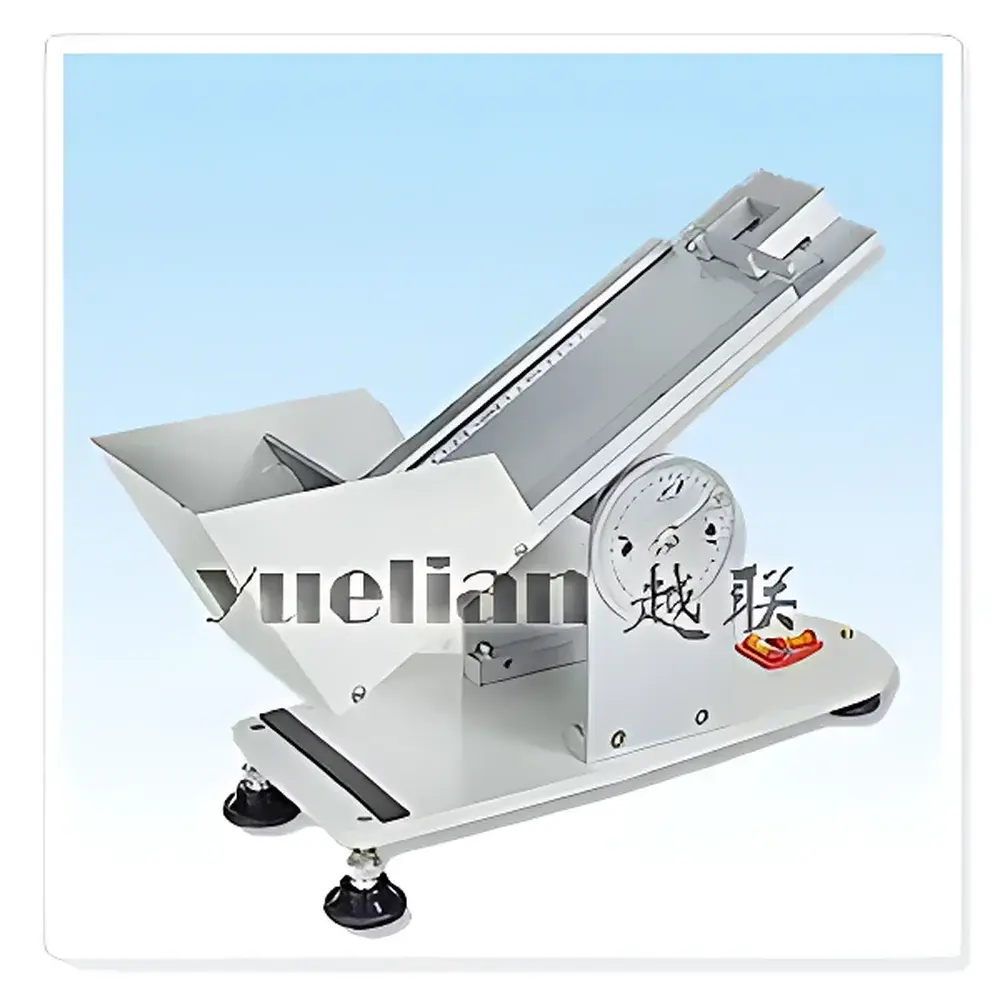
Yuelian YL-8801A Rolling Ball Tack Tester
| Brand | Yuelian |
|---|---|
| Origin | Guangdong, China |
| Model | YL-8801A |
| Test Angle | 20°–40° (adjustable) |
| Run-up Distance | 100 mm |
| Standard Steel Balls | ISO 3290 Grade 10, Nos. 2–32 (1 set) |
| Load Weight | 500 g × 1 |
| Dimensions (W × D × H) | 60 × 20 × 45 cm |
| Weight | 25 kg |
| Compliance | GB/T 4852–2002, CNS 11888 |
Overview
The Yuelian YL-8801A Rolling Ball Tack Tester is a precision mechanical instrument engineered for the quantitative assessment of initial tack—the instantaneous adhesive strength developed upon brief contact—of pressure-sensitive adhesives (PSAs), including acrylic, rubber-based, and silicone tapes. It operates on the standardized rolling ball principle defined in GB/T 4852–2002 and CNS 11888, which aligns with internationally recognized methodologies for tack evaluation (e.g., ASTM D3121–17, though not identical in protocol). In this method, a polished steel ball of defined hardness, sphericity, and surface finish (ISO 3290 Grade 10) is released from rest at the top of an inclined plane and rolls freely over a fixed run-up distance of 100 mm before contacting the adhesive surface. The ball’s stopping distance—or, in some interpretations, the largest ball number that fails to roll off the tape within a specified threshold—is recorded as an inverse indicator of tack performance. This empirical yet reproducible technique provides rapid, operator-independent screening suitable for incoming QC, R&D formulation trials, and batch release testing in adhesive manufacturing and converting facilities.
Key Features
- Adjustable test angle (20°–40°) enables fine-tuning of kinetic energy input to accommodate varying PSA formulations—from low-tack masking tapes to high-performance transfer adhesives.
- Calibrated 100 mm run-up track ensures consistent acceleration prior to adhesive contact, minimizing velocity variance between trials.
- Included full set of ISO 3290 Grade 10 steel balls (Nos. 2–32) conforms to dimensional tolerances (±0.5 µm roundness, Ra ≤ 0.02 µm surface roughness) required for metrological traceability.
- Dedicated 500 g counterweight supports optional auxiliary load application during validation or comparative studies per internal SOPs.
- Sturdy aluminum alloy frame with non-slip base and integrated leveling feet ensures mechanical stability and repeatability across laboratory environments.
- No electrical components or software dependencies—designed for robust, maintenance-free operation under GLP-aligned manual testing protocols.
Sample Compatibility & Compliance
The YL-8801A accommodates standard PSA specimens mounted on rigid backing plates (e.g., stainless steel or glass slides) with minimum dimensions of 100 mm × 50 mm. It supports both single-layer tapes and laminated structures up to 2.0 mm total thickness. While primarily intended for flat, smooth substrates, slight curvature (< ±1° deviation) may be tolerated with appropriate sample fixation. The instrument satisfies national regulatory requirements for initial tack verification in China (GB/T 4852–2002) and Taiwan (CNS 11888). Its mechanical design facilitates audit-ready documentation: all critical parameters—including inclination angle, ball lot number, ambient temperature/humidity (to be logged externally), and stopping distance—are manually recorded in paper-based or LIMS-integrated test reports. Though not inherently 21 CFR Part 11 compliant, its output is fully compatible with electronic record systems when paired with controlled procedural documentation and analyst sign-offs.
Software & Data Management
The YL-8801A is a purely mechanical tester with no embedded firmware, display, or digital interface. All measurements are captured manually using calibrated rulers (±0.5 mm resolution) and documented via standardized test forms. This architecture eliminates firmware validation burdens and ensures long-term operational consistency without obsolescence risk. Users may integrate results into existing LIMS or ELN platforms through structured CSV upload or manual entry. For laboratories requiring enhanced traceability, optional accessories include a digital inclinometer (±0.1° accuracy) and certified steel ball calibration certificates (traceable to NIM, China). Audit trails rely on procedural adherence—not automated logging—making the system well-suited for GMP environments where manual intervention is explicitly permitted and documented.
Applications
- Quality control of pressure-sensitive tapes in manufacturing lines (e.g., medical transdermal patches, labeling films, protective masking tapes).
- Formulation development of acrylic and rubber-based PSAs, where tack–peel–shear balance must be optimized.
- Supplier qualification and incoming material inspection per contractual specifications.
- Comparative benchmarking against competitor products using standardized ball-number ranking.
- Educational demonstration of viscoelastic interfacial phenomena in polymer science curricula.
FAQ
Is the YL-8801A compliant with ASTM or ISO standards?
It implements the rolling ball tack methodology referenced in ASTM D3121–17 (Standard Test Method for Tack of Pressure-Sensitive Tapes by the Rolling Ball Method), though final compliance requires alignment of ball specification, environmental controls, and reporting format per your internal SOP.
Can I use non-standard steel balls?
No. Only ISO 3290 Grade 10 balls (diameter tolerance ±0.5 µm, hardness 60–66 HRC) ensure measurement equivalence. Substitution invalidates GB/T 4852–2002 conformance.
What environmental conditions are required during testing?
Testing shall be conducted at 23 ± 2 °C and 50 ± 5 % RH per GB/T 4852–2002; specimens must condition for ≥2 h prior to test.
Does the instrument require calibration certification?
Angle adjustment mechanism and run-up distance should be verified annually using traceable angle gauges and steel rulers; calibration certificate available upon request.
Is technical support available outside China?
Yes—Yuelian provides remote application guidance, test protocol review, and documentation templates for international users operating under ISO/IEC 17025 or FDA-regulated frameworks.



