
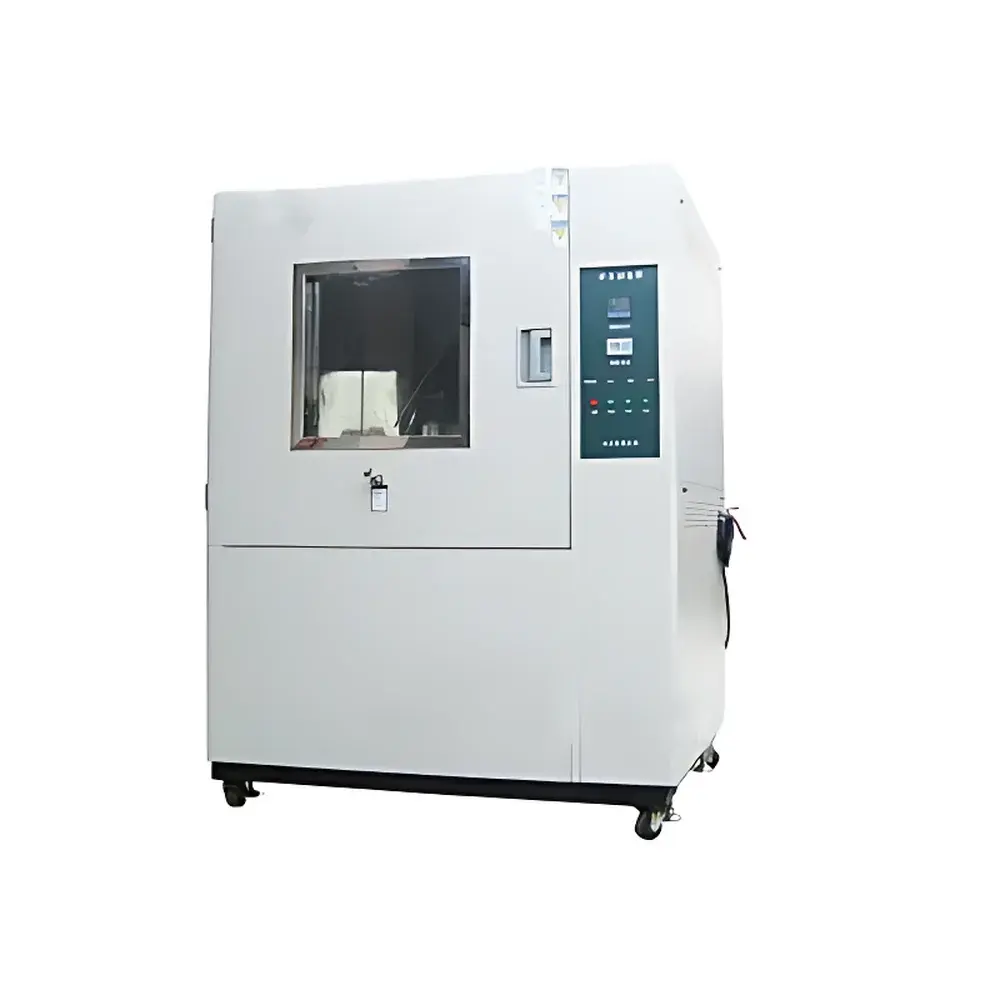
Yuelian YL-9912A Sand and Dust Test Chamber
| Brand | Yuelian |
|---|---|
| Origin | Guangdong, China |
| Model | YL-9912A |
| Internal Volume | 512 L |
| Inner Dimensions (W×H×D) | 800×800×800 mm |
| Outer Dimensions (W×H×D) | ~1300×1667×1100 mm |
| Weight | 300 kg |
| Noise Level | ≤75 dB (measured 1 m in front of unit at 1.2 m height) |
| Max. Power | 3.5 kW |
| Max. Current | 15 A |
| Temperature Range | RT+5°C to 60°C |
| Temp. Resolution | 0.1°C |
| Temp. Uniformity | ±1°C |
| Temp. Stability | ±0.5°C |
| Dust Sieve Mesh | Standard 200 mesh (75 µm), optional up to 75 mesh (200 µm) |
| Air Velocity | ≥7.5 m/s |
| Dust Concentration | 1 kg/m³ |
| Compliant Standards | GB/T 2423.37–2006, IEC 60068-2-68:1994, GB 4208–2008 / IEC 60529, GJB 150.12–2009, GB 7000.1–2007, GB 10485, JIS, DIN, MIL equivalents |
Overview
The Yuelian YL-9912A Sand and Dust Test Chamber is an engineered environmental simulation system designed to evaluate the ingress protection (IP) performance of enclosures—particularly against non-abrasive particulate matter under controlled airborne and settling conditions. It operates on the principle of forced-air suspension and gravitational deposition of standardized dust (typically talc powder per IEC 60529 and GJB 150.12), enabling reproducible assessment of sealing integrity for electrical, electronic, automotive, and aerospace components. The chamber supports both IP5X (limited dust ingress) and IP6X (dust-tight) validation protocols, including optional vacuum-assisted testing for differential-pressure scenarios. Its robust thermal subsystem (RT+5°C to 60°C) allows concurrent evaluation of thermal-dust interaction effects—critical for outdoor-rated equipment exposed to desert or arid environments where temperature cycling accelerates particulate infiltration.
Key Features
- Stainless steel (304#) inner chamber with conical funnel geometry and integrated vibration motor for efficient dust recovery into a dedicated collector—minimizing cross-contamination and enabling rapid test cycle turnaround.
- High-efficiency centrifugal blower delivering ≥7.5 m/s air velocity across the test volume, ensuring uniform dust suspension and compliance with GB/T 2423.37 and IEC 60068-2-68 airflow requirements.
- Imported TEMI880 programmable touch-screen controller supporting dual-mode operation (programmed cycles or fixed-value testing), with 120 user-defined programs, 1200 segment memory, and PID-tuned temperature regulation using PT100 sensors.
- Modular electrical architecture: Optional DC power outputs (12/24/36 V, 20 A), AC 220 V/20 A anti-dust socket interface (timed via programmable relay), and vacuum pump integration port for IP5X/IP6X pressure-differential testing.
- Full safety redundancy: Overtemperature cutoff, motor thermal overload protection, earth leakage circuit breaker (ELCB), short-circuit and overcurrent protection, and grounded chassis (<4 Ω resistance) compliant with TN-S/TT supply configurations.
Sample Compatibility & Compliance
The YL-9912A accommodates samples up to 800 mm × 800 mm × 800 mm (W×H×D) within its 512 L working volume. It explicitly excludes flammable, explosive, volatile, corrosive, biological, or high-EMI-emitting specimens per IEC 61000-4 series safety guidelines. All operational parameters—including dust concentration (1 kg/m³), sieve specification (standard 200-mesh/75 µm talc), and airflow profile—are traceable to internationally harmonized standards: GB/T 2423.37–2006 (equivalent to IEC 60068-2-68), GB 4208–2008 (IEC 60529), GJB 150.12–2009, and MIL-STD-810H Method 510.7. The system supports full audit trails when operated under GLP/GMP-aligned procedures, with timestamped data logging, password-protected parameter locking, and RS-232 interface for external validation recorders.
Software & Data Management
The TEMI880 controller provides native support for test documentation integrity: real-time curve plotting, 60-day buffered data retention (at 1.5-min sampling intervals), and battery-backed RAM preserving setpoints, timestamps, and measured values during power interruption. It enables four programmable digital output signals for synchronized control of external DUT power sequencing (ON/OFF), and supports remote monitoring via RS-232 connection to Windows 2000/XP-compatible PCs. All program edits—including segment insertion, jump-to-step, hold/resume, and multi-program chaining—are fully logged with operator ID and time stamps, satisfying basic FDA 21 CFR Part 11 requirements for electronic records when deployed with validated host software.
Applications
This chamber is routinely deployed in QC laboratories for certification-grade IP rating verification of lighting fixtures, vehicle ECUs, industrial control cabinets, UAV housings, and military-grade connectors. It facilitates failure mode analysis related to dust-induced contact resistance increase, bearing abrasion, optical obscuration, and thermal interface degradation. In R&D settings, it supports accelerated life testing of gasket materials, filter media, and venting membranes under combined thermal-dust stress. Its ability to maintain stable temperature while suspending particles also enables studies on dust agglomeration dynamics and electrostatic charge accumulation in low-humidity environments—parameters directly influencing long-term field reliability in Middle Eastern, North African, and Central Asian deployments.
FAQ
Does the YL-9912A meet IEC 60529 IP5X and IP6X requirements?
Yes—the system fulfills all mechanical, airflow, and dust concentration criteria specified in IEC 60529 Annex B for both ratings, including optional vacuum capability for IP5X differential-pressure testing.
Can alternative dust types be used besides talc powder?
Yes; users may substitute other standardized test dusts (e.g., Arizona Road Dust Test Dust, ISO 12103-1 A2) provided they comply with particle size distribution specifications and are introduced externally—Yuelian supplies only the base chamber and standard talc.
Is the controller compatible with networked laboratory information management systems (LIMS)?
The RS-232 interface supports serial communication with third-party LIMS platforms when paired with appropriate protocol converters or middleware; native Ethernet or Modbus TCP is not included but can be retrofitted via OEM collaboration.
What maintenance is required for long-term calibration stability?
Biannual verification of PT100 sensor accuracy, annual inspection of blower impeller balance and bearing wear, and quarterly cleaning of dust collection ducts and sieve meshes are recommended per ISO/IEC 17025 preventive maintenance guidelines.
How is test repeatability ensured across different operators and laboratories?
By enforcing strict adherence to GB/T 2423.37 procedural sequences—including pre-conditioning dwell times, dust injection duration, and post-test stabilization—and by calibrating airflow velocity and concentration using NIST-traceable anemometers and gravimetric samplers prior to each qualification run.



