
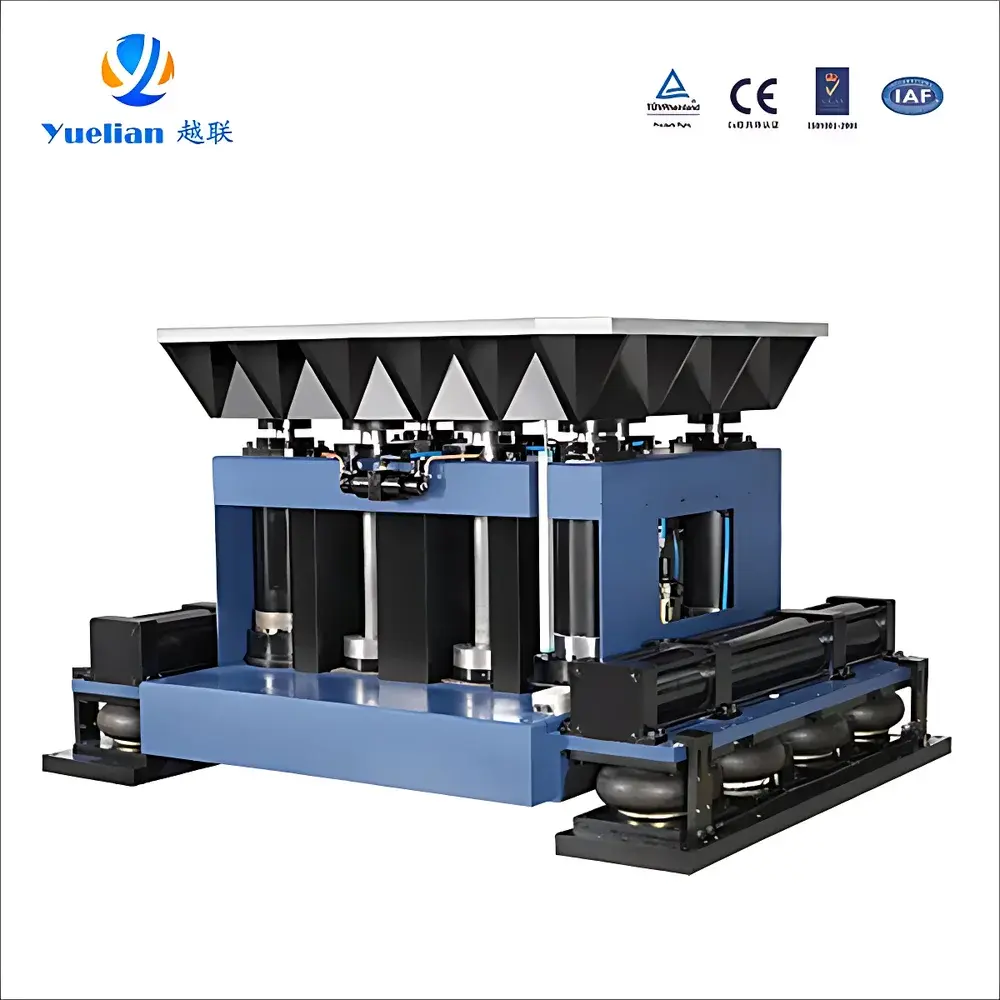
Yuelian YL-AIS-1500 Battery Pack Mechanical Shock and Impact Test System
| Brand | Yuelian |
|---|---|
| Origin | Guangdong, China |
| Manufacturer Type | Authorized Distributor |
| Country of Origin | China |
| Model | YL-AIS-1500 |
| Quotation | Upon Request |
| Max Load Capacity | 1500 kg |
| Table Dimensions | 1500 mm × 1500 mm |
| 冲击 Distance Range | 0–550 mm |
| Overall Dimensions (L×W×H) | 2500 mm × 2000 mm × 1520 mm |
| Mass | 25,000 kg |
| Shock Peak Acceleration (Half-Sine) | 150–2000 m/s² |
| Pulse Duration (Half-Sine) | 6–40 ms |
| Max Velocity Change (Shock) | 8 m/s |
| Collision Peak Acceleration (Half-Sine) | 100–1000 m/s² |
| Collision Pulse Duration | 6–20 ms |
| Max Velocity Change (Collision) | 2.4 m/s |
| Collision Frequency Adjustment Range | 1–60 cycles/min |
| Drop Height Adjustment Range | 0–200 mm |
| Compliant Standards | GB/T 2423.5, GB/T 2423.6, IEC 60068-2-29, JJG 497-2000 |
| Air Supply Requirement (Shock Only) | 1.6 m³/min @ 8 kgf/cm² |
| Air Supply Requirement (Collision) | 3.2 m³/min @ 8 kgf/cm² |
| Power Consumption (Table) | 2 kVA |
| Air Compressor Power | 30 kVA |
| Input Voltage | 380 V ±10%, 3-phase AC, 50 Hz (Control Unit: 220 V ±10%) |
| Operating Temperature | 0–40 °C |
| Relative Humidity | 0–90% RH (non-condensing) |
| Data Acquisition | 4-channel charge input, 200 kHz max sampling rate, ±10 Vp range, 16-bit ADC resolution, 80 dB dynamic range, <−95 dB THD, >95 dB SNR, frequency accuracy ±0.01%, pulse width 0.5–1000 ms, acceleration range 1–100,000 gₙ |
| External Trigger | Supported |
| Physical Dimensions (Controller) | 242 mm × 220 mm × 96 mm |
| Weight (Controller) | 2.5 kg |
| Power (Controller) | 20 W |
| Interface | USB 2.0 |
| OS Compatibility | Windows 2000/XP/7 |
Overview
The Yuelian YL-AIS-1500 Battery Pack Mechanical Shock and Impact Test System is a heavy-duty, electro-pneumatic test platform engineered for rigorous mechanical validation of electric vehicle (EV) battery packs and high-voltage energy storage systems under standardized shock and collision conditions. It operates on the principle of controlled pneumatic acceleration to generate repeatable half-sine acceleration pulses—precisely replicating transient mechanical loads encountered during vehicle crash events, road-induced impacts, or handling-related drops. Designed in strict alignment with international safety and reliability protocols—including GB/T 2423.5 (shock), GB/T 2423.6 (collision), IEC 60068-2-29, and JJG 497-2000—the system enables full compliance testing for UN GTR No. 20, ISO 12405-2, and SAE J2380-derived qualification requirements. Its primary functional objective is to assess structural integrity, electrical isolation performance (post-test insulation resistance ≥100 Ω/V), and thermal stability of battery enclosures under defined mechanical stress profiles, supporting both R&D verification and production-line quality assurance.
Key Features
- High-mass rigid base structure (25,000 kg) minimizes resonance and ensures stable impulse transmission during high-g shock events.
- Dual-mode operation: independently configurable shock (Z-axis, 25 g, 15 ms half-sine) and horizontal collision (X/Y-axis, programmable pulse parameters per GB/T 2423.6 Table 7 and Figure 3).
- Precision pneumatic actuation with real-time pressure regulation supports consistent velocity change (Δv) control: up to 8 m/s for shock, 2.4 m/s for collision.
- Integrated 4-channel high-fidelity data acquisition unit featuring 16-bit resolution, 200 kHz sampling, and ±10 Vp input range—optimized for piezoelectric accelerometer signals and compliant with MIL-STD-810 and ISO 5344 traceability requirements.
- Automated parameter adjustment: collision frequency (1–60 cpm), drop height (0–200 mm), and pulse duration (6–40 ms) are software-controlled and repeatable within ±0.5% of setpoint.
- Modular controller (242 × 220 × 96 mm, 2.5 kg) with USB 2.0 interface and native Windows driver support enables seamless integration into existing lab automation frameworks.
Sample Compatibility & Compliance
The YL-AIS-1500 accommodates battery modules and complete pack assemblies up to 1500 kg and 1500 mm × 1500 mm footprint. Samples are mounted directly onto the reinforced test table using standardized fixture interfaces compatible with ISO 10816-3 mounting practices. The system satisfies mandatory pre-conditioning and pass/fail criteria defined in GB/T 31467.3 (Electric Vehicle Battery Systems – Safety Requirements and Test Methods), including post-test visual inspection for leakage, casing fracture, fire, or explosion, and insulation resistance measurement ≥100 Ω/V (per GB/T 18384 Annex C). All test sequences are fully documentable for GLP/GMP audit trails, and waveform fidelity is verified against ISO 18431-4 spectral validation standards.
Software & Data Management
The system includes proprietary PC-based control and analysis software supporting real-time waveform preview, pre-test simulation, and post-acquisition FFT-based spectral analysis. Raw time-domain data (acceleration, velocity, displacement) is saved in IEEE 1159-compliant .tdms format with embedded metadata: timestamp, operator ID, sample ID, calibration certificate reference, and environmental logs (temperature/humidity). Audit-trail functionality records all parameter changes, start/stop events, and manual overrides—meeting FDA 21 CFR Part 11 electronic record requirements when deployed in regulated manufacturing environments. Export options include CSV, MATLAB .mat, and PDF test reports with annotated waveforms and pass/fail annotations per clause references.
Applications
- Validation of EV battery pack structural design against NCAP-relevant impact scenarios (e.g., frontal offset, side pole impact).
- Qualification of battery enclosure materials (aluminum castings, composite housings) under repeated mechanical stress.
- Verification of cell-to-pack interconnect integrity (busbars, harnesses, cooling plates) after shock exposure.
- Supporting UN 38.3 Section 5 (mechanical tests) and IEC 62660-2 mechanical abuse certification.
- Root-cause analysis of post-impact electrical faults via synchronized insulation resistance monitoring and thermal imaging integration (optional).
- Development of failure mode and effects analysis (FMEA) datasets for battery safety architecture modeling.
FAQ
What standards does the YL-AIS-1500 fully support for battery mechanical testing?
It complies with GB/T 2423.5 (shock), GB/T 2423.6 (collision), IEC 60068-2-29, JJG 497-2000, and is operationally aligned with UN GTR No. 20, ISO 12405-2, and SAE J2380.
Can the system perform both vertical shock and horizontal collision in a single test sequence?
Yes—test profiles are fully programmable and sequenced via software; Z-axis shock and X/Y-axis collision can be executed in automated multi-step routines.
Is waveform fidelity validated and traceable to national metrology institutes?
All shock and collision pulses undergo in-situ verification using NIST-traceable accelerometers and are documented with spectral error margins per ISO 18431-4 Annex B.
Does the controller support external triggering from third-party systems (e.g., thermal cameras or HV monitors)?
Yes—the controller provides TTL-compatible external trigger input and output ports, enabling synchronization with auxiliary instrumentation.
What maintenance intervals are recommended for pneumatic components and data acquisition hardware?
Air filter elements require replacement every 500 operational hours; accelerometer charge amplifiers are calibrated annually per ISO/IEC 17025 accredited procedures; firmware updates are provided biannually via secure download portal.



