
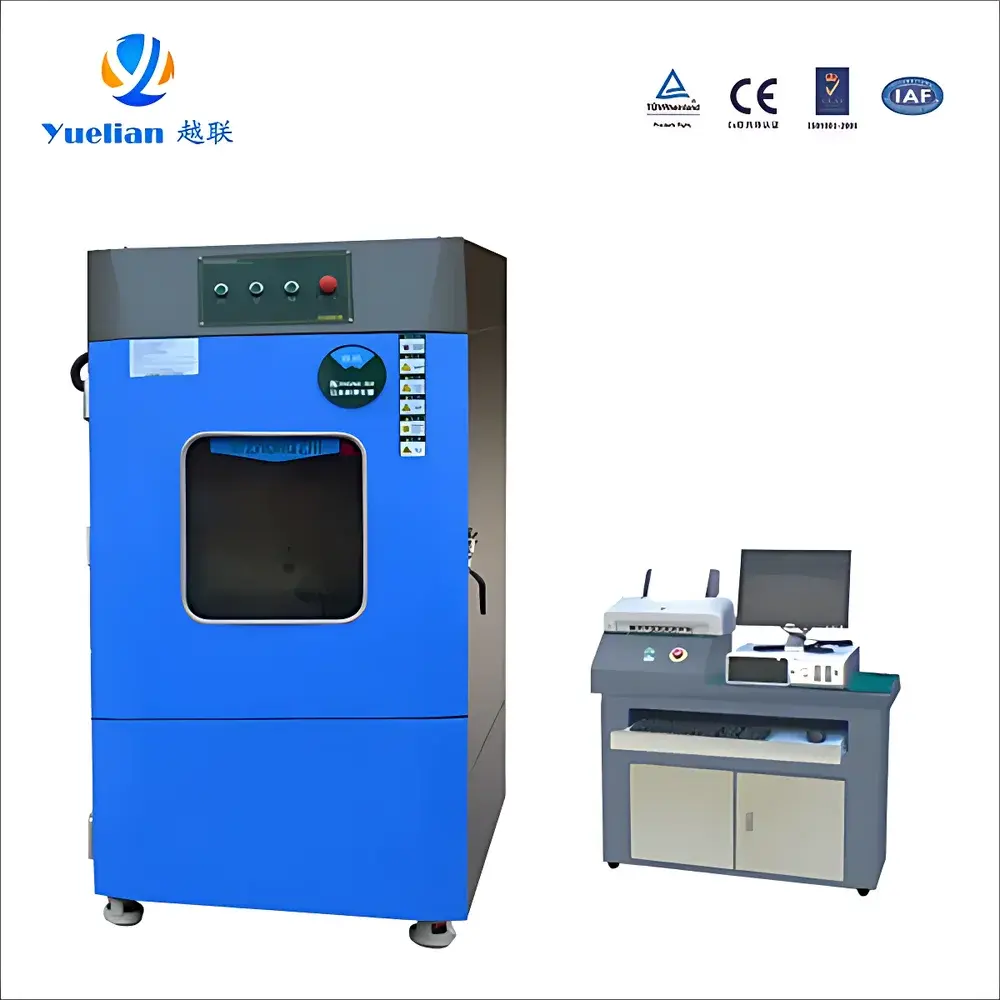
Yuelian YL-DL-300A Battery Forced Internal Short Circuit Tester
| Brand | Yuelian |
|---|---|
| Origin | Guangdong, China |
| Model | YL-DL-300A |
| Short-Circuit Current | 300 A |
| Internal Resistance | 80 mΩ ±5 mΩ |
| Temperature Range | RT+10°C to 150°C |
| Temperature Uniformity | ≤2°C |
| Temperature Fluctuation | ±0.5°C |
| Data Acquisition Rate | ≥30 Hz |
| Voltage Measurement Range | 0–36 V |
| Current Measurement Range | 0–300 A |
| Temperature Measurement Range | 0–300°C |
| Voltage/Current Accuracy | ±0.5% FS |
| Temperature Accuracy | ±1°C |
| Chamber Interior Dimensions | W306×D330 mm |
| Overall Dimensions | W880×H1680×D730 mm |
| Construction | Integrated steel frame with stainless-steel inner chamber and dual-layer explosion-proof observation window (350×400 mm) |
| Control System | PC-based software with real-time 4-channel (I/V/T/t) curve synchronization, data export (CSV), and audit-trail-capable logging |
Overview
The Yuelian YL-DL-300A Battery Forced Internal Short Circuit Tester is an engineered safety validation system designed for controlled, repeatable simulation of internal short circuit conditions in lithium-ion and other rechargeable battery cells. Unlike external short circuit tests governed by UN 38.3 or IEC 62133, this instrument implements a precisely regulated forced internal short circuit methodology—a critical requirement for evaluating thermal runaway initiation thresholds under standardized mechanical intrusion protocols (e.g., ISO 12405-4, GB/T 31485, and UL 1642 Annex B). The system utilizes a vacuum-arc DC contactor assembly to achieve sub-millisecond switching response, minimizing arcing-induced energy variance and ensuring consistent fault current delivery. Its core architecture integrates a thermally stable test chamber (RT+10°C to 150°C), high-fidelity multi-parameter acquisition (current, voltage, surface temperature, time), and fail-safe mechanical containment—enabling laboratories to perform ASTM F3048-compliant intracellular short simulations while maintaining full traceability and environmental control.
Key Features
- Vacuum灭弧 DC contactor with 300,000-cycle mechanical life and <80 mΩ nominal closed-circuit resistance (±5 mΩ tolerance), calibrated per IEC 61000-4-5 surge immunity requirements
- Integrated thermal chamber with dual-zone PID control: ambient-to-150°C range, ±0.5°C fluctuation, ≤2°C spatial uniformity across the test zone
- Real-time synchronized acquisition at ≥30 samples/second for current (0–300 A, ±0.5% FS), voltage (0–36 V, ±0.5% FS), and surface temperature (0–300°C, ±1°C)
- Explosion-resistant dual-layer tempered glass viewport (350 × 400 mm), reinforced stainless-steel inner chamber, and automatic pressure-relief venting compliant with EN 14470-1 storage safety guidelines
- PC-based control software supporting GLP/GMP-aligned data integrity: electronic signatures, audit trails, version-controlled method templates, and 21 CFR Part 11–ready export (CSV/Excel)
- Modular fixture interface accommodating cylindrical (18650, 21700), prismatic, and pouch cells on precision-ground granite base plate (included)
Sample Compatibility & Compliance
The YL-DL-300A accommodates single-cell formats up to 200 mm in length and 80 mm in width, including wound cylindrical, stacked prismatic, and laminated pouch configurations. It supports standard cell mounting via interchangeable electrode clamps with low-thermal-mass copper busbars. All operational parameters align with international regulatory frameworks for battery safety evaluation: test sequences conform to the forced internal short circuit procedures defined in ISO 12405-4 (Section 7.3.4), GB/T 31485-2015 (Clause 7.3), and UL 1642 (Annex B). The system’s measurement uncertainty budget satisfies ISO/IEC 17025 calibration traceability requirements when paired with NIST-traceable shunts and thermocouples. Chamber ventilation and pressure relief mechanisms meet NFPA 855 secondary containment recommendations for thermal runaway gas management.
Software & Data Management
The embedded Windows-based control suite provides deterministic real-time monitoring with four synchronized waveform displays (I-t, V-t, T-t, and ΔT/Δt derivative). Users define test profiles—including pre-soak dwell, ramped current activation, and conditional termination logic (e.g., “stop if dT/dt > 2°C/s for >5 s” or “terminate at 24 h”). All raw data are timestamped with microsecond resolution and stored in encrypted binary archives; CSV exports include column headers compliant with ASTM E2913 metadata conventions. Audit logs record operator ID, parameter changes, start/stop events, and calibration status. Optional integration with LIMS platforms is supported via TCP/IP API and OPC UA protocol stack, enabling automated report generation for ISO 9001 internal audits.
Applications
- Thermal runaway onset analysis during nail penetration or spacer-induced internal short circuit validation
- Cell-level safety qualification for automotive OEMs per VW 80300 and GMW16890 requirements
- Electrolyte formulation screening under controlled fault-current stress conditions
- Separator mechanical integrity assessment under dynamic short-circuit loading
- Post-test forensic correlation between voltage collapse rate, peak temperature, and vent gas composition (when coupled with FTIR or GC-MS)
- Development of cell-level BMS fault-response algorithms using empirically derived short-circuit signatures
FAQ
What distinguishes forced internal short circuit testing from external short circuit testing?
Forced internal short circuit replicates localized intra-cell failure (e.g., dendrite-induced separator breach) using mechanical or thermal triggers, whereas external short circuit applies load across terminals only. The YL-DL-300A enables controlled current injection directly into the cell’s internal architecture—critical for evaluating intrinsic thermal stability.
Is the 80 mΩ resistance value adjustable?
No—the contactor and fixed-resistance load bank are factory-calibrated to 80 mΩ ±5 mΩ per IEC 62133-2:2017 Annex D requirements. Custom resistance modules (e.g., 30 mΩ or 150 mΩ) are available as optional accessories with recalibration certificate.
Does the system support automated pass/fail evaluation per UL 1642 criteria?
Yes—software-defined termination rules can enforce UL 1642 Annex B pass criteria: no fire/explosion, peak temperature ≤150°C, and post-test voltage ≥0 V after 1-hour stabilization.
Can temperature sensors be mounted directly on the cell surface?
Yes—the system includes Type-K thermocouple inputs with cold-junction compensation; users may affix surface-mount TCs (e.g., Omega HH309) to electrode tabs or jellyroll edges using ceramic adhesive per ISO 12405-4 guidance.
Is remote operation and monitoring supported?
The control PC supports RDP and VNC protocols; optional fiber-optic isolated I/O modules enable safe operation in shielded EMC environments (e.g., adjacent to RF test chambers).



