
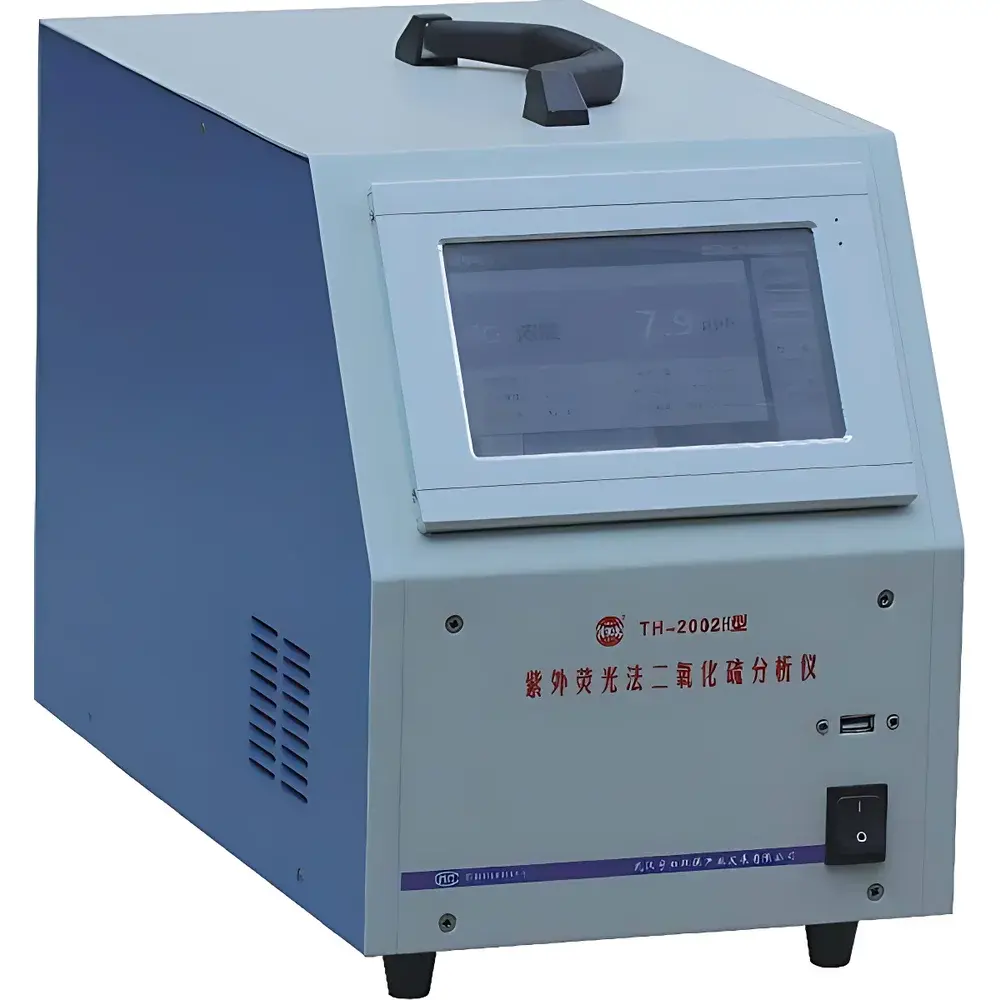
Yuhong TH-2002H Portable Sulfur Dioxide (SO₂) Analyzer
| Brand | Yuhong |
|---|---|
| Model | TH-2002H |
| Detection Principle | UV Fluorescence (214 nm excitation / 330 nm emission) |
| Detection Range | 0–10 ppm (selectable auto-ranging) |
| Resolution | 0.1 ppb |
| Accuracy | ±2% FS |
| Response Time (T90) | <60 s |
| Operating Temperature | −20 °C to +50 °C |
| Power Supply | Rechargeable Li-ion battery (≥10 h continuous operation) |
| Display | 7-inch capacitive touchscreen |
| Data Logging | Internal storage ≥12 months @ 5-min intervals |
| Compliance | Meets GB/T 15438–1995, EPA Method RFNA-01 (UV Fluorescence), ISO 7935:1990 (Ambient Air – SO₂ Measurement) |
Overview
The Yuhong TH-2002H Portable Sulfur Dioxide (SO₂) Analyzer is a field-deployable, laboratory-grade ambient air quality monitor engineered for high-sensitivity, real-time quantification of sulfur dioxide in outdoor, industrial, and emergency response environments. It operates on the principle of ultraviolet fluorescence (UVF), a reference-grade optical detection method standardized under ISO 7935:1990 and aligned with U.S. EPA Reference Method RFNA-01. In this technique, gaseous SO₂ molecules are excited by monochromatic 214 nm UV radiation generated from a stabilized zinc vapor lamp. Upon relaxation from the excited singlet state, SO₂ emits characteristic fluorescence at ~330 nm. The intensity of this emitted signal—measured via a low-noise photomultiplier tube (PMT)—is linearly proportional to SO₂ concentration over six orders of magnitude. To ensure long-term photometric stability, the instrument implements dual-beam optical compensation: one channel monitors the fluorescence signal from the sample gas stream, while the second continuously tracks the spectral output and intensity drift of the excitation source, enabling real-time correction for lamp aging or thermal fluctuation.
Key Features
- 7-inch high-resolution capacitive touchscreen with intuitive graphical user interface supporting both English and Chinese language modes
- Multi-unit display capability: seamless switching between ppb, ppm, µg/m³, and mg/m³—automatically recalculated using local temperature and pressure inputs
- Integrated environmental compensation: automatic correction for ambient temperature (−20 °C to +50 °C) and barometric pressure (60–110 kPa)
- Adaptive signal processing algorithm optimizing dynamic response time (T90 ≤ 60 s) while maintaining signal-to-noise ratio >300:1
- Dual-channel UV optical path with active reference beam stabilization, reducing photometric drift to <0.5% per 24 h
- Onboard data logger storing ≥12 months of 5-minute averaged records (timestamped, with GPS-tagged metadata when external module connected)
- Remote diagnostics and calibration support via secure Bluetooth 5.0 or optional LTE module—enabling firmware updates, parameter verification, and zero/span validation without physical access
- Rechargeable lithium-ion battery providing ≥10 hours of continuous operation; AC/DC universal input (100–240 VAC, 50/60 Hz) for lab or vehicle-based charging
Sample Compatibility & Compliance
The TH-2002H is designed for direct analysis of ambient air, stack effluent (with appropriate dilution and particulate filtration), and indoor workplace atmospheres. Sample inlet includes a heated Nafion™ membrane dryer (optional) to minimize humidity interference (<5% RH effect on reading). All wetted materials comply with ASTM D509–21 for inertness toward acidic gases. The analyzer meets national standard GB/T 15438–1995 “Ambient Air Quality—Determination of Sulfur Dioxide—Ultraviolet Fluorescence Method” and supports regulatory reporting under China’s HJ 692–2014 and HJ 693–2014 protocols. Its architecture supports GLP-compliant audit trails, including operator ID logging, calibration event timestamps, and sensor health diagnostics—facilitating traceability during environmental inspections or QA/QC audits.
Software & Data Management
Data acquisition and visualization are managed through embedded firmware compliant with IEC 62443-3-3 security principles. Raw and processed data export formats include CSV, PDF report templates, and XML-compatible structured logs. Optional cloud integration enables automated synchronization with centralized air quality management platforms (e.g., AQMesh, EQuIS, or custom GIS dashboards) via TLS 1.2 encrypted HTTPS. All stored measurements include full metrological metadata: calibration certificate IDs, zero/span dates, PMT gain settings, lamp hours, and temperature-compensated flow rates. Audit logs retain immutable records of configuration changes and user actions—meeting requirements for FDA 21 CFR Part 11–aligned electronic record integrity where applicable.
Applications
- Emergency response monitoring following industrial SO₂ releases or transportation incidents
- Regulatory compliance verification at power plants, smelters, and petrochemical facilities
- Mobile ambient air quality surveys across urban, rural, and border regions
- Method validation and inter-laboratory comparison studies against fixed-site reference analyzers
- Indoor air quality assessment in coal-heating communities or volcanic hazard zones
- Research applications requiring high-temporal-resolution SO₂ kinetics, such as plume dispersion modeling or photochemical reaction studies
FAQ
What is the minimum detectable concentration (MDL) of the TH-2002H?
The instrument achieves an MDL of 0.3 ppb (3σ criterion, 60-second averaging) under typical field conditions.
Does the analyzer require periodic lamp replacement?
The zinc vapor lamp has a rated lifetime of ≥5,000 hours; integrated lamp-hour tracking and intensity monitoring trigger maintenance alerts prior to performance degradation.
Can the TH-2002H be used for stack gas monitoring without modification?
Direct stack use requires optional accessories: a heated sampling probe (up to 200 °C), particulate filter, and dilution module to maintain linearity and prevent condensation-induced quenching.
Is the data logger compliant with ISO/IEC 17025 documentation requirements?
Yes—the internal memory stores uneditable binary logs with cryptographic checksums; exported files include digital signatures verifiable via public key infrastructure (PKI) upon request.
How is zero calibration performed in the field?
Zero calibration uses catalytic scrubbers (platinum-coated alumina) to remove SO₂ from ambient air; span calibration employs certified NIST-traceable SO₂ permeation tubes or dynamic dilution systems.
Related Products







