
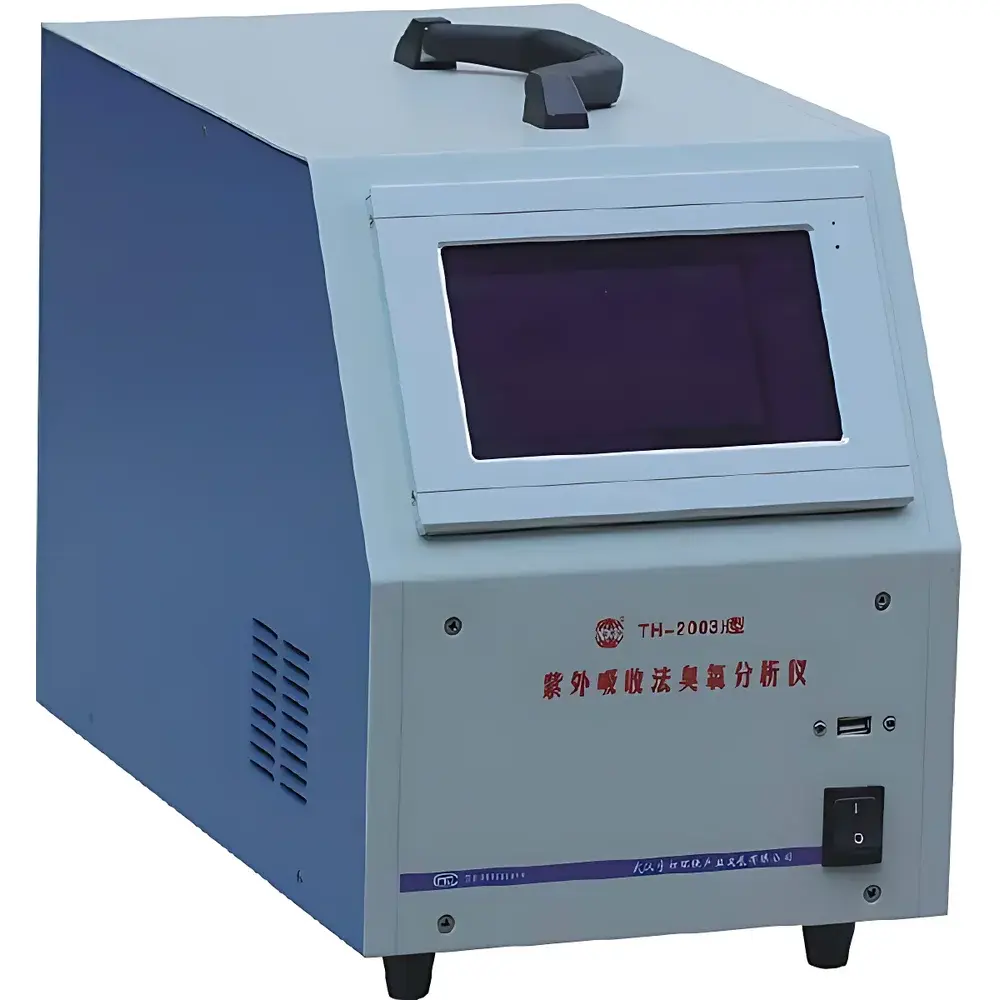
Yuhong TH-2003H Portable Ozone Analyzer
| Brand | Yuhong |
|---|---|
| Model | TH-2003H |
| Detection Principle | UV Absorption at 254 nm |
| Display | 7-inch capacitive touchscreen |
| Concentration Units | ppb, ppm, µg/m³, mg/m³ |
| Data Logging Interval | 5 minutes |
| Battery Life | >10 hours (rechargeable Li-ion) |
| Flow Path Materials | PTFE (Teflon®) |
| Auto Range Switching | Yes |
| Temperature & Pressure Compensation | Integrated |
| Remote Diagnostics & Calibration Support | Yes |
| Alarm Functions | Multi-parameter configurable |
| Power Supply | AC/DC dual-mode |
Overview
The Yuhong TH-2003H Portable Ozone Analyzer is a field-deployable, high-stability gas monitoring instrument engineered for accurate, real-time measurement of ambient ozone (O₃) concentrations using the well-established ultraviolet (UV) absorption spectroscopy principle. It operates at the characteristic absorption wavelength of ozone—254 nm—where O₃ exhibits strong and selective absorbance in accordance with the Lambert–Beer law. The analyzer employs a dual-beam optical configuration: one beam passes through the sample gas stream containing ozone; the other traverses a reference stream from which ozone has been catalytically removed. By continuously comparing the intensities of these two beams via high-sensitivity photodetectors, the instrument calculates ozone concentration with inherent compensation for lamp drift and optical path degradation. Designed for environmental compliance verification, emergency response, inter-laboratory comparison studies, and mobile air quality surveys, the TH-2003H delivers trace-level sensitivity and operational robustness under variable ambient conditions.
Key Features
- 7-inch high-resolution capacitive touchscreen display with intuitive icon-driven interface
- Multi-unit concentration readout: ppb, ppm, µg/m³, and mg/m³—user-selectable in real time
- Full bilingual operation (English/Chinese) with context-sensitive menu navigation
- Intelligent auto-ranging system ensures optimal signal-to-noise ratio across dynamic concentration spans
- Real-time graphical display of time-series data with pinch-to-zoom and pan functionality
- Integrated temperature and barometric pressure sensors enable automatic environmental compensation per ISO 13964 and EPA Method IO-3
- Adaptive digital filtering algorithm optimizes response time while maintaining baseline stability
- Remote access capability supports secure firmware updates, diagnostic parameter interrogation, and zero/span calibration verification via encrypted Ethernet or Wi-Fi
- Non-reactive flow path constructed entirely of PTFE (Teflon®) components to eliminate adsorption artifacts and cross-contamination
- Dual-power architecture: operates on AC mains or internal rechargeable lithium-ion battery (>10 h continuous runtime)
- Pre-warm mode allows thermal stabilization prior to deployment—enabling rapid start-up and measurement readiness upon arrival at site
Sample Compatibility & Compliance
The TH-2003H is validated for direct analysis of ambient air, stack effluent dilutions, and indoor air samples within standard atmospheric pressure (80–106 kPa) and temperature ranges (−10 °C to +45 °C). Its PTFE-lined sampling train ensures compatibility with humid, particulate-laden, or mildly corrosive matrices without performance degradation. The instrument meets functional requirements outlined in ISO 13964:2021 (ambient air quality—determination of ozone—UV photometric method), aligns with U.S. EPA Reference Method IO-3 for ozone monitoring, and supports data integrity practices consistent with GLP and ISO/IEC 17025 laboratory accreditation frameworks. All stored measurements include timestamp, environmental metadata (T/P), and operational status flags—facilitating audit-ready recordkeeping.
Software & Data Management
Onboard memory retains up to 12 months of 5-minute averaged data (equivalent to >100,000 records), each tagged with GPS coordinates (when external module connected), battery voltage, and diagnostic flags. Data export is supported via USB mass storage or microSD card in CSV format, compatible with common environmental data management platforms (e.g., EPA’s AQS, EEA AirBase, custom LIMS). Optional PC software provides spectral diagnostics, calibration history tracking, and trend visualization with statistical summary (min/max/mean/std dev). Audit trail functionality logs all user-initiated actions—including parameter changes, calibrations, and alarm acknowledgments—in tamper-evident format compliant with FDA 21 CFR Part 11 principles where locally applicable.
Applications
- Field validation of fixed-site ozone monitors during QA/QC audits
- Rapid-response assessment following industrial incidents involving ozone-generating equipment
- Mobile mapping of urban ozone gradients using vehicle-mounted or handheld configurations
- Indoor air quality surveys in healthcare facilities, laboratories, and cleanrooms
- Educational demonstrations of UV absorption spectroscopy and atmospheric chemistry principles
- Supporting regulatory compliance under China’s HJ 504-2009 and EU Directive 2008/50/EC
FAQ
What is the detection limit and typical measurement range?
The instrument achieves a lower detection limit of ≤0.5 ppb (3σ) with a standard operating range of 0–1000 ppb, extendable to 0–10 ppm via optional range selection.
Does it require periodic calibration with certified ozone standards?
Yes—zero calibration uses ozone-scrubbed air; span calibration requires NIST-traceable ozone gas standards (e.g., 100 ppb or 500 ppb). Annual verification against primary standards is recommended per ISO/IEC 17025 guidelines.
Can it operate unattended for extended periods?
While designed for portability, the TH-2003H supports continuous operation when powered externally and mounted in weather-protected enclosures—commonly deployed for 72-hour comparative campaigns.
Is the firmware upgradable in the field?
Yes—firmware updates are delivered via signed binary files through the embedded web server or dedicated desktop utility, preserving all user configurations and historical data.
How is data security managed during remote access?
All remote sessions use TLS 1.2 encryption; authentication requires username/password plus optional certificate-based client verification, meeting IEC 62443-3-3 SL2 requirements for industrial control systems.







