
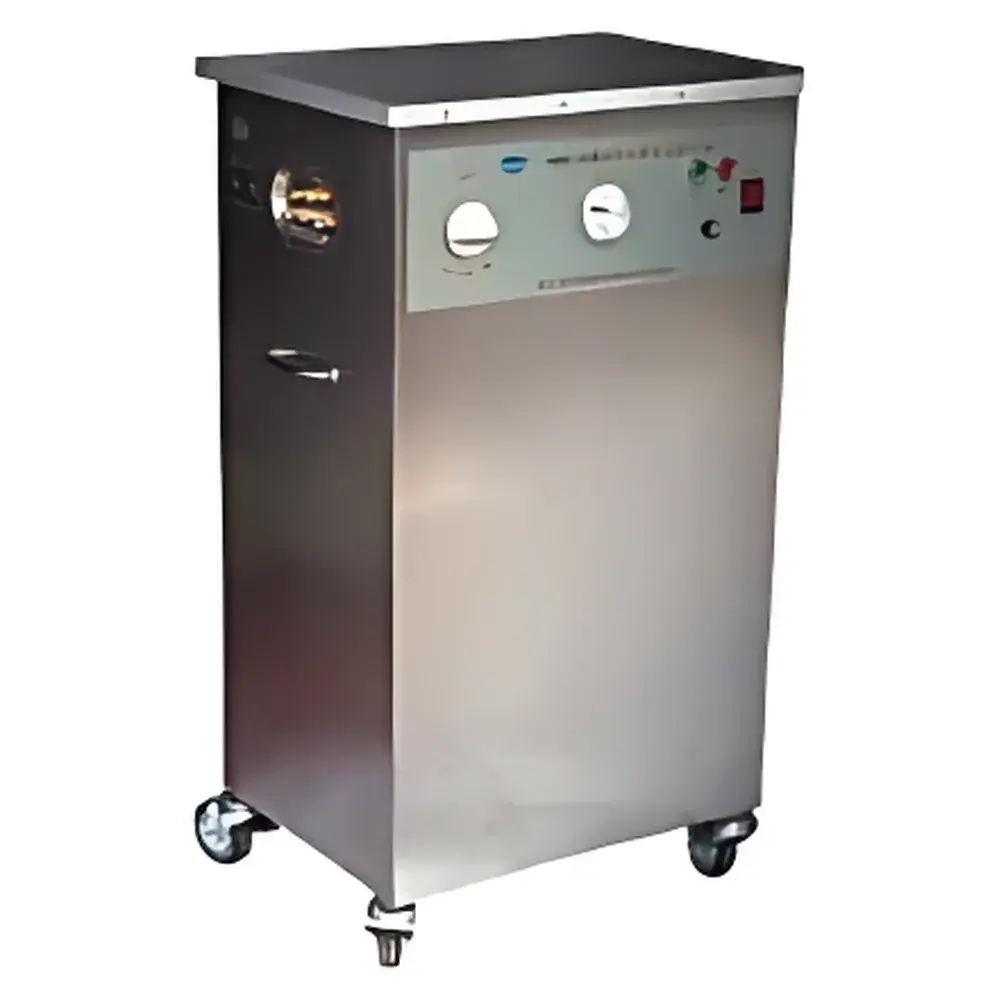
Yuhua SHZ-C Stainless Steel Five-Port Circulating Water Vacuum Pump
| Brand | Yuhua |
|---|---|
| Origin | Henan, China |
| Model | SHZ-C |
| Construction | Full stainless steel pump body, impeller, and water distributor |
| Ports | 5 independent vacuum ports |
| Operation | Self-cooling circulating water system (internal + external loop) |
| Lubrication | Oil-free operation |
| Compliance | Designed for general laboratory vacuum applications under ambient conditions |
| Power Supply | Standard AC mains (220 V, 50 Hz) |
| Noise Level | ≤55 dB(A) |
| Max. Vacuum | Approx. 0.098 MPa (735 mmHg) |
| Flow Rate | Approx. 60 L/min (total, distributed across ports) |
| Cooling | Closed-loop water circulation with external reservoir compatibility |
| Certifications | CE-marked per EN 61000-6-3 (EMC) and EN 61000-6-2 (Immunity) |
Overview
The Yuhua SHZ-C Stainless Steel Five-Port Circulating Water Vacuum Pump is an oil-free, water-cooled vacuum source engineered for continuous-duty operation in chemistry, pharmaceutical, and materials science laboratories. It operates on the principle of water-ring vacuum generation: rotating stainless steel impellers displace water within a cylindrical chamber to create sealed cavities that expand and contract—generating suction at each port via volumetric displacement. Unlike mechanical or diaphragm pumps, this design eliminates hydrocarbon contamination risks and avoids vacuum degradation due to oil vapor backstreaming. The integrated dual-loop cooling architecture—comprising both internal recirculation and optional external reservoir connection—ensures thermal stability during extended operation, minimizing vapor pressure drift and maintaining consistent ultimate vacuum performance (~0.098 MPa). Its five independently valved ports support simultaneous multi-apparatus evacuation, making it suitable for rotary evaporation, vacuum filtration, solvent distillation, and degassing protocols where parallel processing improves workflow efficiency.
Key Features
- Five isolated vacuum ports with individual on/off control valves—enabling selective engagement without compromising system integrity
- Full stainless steel construction of pump body, impeller, and water distributor—resistant to corrosion from acidic, alkaline, or organic vapors commonly encountered in extraction and purification workflows
- Oil-free operation eliminates maintenance associated with oil changes, filter replacements, and hydrocarbon residue management—reducing total cost of ownership and analytical interference
- Dual-mode water circulation: internal closed-loop for compact setups; external reservoir interface (standard 8 mm ID tubing) for high-heat-load applications requiring enhanced thermal dissipation
- Low-noise operation (<55 dB[A] at 1 m distance) achieved through balanced rotor dynamics, vibration-damped mounting, and acoustic enclosure geometry
- Energy-efficient motor design compliant with IEC 60034-30 IE2 efficiency standards—reducing power consumption by up to 15% versus legacy water-ring equivalents
Sample Compatibility & Compliance
The SHZ-C is compatible with standard laboratory glassware (e.g., Büchner funnels, rotary evaporator condensers, Schlenk lines) via universal 6–10 mm ID vacuum tubing connections. It does not require calibration traceable to NIST or other national metrology institutes, as it serves as a process vacuum source rather than a measurement instrument. However, its construction adheres to ISO 9001-certified manufacturing protocols, and electromagnetic compatibility conforms to EN 61000-6-2 (immunity) and EN 61000-6-3 (emission) standards. While not explicitly validated for GMP or GLP environments, its stainless steel wetted parts and absence of lubricants make it suitable for use in facilities following FDA 21 CFR Part 11–aligned documentation practices when paired with appropriate logbook procedures.
Software & Data Management
The SHZ-C is a standalone analog device with no embedded microcontroller, digital interface, or data logging capability. Vacuum output is manually regulated via individual port valves and monitored using external analog gauges (e.g., Bourdon tube or diaphragm-type vacuum meters). For integration into automated systems, third-party pressure transducers (e.g., capacitance manometers, 0–1000 Torr range) may be installed downstream, with signal acquisition handled via LabVIEW, MATLAB, or PLC-based SCADA platforms. No proprietary software or firmware updates are required or supported.
Applications
- Simultaneous vacuum filtration across multiple Buchner funnels in analytical sample preparation
- Supporting up to five rotary evaporators in parallel synthesis or natural product isolation workflows
- Evacuation of desiccators, glove boxes, and vacuum ovens during moisture-sensitive material handling
- Gas-phase reaction setup requiring inert atmosphere purging prior to catalyst introduction
- Distillation train configurations where differential pressure control between columns is maintained via port-specific throttling
- Lyophilization pre-freezing stages requiring stable sub-atmospheric conditions without refrigerant cross-contamination
FAQ
Is the SHZ-C suitable for vacuum drying of heat-sensitive compounds?
Yes—its oil-free operation prevents thermal decomposition pathways associated with hot oil vapors, and its stable ~0.098 MPa vacuum supports gentle solvent removal below 40 °C.
Can I connect an external chiller to improve cooling efficiency?
Yes—the unit features standardized inlet/outlet ports (8 mm ID) compatible with recirculating chillers operating between 5–25 °C.
What maintenance intervals are recommended?
Inspect water level and clarity daily; replace circulating water every 48–72 hours under continuous use; inspect impeller clearance and valve seals annually per ISO 5842 maintenance guidelines.
Does the pump meet explosion-proof requirements for solvent-rich environments?
No—it lacks ATEX or IECEx certification; use only in well-ventilated areas with vapor concentration monitoring per OSHA 1910.1200.
Can vacuum level be digitally recorded?
Not natively—but analog vacuum gauges with 4–20 mA output or RS485 interfaces can be retrofitted for continuous logging in validated environments.



