
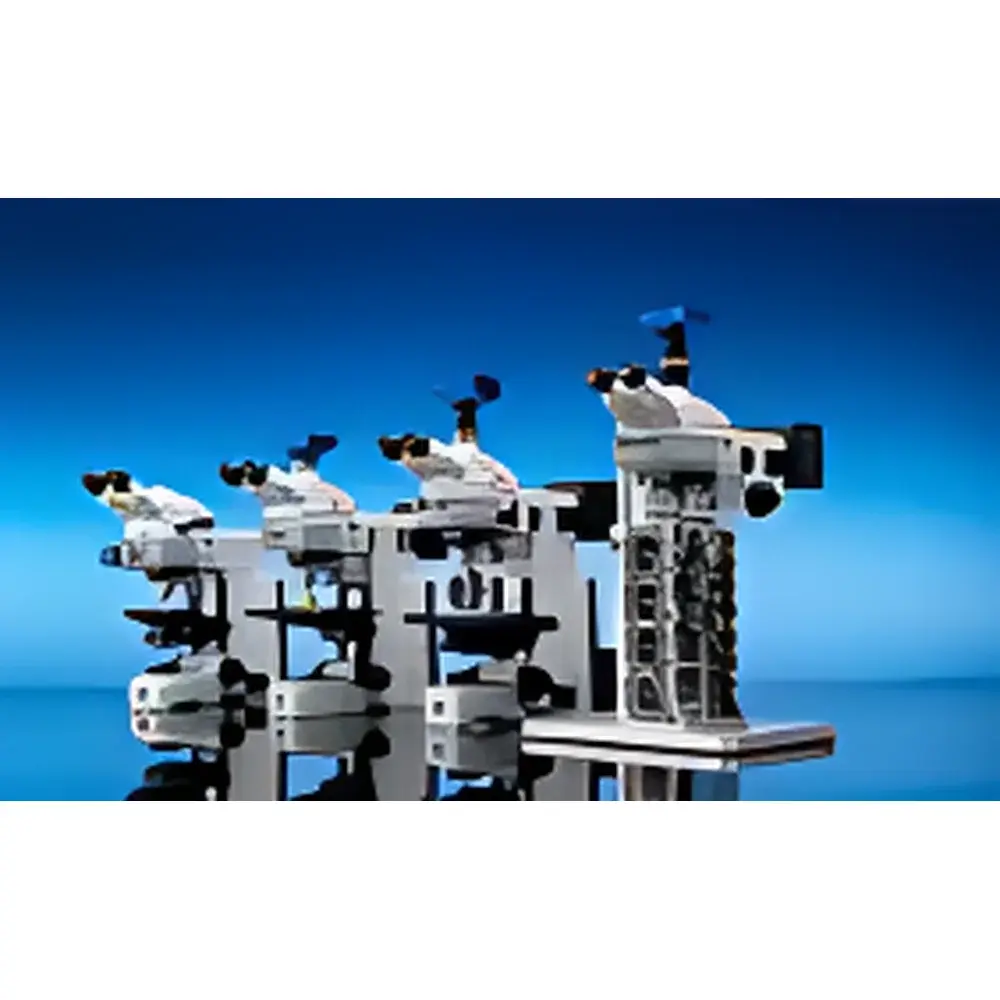
ZEISS Axio Imager High-Temperature Metallurgical Microscope
| Brand | ZEISS |
|---|---|
| Origin | Germany |
| Manufacturer Status | Authorized Distributor |
| Origin Category | Imported |
| Model | Axio Imager |
| Pricing | Upon Request |
| Objective Magnifications | 5×, 10×, 20×, 50× |
| Eyepiece Magnification | 10× |
| Total Magnification Range | 50×–500× |
| Turret | Research-grade 6- or 7-position brightfield/darkfield objective turret |
| Observation Mode Selector | 6–10 position, modular with expansion slots |
| Observation Modes | Brightfield, Advanced Darkfield, Circular Polarization, Differential Interference Contrast (DIC), Fluorescence |
| Illumination | 12 V / 100 W Halogen Lamp with Intelligent Light Path Manager and Auto-Adjustable Intensity |
| Digital Platform Compatibility | Integrated support for high-resolution digital cameras, PC-based acquisition, and quantitative image analysis software |
| Temperature Stage | Integrated high-temperature heating stage, operating range: ambient to 1500 °C |
| Temperature Accuracy | ±1 °C |
| Heating Rate | up to 130 °C/s |
Overview
The ZEISS Axio Imager High-Temperature Metallurgical Microscope is an advanced in situ observation platform engineered for real-time microstructural analysis of metallic and alloyed materials under controlled thermal conditions. Built upon ZEISS’s Axio Imager optical architecture—a system widely adopted in metallurgical R&D laboratories and industrial quality control centers—the instrument integrates a precision-engineered 1500 °C resistive heating stage directly into the optical path. This configuration enables direct, high-fidelity visualization of dynamic phase transformations, grain boundary migration, precipitate dissolution, eutectic melting, and recrystallization kinetics during thermal cycling. The system operates on conventional transmitted-light-free reflected-light optics, optimized for opaque, polished metallographic specimens. Its optical design complies with Köhler illumination principles and supports quantitative reflectance contrast measurement across all modalities, including brightfield, advanced darkfield, circular polarization, DIC, and fluorescence—where applicable to surface-emitting phases or thermally activated luminescent markers.
Key Features
- Thermally stable optical column with apochromatic correction and high numerical aperture (NA) objectives (5×, 10×, 20×, 50×) ensuring diffraction-limited resolution across the full magnification range (50×–500×)
- Modular 6–10 position observation mode selector with pre-aligned filter cubes and polarizer/analyzer mounts, enabling rapid reconfiguration between contrast mechanisms without optical realignment
- Research-grade 6- or 7-position objective turret with motorized positioning and encoded lens recognition for repeatable, software-synchronized magnification recall
- Intelligent illumination management: 12 V / 100 W halogen source with closed-loop light intensity regulation, automatic exposure compensation, and spectral stability monitoring over extended thermal runs
- High-temperature stage with inert atmosphere compatibility (N₂, Ar), vacuum-rated construction, and integrated thermocouple feedback loop ensuring ±1 °C temperature accuracy from ambient to 1500 °C
- Ultra-fast heating capability (up to 130 °C/s) with programmable ramp/soak profiles, enabling simulation of industrial thermal cycles such as hot rolling, annealing, and solution heat treatment
Sample Compatibility & Compliance
The system accommodates standard metallographic specimens (up to 30 mm diameter, 25 mm thickness) mounted in conductive or insulating resins. Specimen holders are compatible with ASTM E3, ISO 643, and EN 10365 standards for microstructural preparation. All optical components meet ZEISS’s DIN EN ISO 9022-18 environmental durability specifications. The heating stage conforms to IEC 61000-6-3 (EMC) and UL 61010-1 safety requirements for laboratory equipment. Data acquisition workflows support audit trails compliant with FDA 21 CFR Part 11 when paired with validated ZEN Blue software configurations. Full traceability of thermal parameters, image metadata, and operator actions is maintained for GLP/GMP-regulated environments.
Software & Data Management
Controlled via ZEISS ZEN Blue (Core or Professional edition), the system provides synchronized acquisition of time-lapse image sequences, thermal profiles, and stage position data. Software modules include quantitative grain size analysis (ASTM E112-compliant), phase fraction mapping, particle dispersion statistics, and thermal derivative curve overlay (dT/dt vs. time). Raw image stacks are stored in TIFF or CZI format with embedded EXIF metadata—including objective ID, exposure time, temperature stamp, and illumination settings. Export options include CSV for statistical post-processing in MATLAB or Python-based metallurgical modeling frameworks (e.g., Thermo-Calc coupling via API).
Applications
- In situ characterization of dynamic recrystallization and recovery kinetics in hot-rolled steels, supporting optimization of thermo-mechanical processing parameters
- Quantitative tracking of austenite grain growth and secondary phase dissolution (e.g., NbC, TiN) in microalloyed steels above 1200 °C
- Observation of eutectic melting onset and liquid-phase redistribution in Ni-base superalloys during solidification simulation
- Analysis of liquation cracking susceptibility in weld heat-affected zones through controlled thermal cycling with simultaneous DIC strain mapping
- Correlation of high-temperature microstructural evolution with mechanical property degradation in creep-resistant alloys
FAQ
What is the maximum usable magnification at 1500 °C?
At elevated temperatures, optimal resolution is maintained up to 500× using the 50× objective with oil immersion compatibility disabled; dry objectives are recommended for thermal stability.
Can the system operate under protective gas or vacuum?
Yes—the stage features dual gas inlet ports and a vacuum flange (KF40) for inert atmosphere purging or low-pressure operation down to 10⁻² mbar.
Is automated focus maintenance available during heating?
ZEN Blue supports motorized Z-drive with continuous focus tracking enabled via contrast-based autofocus algorithms calibrated for thermal drift compensation.
Does the system support ASTM E112 grain size analysis?
Yes—integrated grain detection and linear intercept measurement tools are pre-validated against ASTM E112 Annex A1 reference images.
How is temperature uniformity verified across the field of view?
Uniformity is characterized using calibrated infrared thermography and multi-point thermocouple mapping; typical radial deviation is ≤±3 °C at 1400 °C over a 1.2 mm diameter field.



