
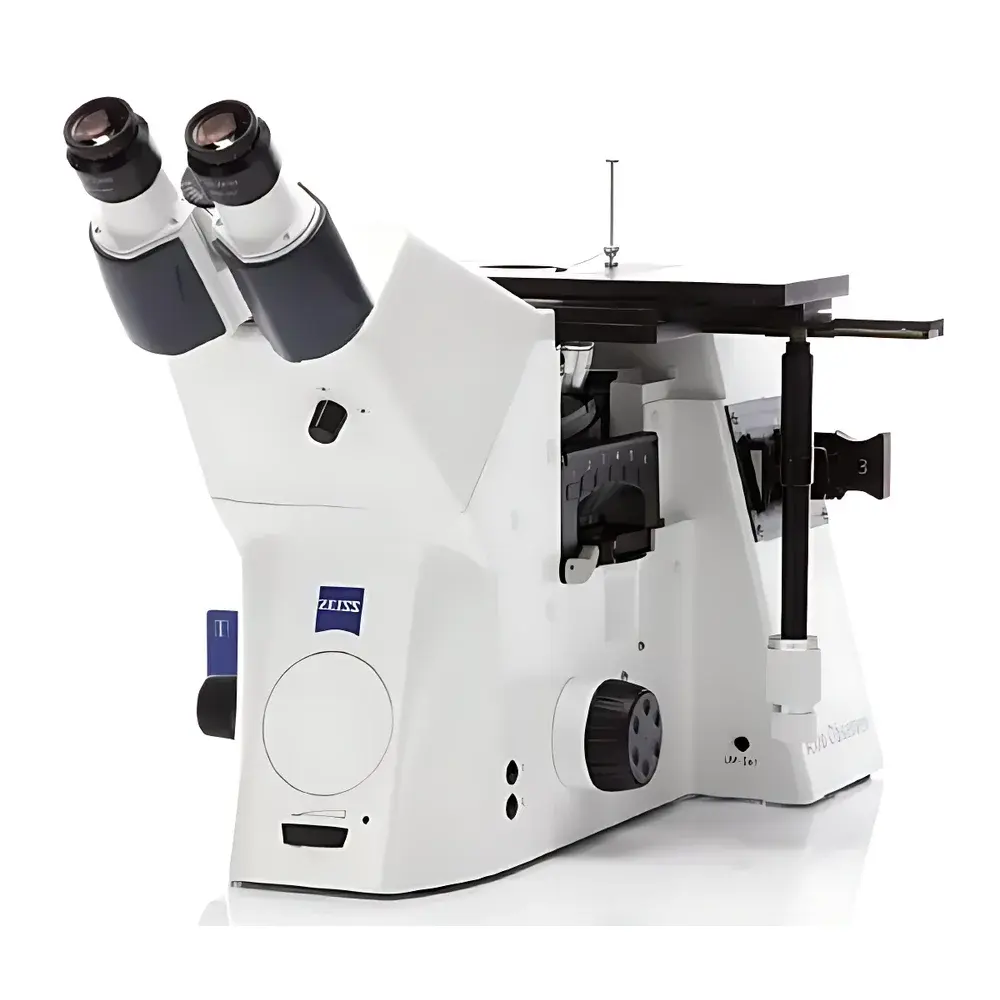
ZEISS Axio Observer 3m Research-Grade Inverted Universal Microscope
| Brand | ZEISS |
|---|---|
| Origin | Germany |
| Model | Axio Observer 3m |
| Configuration | Inverted |
| Total Magnification | Up to 1000× |
| Eyepieces | 10×/23 mm field number |
| Objective Lenses | 5×, 10×, 20×, 50×, 100× (optional: 1.25×, 2.5×, 150×) |
| Optical System | ICCS (Infinity Corrected Color and Contrast Superior) |
| Illumination | 12 V / 100 W halogen lamp with intelligent light-path manager and auto-adjustable intensity |
| Objective Turret | 6-position universal brightfield/darkfield turret |
| Observation Head | FEM-optimized mechanical design with ACR position encoding |
| Digital Integration | Compatible with high-resolution digital cameras, image analysis software, motorized stages, heating stages, and ZEISS LSM laser scanning modules |
Overview
The ZEISS Axio Observer 3m is a research-grade inverted universal microscope engineered for precision materials science, metallurgy, and advanced life science applications requiring high-fidelity optical characterization of opaque, thick, or container-based specimens. Built upon ZEISS’s proven ICCS (Infinity Corrected Color and Contrast Superior) optical architecture, the system delivers diffraction-limited resolution, exceptional chromatic and spherical aberration correction, and optimized contrast across visible and near-visible spectral bands. Its inverted configuration places the objective lenses beneath the specimen stage—enabling stable observation of large, heavy, or temperature-controlled samples (e.g., molten metal interfaces, in-situ furnace chambers, or live-cell culture vessels) without mechanical interference. The Axio Observer 3m represents the evolutionary culmination of the Axio Observer A1m platform, incorporating finite element method (FEM)-validated structural rigidity, ACR (Automatic Component Recognition) encoded turret positioning, and modular expansion capability for correlative imaging workflows.
Key Features
- ICCS optical system with apochromatic correction across all standard objectives (5×–100×), ensuring minimal color fringing and maximal edge sharpness at full numerical aperture.
- 6-position universal brightfield/darkfield objective turret with integrated alignment calibration—enabling rapid switching between illumination modes without realignment.
- FEM-optimized microscope stand with vibration-damped base and thermally stable aluminum-magnesium alloy frame, minimizing drift during long-duration acquisition or thermal ramping experiments.
- Intelligent illumination management: 12 V / 100 W halogen source coupled with dynamic light-path control, enabling automatic intensity adjustment per magnification and objective-specific Köhler illumination presets.
- ACR-encoded components—including turret, filter cubes, and condenser—allow seamless integration with ZEISS ZEN software for hardware-aware acquisition protocols and audit-compliant metadata logging.
- Ergonomic stage design supporting motorized XYZ translation (optional), programmable thermal stages (up to 1200 °C), and compatibility with ZEISS LSM 900 laser scanning modules for confocal reflectance or fluorescence hybrid imaging.
Sample Compatibility & Compliance
The Axio Observer 3m accommodates a broad range of metallurgical and industrial specimens: polished metallographic mounts (ferrous/non-ferrous alloys), ceramic fracture surfaces, semiconductor wafers, additive-manufactured cross-sections, and corrosion test coupons. Its inverted geometry permits direct imaging of samples in environmental chambers, electrochemical cells, or high-temperature furnaces (with optional heating stage). All optical components comply with ISO 10934-1 (microscopy terminology), DIN EN ISO 9001 quality manufacturing standards, and EU RoHS directives. When configured with ZEN Blue software and optional audit trail modules, the system supports GLP/GMP-aligned documentation per FDA 21 CFR Part 11 requirements—including electronic signatures, user access controls, and immutable acquisition logs.
Software & Data Management
ZEISS ZEN software (Blue edition) serves as the native acquisition and analysis environment, offering calibrated measurement tools (grain size per ASTM E112, inclusion rating per ASTM E45, phase fraction quantification), multi-channel stitching, and time-lapse registration. Image metadata—including objective ID, illumination settings, stage coordinates, and ACR-derived component status—is embedded directly into TIFF and CZI file headers. Export formats support DICOM-SR for materials diagnostics archives and CSV/Excel for statistical process control (SPC) integration. Optional ZEN Connect enables secure remote collaboration, centralized instrument monitoring, and automated report generation compliant with ISO/IEC 17025 laboratory accreditation frameworks.
Applications
- Quantitative metallography: grain boundary mapping, precipitate dispersion analysis, and phase identification in heat-treated steels and superalloys.
- In-situ thermal analysis: real-time observation of solidification fronts, recrystallization kinetics, and oxide scale growth under controlled atmosphere.
- Failure analysis: fracture surface morphology assessment (ductile/brittle transition, fatigue striations), inclusion characterization per ASTM E45 Type A–D classification.
- Advanced manufacturing QA: porosity evaluation in laser powder bed fusion (LPBF) builds, interlayer bond integrity verification, and coating thickness measurement via focus variation.
- Correlative workflow foundation: registered optical imaging prior to SEM-EDS, XRD, or micro-tomography—ensuring spatial fidelity across modalities.
FAQ
Is the Axio Observer 3m suitable for quantitative ASTM-compliant grain size analysis?
Yes—the system supports fully calibrated linear and area-based measurements via ZEN Blue’s ASTM E112 module, including Heyn intercept and planimetric methods, with traceable pixel-to-micron scaling and uncertainty reporting.
Can darkfield and polarized light be used simultaneously on this platform?
The 6-position universal turret includes dedicated darkfield and polarization slots; however, simultaneous use requires custom optical path routing and is typically implemented via sequential acquisition with hardware-triggered filter exchange.
What level of positional repeatability does the ACR-encoded turret provide?
ACR ensures ±0.5 µm positional reproducibility across turret rotations, validated via interferometric stage calibration and logged in every acquisition metadata set.
Does ZEISS offer validation documentation for GMP-regulated environments?
Upon request, ZEISS provides IQ/OQ documentation packages, including installation verification, optical performance qualification (per ISO 10934-2), and software validation reports aligned with Annex 11 and 21 CFR Part 11.
How is thermal drift compensated during extended high-temperature imaging sessions?
Thermal stability is achieved through passive FEM-optimized stand design; active compensation requires integration of a motorized focus drive with closed-loop Z-sensor feedback—available as an optional upgrade.




