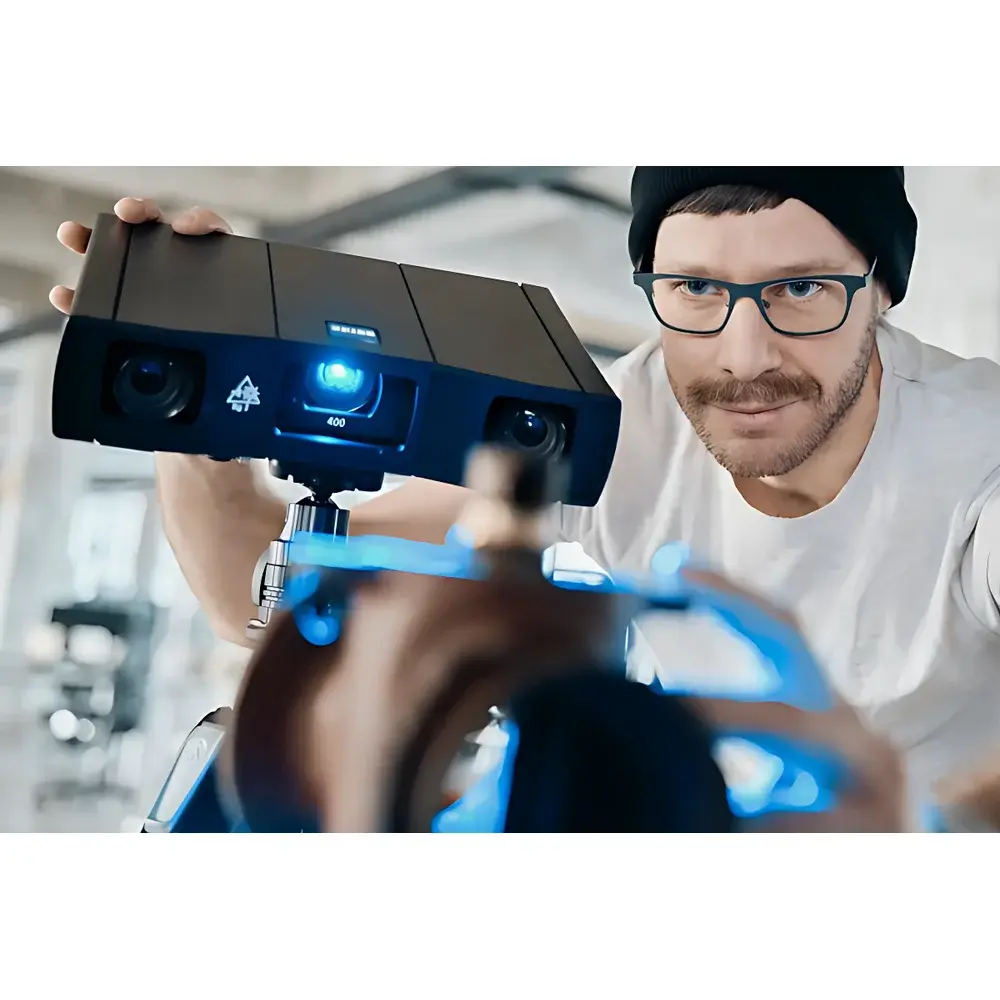
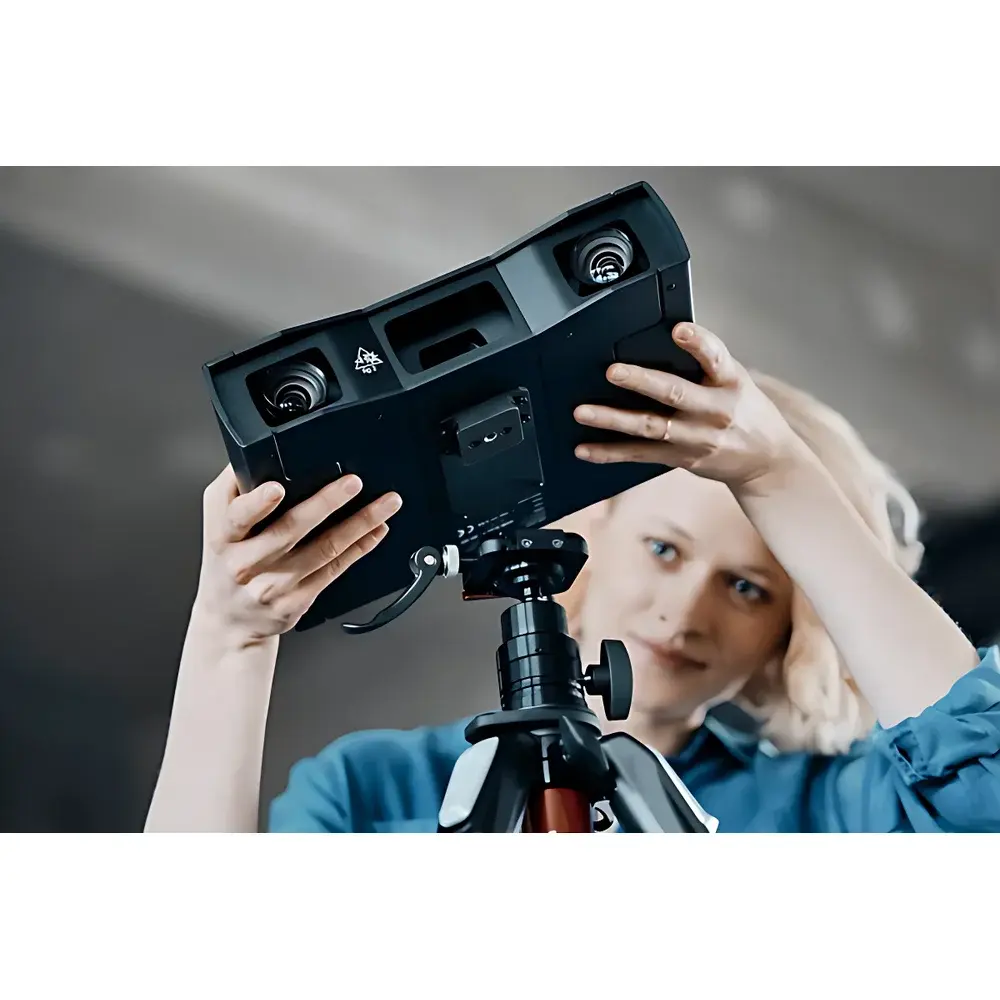
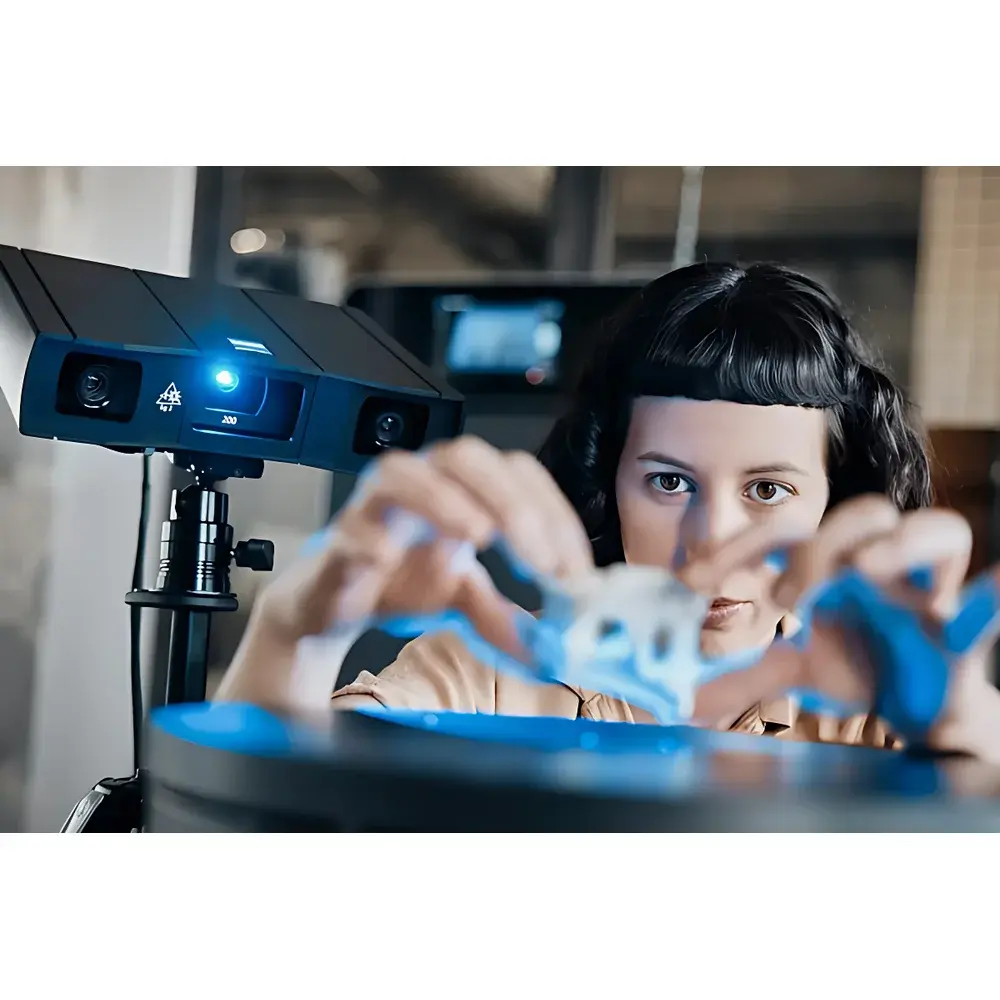
ZEISS GOM Scan 1 Automotive Headlamp 3D Scanning System
| Brand | ZEISS |
|---|---|
| Model | GOM Scan 1 |
| Measurement Principle | Structured Blue-Light Fringe Projection |
| Sensor Type | Dual-Camera Stereo Vision System |
| Point Resolution (MV100) | 0.037 mm |
| Point Resolution (MV200) | 0.060 mm |
| Point Resolution (MV400) | 0.129 mm |
| Single-Scan Point Count | 6 million points |
| Measurement Volumes | MV100 (100 × 65 mm²), MV200 (200 × 125 mm²), MV400 (400 × 250 mm²) |
| Working Distance | 400–500 mm |
| Light Source | High-Stability Blue LED |
| Weight | ~2.5 kg |
| Dimensions | 290 × 215 × 80 mm³ |
| Interface | USB 3.0 |
| OS Compatibility | Windows 10 |
| Software | GOM Inspect Suite (included) |
Overview
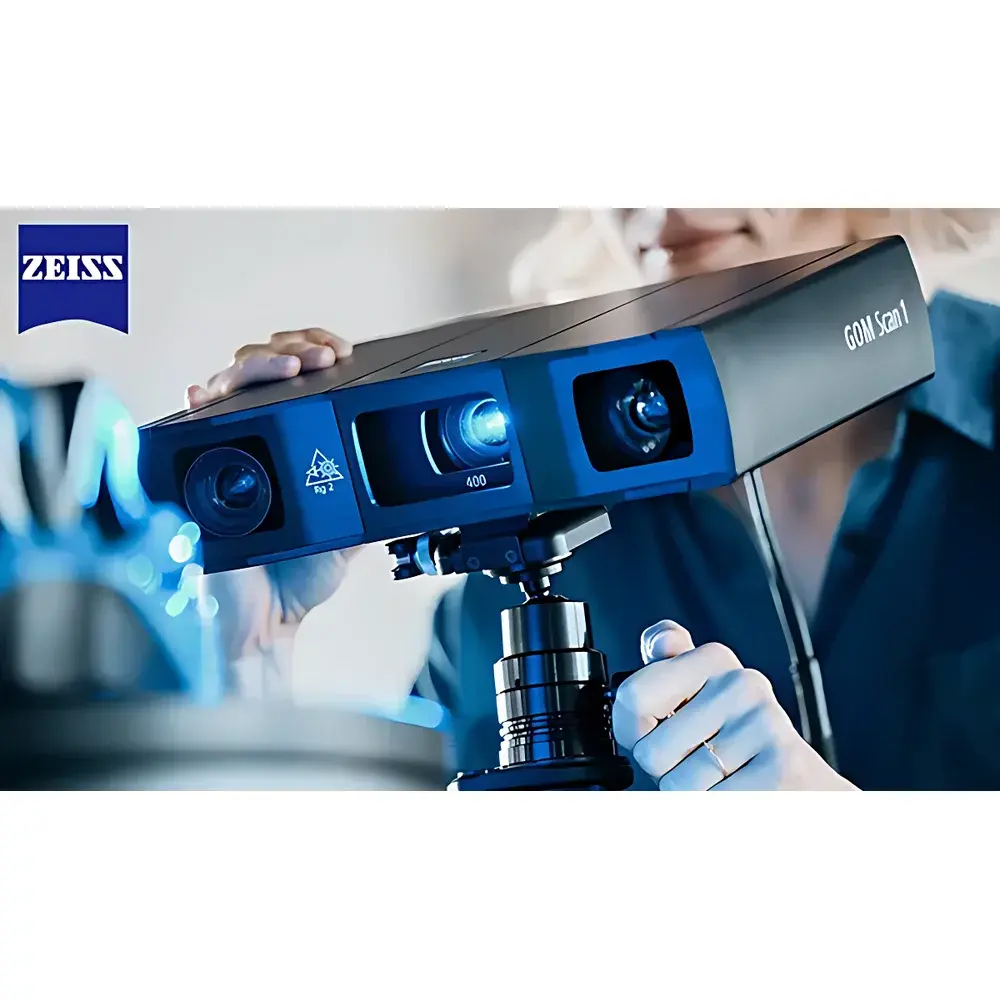
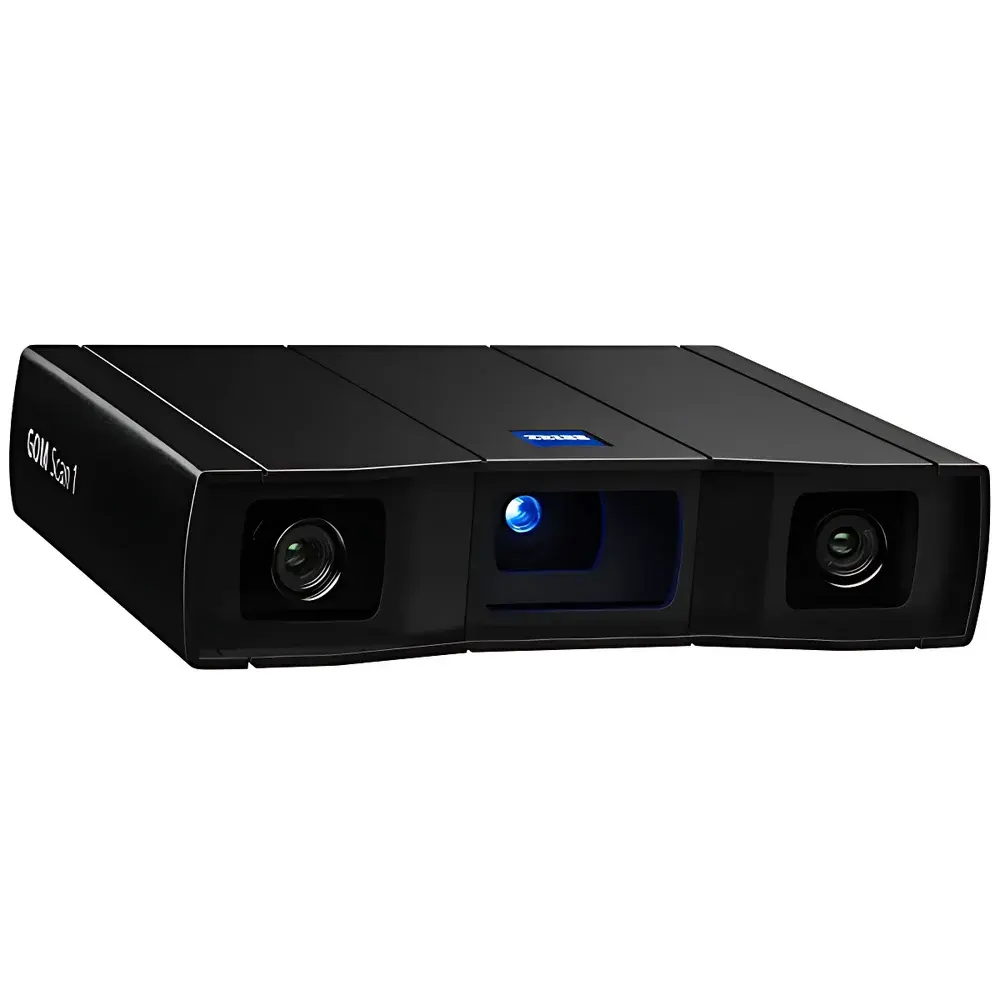
The ZEISS GOM Scan 1 Automotive Headlamp 3D Scanning System is a compact, portable, and metrology-grade structured-light scanner engineered for high-accuracy digitization of medium- to small-sized components—particularly automotive lighting assemblies, reflectors, lenses, and housing geometries. It operates on the principle of blue-light fringe projection combined with stereo photogrammetry: two synchronized high-resolution cameras capture phase-shifted blue-light patterns projected onto the object surface, enabling dense point cloud generation through triangulation and sub-pixel edge detection. Unlike laser-based scanners, the GOM Scan 1’s narrow-band blue LED illumination minimizes ambient light interference, ensuring stable performance under typical industrial lighting conditions—including factory floors, R&D labs, and quality control booths. Its rigid aluminum housing, thermal-stable optical path, and real-time sensor self-monitoring architecture deliver traceable, repeatable results compliant with ISO 10360 and VDI/VDE 2634 Part 2 standards for optical 3D measurement systems.
Key Features
- Compact and field-deployable design: Weighing only ~2.5 kg and measuring 290 × 215 × 80 mm³, the system fits into standard carry-on luggage and supports on-site scanning in constrained environments such as assembly lines or supplier audits.
- Three interchangeable measurement volumes (MV100, MV200, MV400): Each variant maintains identical 6-million-point single-scan resolution but scales spatial sampling density to match part size—enabling consistent uncertainty budgets across applications from micro-optics to full headlamp modules.
- Real-time environmental compensation: Embedded photometric sensors continuously monitor ambient illumination levels; software dynamically adjusts exposure time and fringe contrast to preserve signal-to-noise ratio without manual recalibration.
- Integrated hardware-software synchronization: The USB 3.0 interface ensures deterministic data transfer latency (<1 ms jitter), critical for phase-shifting algorithms requiring precise temporal alignment between projector frames and camera exposures.
- Ruggedized industrial construction: Sealed optics, shock-absorbing mounts, and IP52-rated enclosure protect against dust ingress and incidental vibration during transport or benchtop operation.
Sample Compatibility & Compliance
The GOM Scan 1 is optimized for non-contact digitization of opaque, matte-finished, or lightly textured surfaces common in automotive lighting—e.g., injection-molded polycarbonate lenses, vapor-deposited aluminum reflectors, and painted ABS housings. For highly reflective or transparent parts (e.g., clear PMMA covers), application of removable, ISO-compliant matte spray (Z200 series) restores measurement fidelity without residue. The system complies with CE, FCC, and RoHS directives. Data integrity workflows support FDA 21 CFR Part 11 requirements when paired with GOM Inspect Suite’s audit-trail-enabled project files, electronic signatures, and version-controlled report exports. All measurement reports include traceable uncertainty statements per ISO/IEC 17025 guidelines when used with certified calibration artifacts (e.g., ZEISS GOM Calibration Plates).
Software & Data Management
GOM Inspect Suite serves as the validated metrology platform bundled with the GOM Scan 1. It provides native handling of polygonal mesh data (STL, OBJ, PLY) and direct import of CAD formats (STEP, IGES, JT). Core capabilities include automatic mesh registration via best-fit iterative closest point (ICP) algorithms, GD&T-compliant dimensioning (ISO 1101), deviation color mapping against nominal geometry, and automated report generation in PDF or Excel with customizable templates. Advanced mesh processing tools—such as adaptive remeshing, curvature-aware hole filling, and intelligent decimation—enable preparation of production-ready STLs for additive manufacturing while preserving critical feature fidelity. All user actions are logged in an immutable audit trail, supporting GLP/GMP-regulated environments where process validation and data reproducibility are mandatory.
Applications
- Automotive headlamp validation: Full-field comparison of as-manufactured reflector geometry against optical simulation models to verify beam pattern compliance (ECE R112, SAE J2049).
- Reverse engineering of legacy lighting components: Rapid reconstruction of NURBS surfaces from scan data for tooling redesign or digital twin creation.
- First-article inspection: Quantitative verification of dimensional conformance for newly tooled lens molds prior to mass production.
- Design iteration feedback: In-house scanning of clay or 3D-printed prototypes to assess surface continuity, draft angles, and mounting interface tolerances before CNC machining.
- Educational metrology training: Hands-on instruction in optical measurement principles, uncertainty analysis, and GD&T interpretation using industry-standard hardware and software.
FAQ
Is the GOM Scan 1 calibrated to national metrology standards?
Yes—each unit ships with a ZEISS-certified calibration certificate traceable to PTB (Physikalisch-Technische Bundesanstalt) reference standards. Optional annual recalibration services maintain compliance with ISO/IEC 17025.
Can it scan moving objects or live assembly-line parts?
No—the system requires static part positioning during acquisition. However, integration with motorized turntables (e.g., GOM ROT 350) enables fully automated multi-view scanning sequences with seamless mesh fusion.
Does GOM Inspect support batch processing of multiple parts?
Yes—via Python scripting interface (GOM Script), users can automate alignment, comparison, and reporting across hundreds of datasets, reducing manual effort in high-volume QA environments.
What surface preparation is required for optimal results?
Matte-spray application is recommended for glossy or specular surfaces. No preparation is needed for inherently diffuse surfaces such as sandblasted metal or textured plastics meeting Ra ≥ 0.8 µm roughness criteria.
Is technical support available globally?
ZEISS offers tiered support contracts including remote diagnostics, on-site service, and application engineering assistance through authorized partners in North America, EMEA, and APAC regions.