
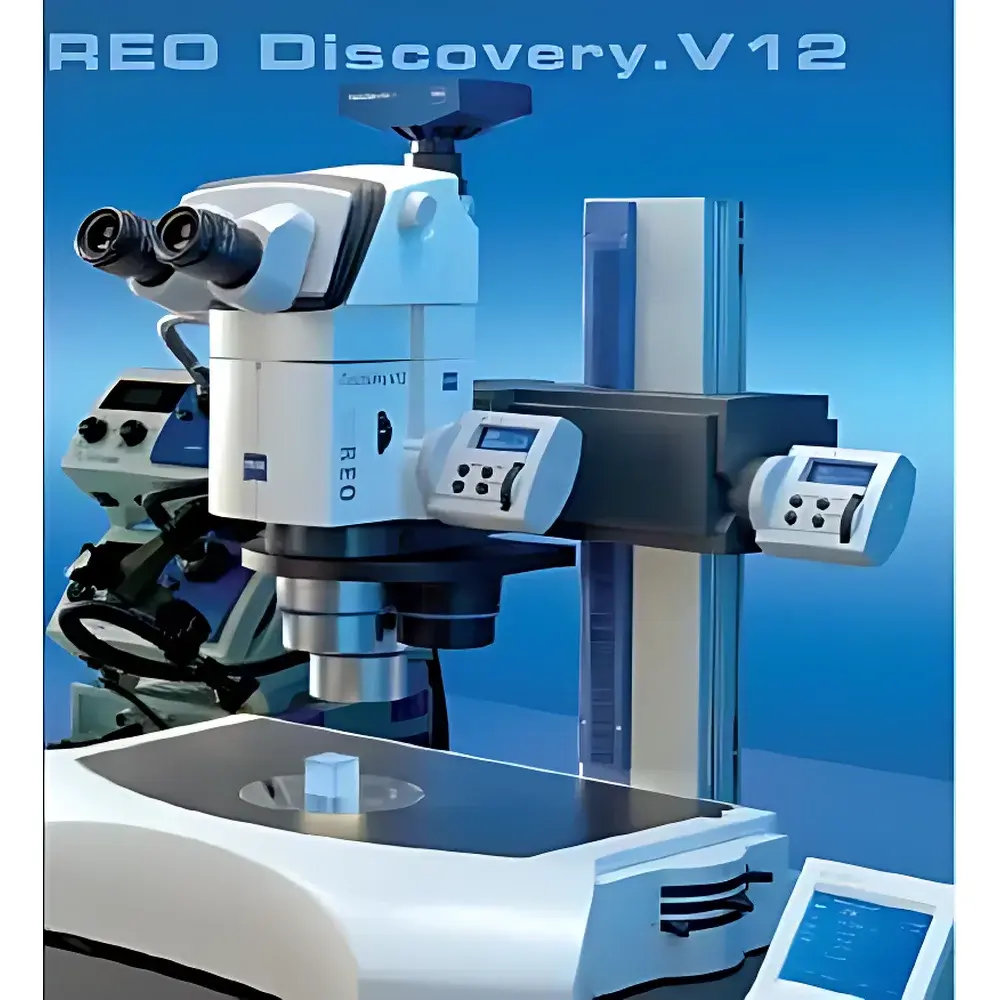
ZEISS SteREO Discovery.V12 Research-Grade Intelligent Digital Fully Automated Stereo Microscope
| Brand | ZEISS |
|---|---|
| Origin | Germany |
| Manufacturer Status | Authorized Distributor |
| Product Origin | Imported |
| Model | SteREO Discovery.V12 |
| Price | Upon Request |
| Total Magnification Range | 12×–375× |
| Working Distance | 81 mm |
| Vertical Travel | 340 mm |
| Maximum Field Diameter (at lowest magnification) | 25 mm |
| Focusing Resolution | 350 nm |
| Field of View (Actual) | 2.3–28.8 mm |
| Illumination | 15 V / 150 W Halogen or 24 V / 250 W Halogen Cold Light Source |
| Expandability | Compatible with digital cameras, CCD/CMOS imaging modules, and quantitative image analysis software suites |
Overview
The ZEISS SteREO Discovery.V12 is a research-grade, fully automated stereo microscope engineered for high-fidelity macroscopic inspection and dimensional analysis in industrial quality control, failure analysis, materials science, and advanced manufacturing R&D environments. Built upon Carl Zeiss’s proprietary Common Main Objective (CMO) optical architecture — the industry benchmark for parallel beam path stereo imaging — the system delivers exceptional depth of field, true color fidelity, and diffraction-limited resolution across its entire 12×–375× magnification range. Its core functionality is governed by two integrated intelligent control layers: the System Controller (SyCop), which orchestrates hardware-level actuation (motorized zoom, focus, illumination intensity, and white balance), and the Human Interface Panel (H.I.P.), a tactile, ergonomic touchscreen interface enabling intuitive workflow navigation without keyboard or mouse dependency. This dual-controller architecture ensures repeatable, operator-independent acquisition protocols — a prerequisite for GLP-compliant documentation and ISO/IEC 17025-accredited laboratories.
Key Features
- CMO-based optical design delivering constant resolution and distortion-free stereoscopic imaging across all magnifications
- Motorized zoom and focus with sub-350 nm axial positioning repeatability, supporting precise Z-stack acquisition and surface topography profiling
- Anti-glare optical coating technology (ZEISS patent-protected) minimizing specular reflection from metallic, polished, or anodized surfaces during defect inspection
- Ergonomic modular chassis with open-frame architecture — supports future integration of motorized stages, environmental chambers, or micro-manipulators
- Integrated cold-light halogen illumination (15 V / 150 W or 24 V / 250 W) with adjustable intensity and color temperature compensation to maintain consistent chromatic rendering under varying sample reflectivity
- 81 mm working distance and 340 mm vertical travel enabling safe, non-contact examination of large or vertically constrained components (e.g., castings, weldments, PCB assemblies)
Sample Compatibility & Compliance
The SteREO Discovery.V12 accommodates specimens ranging from small electronic components (≤2 mm) to large mechanical assemblies (up to Ø25 mm field diameter at 12×). Its extended working distance and wide field of view make it ideal for inspecting fracture surfaces, porosity distribution in investment-cast alloys, intergranular cracking in heat-treated steels, oxide film uniformity on aluminum extrusions, and solder joint integrity in aerospace electronics. The system complies with key international standards governing optical metrology and laboratory instrumentation, including ISO 10934-1 (optical microscopy terminology), DIN EN ISO 9001 (quality management systems), and ASTM E3 (standard guide for preparation of metallographic specimens). When paired with ZEISS ZEN imaging software, audit trails, user access controls, and electronic signature support align with FDA 21 CFR Part 11 requirements for regulated environments.
Software & Data Management
The microscope integrates natively with ZEISS ZEN Core and ZEN Blue software platforms. ZEN Core provides real-time image capture, multi-focus stacking, measurement annotation (length, angle, area, profile height), and export to TIFF, JPEG2000, or lossless PNG formats. ZEN Blue adds advanced quantification modules — particle analysis, grain size determination per ASTM E112, and grayscale thresholding for void fraction estimation in porous materials. All image metadata (magnification, objective ID, illumination settings, timestamp, operator ID) are embedded automatically. Data integrity is preserved via encrypted local storage and optional networked archiving to PACS or LIMS-compatible servers. Software validation packages and IQ/OQ documentation kits are available for GMP and ISO 13485-certified facilities.
Applications
- Failure analysis of metallurgical fractures: identification and spatial mapping of quench cracks, hot tears, fatigue striations, and inclusion-induced voids
- Weld quality assessment: evaluation of penetration depth, undercut, lack-of-fusion, and spatter morphology in TIG/MIG joints
- Electronics manufacturing: visual verification of conformal coating coverage, wire bond integrity, and component placement accuracy
- Additive manufacturing post-processing: surface roughness screening, layer adhesion verification, and powder residue detection
- Geological thin-section characterization: mineral grain boundary delineation and vesicle distribution analysis in volcanic rocks
- Forensic toolmark comparison: 3D surface texture correlation between questioned tools and impression evidence
FAQ
Is the SteREO Discovery.V12 compatible with third-party camera systems?
Yes — the C-mount adapter supports standard 1″ and 2/3″ sensor cameras from providers including Basler, FLIR, and IDS. SDKs for custom API integration are available upon request.
Can the system be validated for use in pharmaceutical QC labs?
Absolutely. With ZEN Blue software configured for 21 CFR Part 11 compliance and full IQ/OQ documentation, the platform meets regulatory expectations for raw material inspection and packaging defect review.
What is the expected service life of the optical train?
ZEISS specifies a minimum operational lifetime of 60 years for the CMO optical assembly under normal laboratory conditions, supported by factory-calibrated alignment retention and corrosion-resistant housing materials.
Does the system support automated report generation?
Yes — ZEN software includes customizable report templates with dynamic fields for pass/fail criteria, statistical summaries, and embedded annotated images; outputs comply with ISO/IEC 17025 clause 7.8.2.
How is thermal drift managed during long-duration focus-stacking acquisitions?
The motorized focus drive incorporates real-time thermal compensation algorithms, and the base casting uses low-expansion Zerodur®-derived alloy to minimize positional drift over 8-hour continuous operation.



