
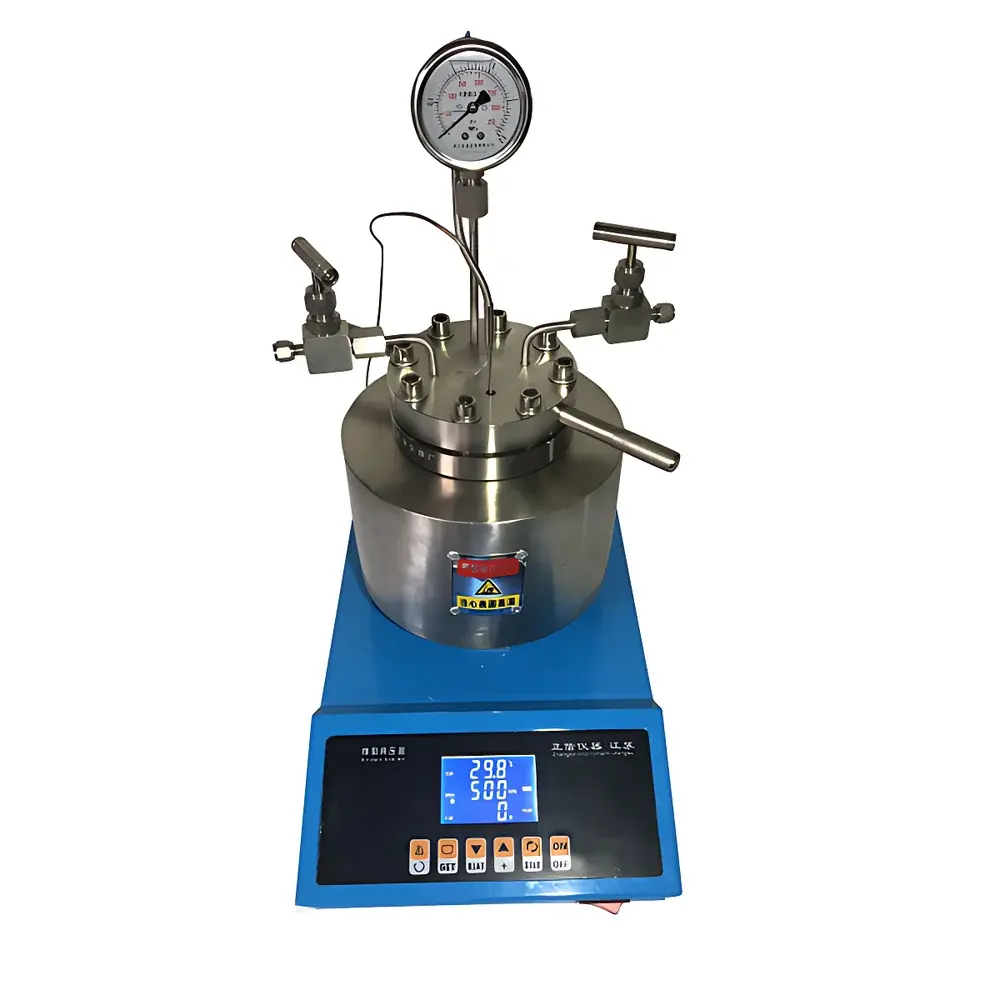
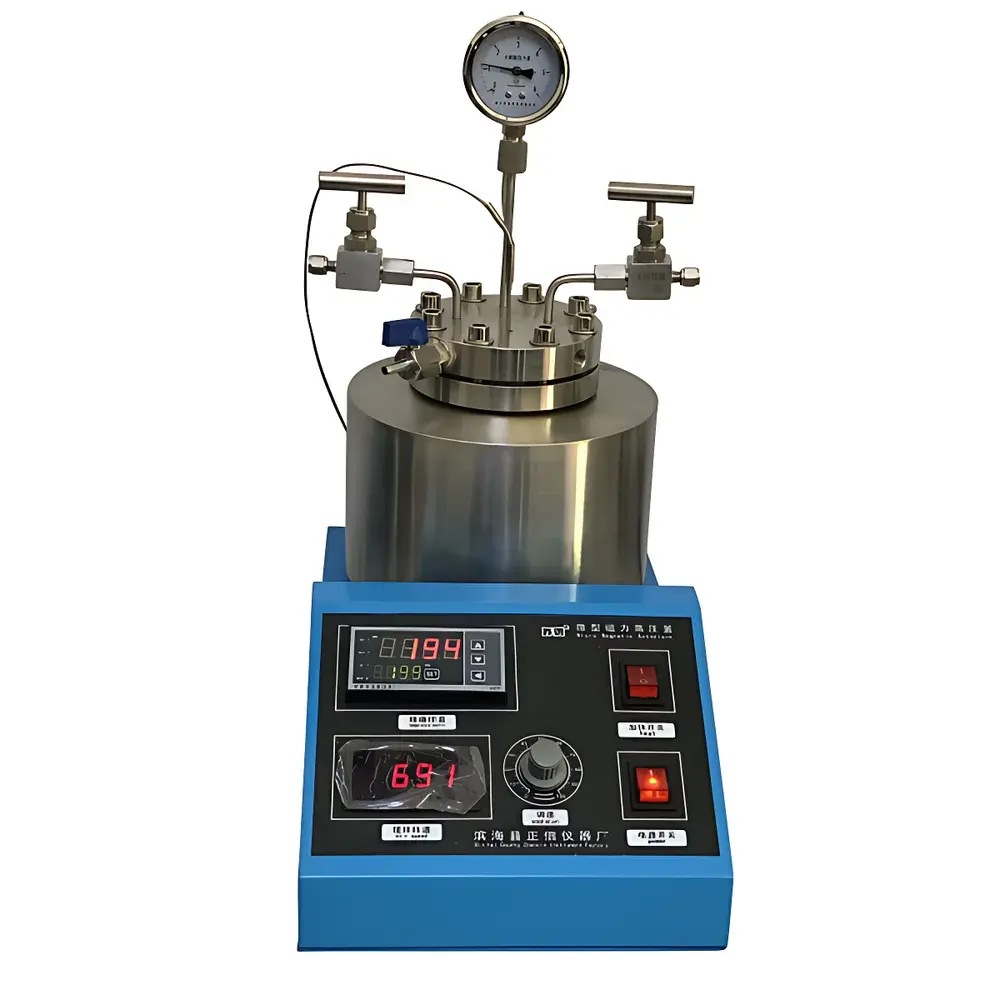
Zhengxin PSK4 Magnetic Stirring High-Pressure Reactor – Customizable Lab-Scale Synthesis Reactor
| Brand | Zhengxin Instruments |
|---|---|
| Origin | Jiangsu, China |
| Manufacturer Type | Authorized Distributor |
| Country of Origin | China |
| Model | PSK4 |
| Price | USD 650 (FOB) |
| Usable Volume | 50–5000 mL |
| Vessel Material | 316L Stainless Steel (standard), optional Hastelloy C-276, Titanium, Zirconium, PTFE/PPL/Quartz Linings |
| Operating Pressure Range | −0.1 to 60 MPa (vacuum to high pressure) |
| Operating Temperature Range | 0–350 °C |
| Heating Method | Modular Electric Cartridge Heater (400–1800 W) |
| Stirring | Permanent Magnet Coupling Drive, 0–1500 rpm |
| Temperature Control | LCD PID Controller with Auto-Tuning (AT), Timer Function (0–999 min/h, dual modes: hold-time & run-time) |
| Pressure Monitoring | Stainless Steel Bourdon Tube Gauge |
| Vacuum Capability | ≤ −0.1 MPa (absolute) |
| Compliance | Designed per GB/T 25973–2010 (Chinese Standard for Laboratory Pressure Vessels), ASME BPVC Section VIII Div. 1 Design Principles Applied |
| Safety Features | Dual-pressure relief path, rupture disc option, explosion-proof flange sealing, static-seal magnetic drive |
Overview
The Zhengxin PSK4 Magnetic Stirring High-Pressure Reactor is an engineered laboratory-scale synthesis system designed for controlled chemical reactions under elevated temperature and pressure conditions. It operates on the principle of magnetically coupled torque transmission—eliminating dynamic seals and ensuring true static hermeticity—making it ideal for oxygen-sensitive, pyrophoric, toxic, or highly viscous reaction systems where leakage, contamination, or catalyst deactivation must be rigorously avoided. The reactor’s monolithic 316L stainless steel body is CNC-machined in a single setup to guarantee dimensional integrity, surface finish consistency, and pressure boundary reliability. Its flanged closure system utilizes 4–12 high-strength alloy bolts (per ASME B18.2.1 specifications) to maintain uniform gasket compression across the full sealing surface, enabling repeatable, leak-tight operation up to 60 MPa. The modular heater design allows full thermal decoupling from the vessel during maintenance or sample handling—reducing cooldown time and minimizing cross-contamination risk between experiments.
Key Features
- Static-Seal Magnetic Drive: Hermetically sealed coupling eliminates rotating shaft seals; prevents gas permeation, solvent evaporation, and mechanical wear—critical for long-duration catalytic hydrogenation or supercritical fluid synthesis.
- Modular Thermal Architecture: Removable cartridge heaters enable rapid thermal cycling and simplify calibration traceability; heating uniformity ±1.5 °C across vessel wall (verified per ASTM E220).
- Intelligent PID Control: LCD-based controller supports auto-tuning (AT), dual-mode timing (hold-time for isothermal holds; run-time for total experiment duration), and reversible stirring direction—essential for heterogeneous slurry mixing and precipitate suspension.
- Multi-Material Compatibility: Standard 316L construction; optional linings (PTFE, PPL, quartz) or full-vessel alternatives (Hastelloy C-276, Grade 2 titanium, zirconium) accommodate aggressive media including HF, molten alkalis, or chlorinated solvents.
- Integrated Process Instrumentation: Built-in high-accuracy Pt100 RTD sensor (IEC 60751 Class A, immersion depth ≥75% of liquid height), calibrated stainless steel pressure gauge (0–100 MPa range, ±0.5% FS), and precision needle valves (3 mm Swagelok-compatible ferrule) for controlled gas dosing and vacuum purging.
- Configurable Safety Interface: Optional rupture disc assembly (ASME-certified), pressure-relief valve port, and explosion-proof flange gasketing comply with IEC 60079-0 intrinsic safety guidelines for Class I, Division 1 environments.
Sample Compatibility & Compliance
The PSK4 reactor accommodates heterogeneous, multiphase, and highly viscous systems—including slurries, polymer melts, nanoparticle dispersions, and solid-catalyzed reactions—without compromising seal integrity or measurement fidelity. Its design adheres to fundamental principles of ASME Boiler and Pressure Vessel Code Section VIII Division 1 for pressure boundary evaluation, while material selections conform to NACE MR0175/ISO 15156 for sour service applications. For regulated environments (e.g., pharmaceutical process development), the system supports 21 CFR Part 11-compliant data logging when paired with optional USB/RS485 interface modules. All standard configurations meet GLP audit requirements for traceable temperature/pressure recording, user access control, and electronic signature capability (when integrated with validated third-party SCADA software).
Software & Data Management
While the base PSK4 operates via standalone PID controller, optional digital upgrade kits provide real-time data acquisition via Modbus RTU or Ethernet/IP protocols. Logged parameters—including internal temperature, jacket temperature, pressure, stir speed, and elapsed time—are timestamped and stored in CSV or SQLite format. Audit trails include operator ID, parameter change history, and alarm event logs—fully compliant with FDA 21 CFR Part 11 Annex 11 requirements for electronic records and signatures. Firmware updates are performed via secure HTTPS endpoint with SHA-256 verification; no proprietary drivers required for Windows/macOS/Linux compatibility.
Applications
- Catalytic hydrogenation and hydrodeoxygenation under H₂ pressures up to 10 MPa
- Supercritical CO₂-mediated extractions and polymerizations (T > 31 °C, P > 7.38 MPa)
- High-temperature hydrothermal synthesis of metal oxides, MOFs, and quantum dots
- Accelerated aging studies of battery electrolytes and solid-state conductors
- Pharmaceutical route scouting involving air-sensitive Grignard or organolithium reagents
- Corrosion testing of alloys in simulated geothermal brines (pH 2–12, Cl⁻ up to 20 wt%)
FAQ
Can the PSK4 be used for exothermic reactions requiring precise cooling control?
Yes—while the standard configuration includes only heating, the vessel jacket can be retrofitted with a circulating chiller interface (−20 to +200 °C range) using optional double-wall cooling channels. Thermal response time is < 90 s for 50 °C step changes (tested at 1 L fill volume).
Is third-party calibration certification available for the pressure and temperature sensors?
Yes—NIST-traceable calibration certificates (ISO/IEC 17025 accredited) are available upon request for both the embedded Pt100 RTD and bourdon tube pressure gauge, with uncertainty budgets provided per ISO 5167.
What documentation is supplied for regulatory submissions (e.g., IND, ANDA)?
Standard delivery includes Equipment Qualification Protocol (EQP), Factory Acceptance Test Report (FATR), Material Certificates (EN 10204 3.1), and Pressure Vessel Design Calculations Summary—sufficient for GMP facility validation under EU Annex 15 and USP .



