
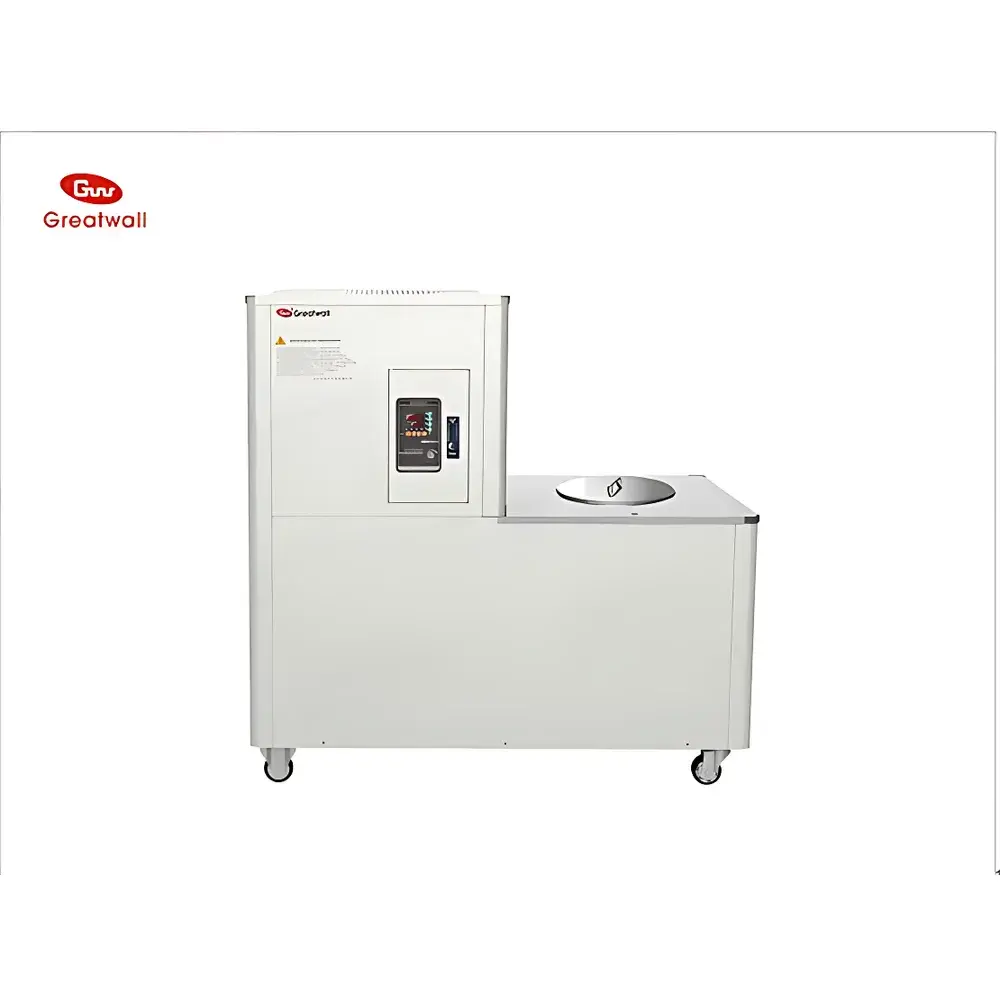
Zhengzhou Great Wall Scientific Industrial & Trading Co., Ltd. DHJF-1250 Ultra-Low-Temperature Circulating Cooling Bath
| Brand | The Great Wall |
|---|---|
| Origin | Henan, China |
| Manufacturer Type | OEM Manufacturer |
| Country of Origin | China |
| Model | DHJF-1250 |
| Quotation | Upon Request |
| Refrigerant | Mixed Cryogenic Refrigerant |
| Temperature Range | −120 °C to −60 °C |
| Temperature Stability | ±2 °C |
| Bath Volume | 50 L |
| Refrigeration Capacity | 700 W at −60 °C / 580 W at −80 °C / 420 W at −100 °C / 125 W at −120 °C |
| Circulation Pump Power | 100 W |
| Flow Rate | 20 L/min |
| Max. Pressure | 0.4 bar |
| Display Resolution | 0.1 °C |
| Power Supply | 3-phase, 380 V, 50 Hz |
| Dimensions (W×D×H) | 1340 × 820 × 1310 mm |
| Weight | 265 kg |
| Bath Material | 304 Stainless Steel |
| Max. Flask Capacity | 20,000 mL |
| Ambient Operating Conditions | 5–35 °C, ≤70% RH |
| Safety Protections | Phase sequence, overcurrent, overheat, and delayed startup protection |
| Note | External circulation must be disabled when bath temperature < −90 °C |
Overview
The Zhengzhou Great Wall Scientific Industrial & Trading Co., Ltd. DHJF-1250 Ultra-Low-Temperature Circulating Cooling Bath is an engineered solution for sustained, stable cryogenic thermal control in laboratory-scale reaction systems. Designed for applications requiring precise low-temperature environments—such as organometallic synthesis, lithium battery electrolyte testing, low-T superconductivity studies, and cryo-precipitation protocols—the DHJF-1250 integrates a single-stage compression cascade refrigeration architecture with proprietary series-connected heat exchangers. Unlike conventional two-stage or mechanical booster systems, this configuration leverages optimized phase separation within a single compressor loop to achieve −120 °C without liquid nitrogen dependency. The system employs a hermetically sealed Panasonic scroll compressor with internal thermal overload protection, ensuring long-term operational integrity under continuous duty cycles. Heat rejection occurs via an air-cooled finned-tube condenser fabricated from oxygen-free copper with enhanced surface geometry, delivering high heat transfer coefficients and reduced fouling susceptibility. The evaporator is a coil-type design fully immersed in the 304 stainless steel reservoir—engineered to withstand thermal shock and mechanical stress even during localized freezing of the heat transfer fluid.
Key Features
- Single-compressor cascade refrigeration architecture enabling −120 °C operation without external cryogens
- Oxygen-free copper spiral-tube condenser with proprietary expansion-brazing technology for uniform thermal distribution and serviceability
- Immersed coil evaporator housed directly within the 50 L 304 stainless steel bath tank—resistant to embrittlement and ice-induced deformation
- Low-temperature-compatible canned motor circulation pump (100 W), rated for continuous operation down to −120 °C with flow stability up to 20 L/min at 0.4 bar
- Digital PID controller with 0.1 °C display resolution, real-time temperature logging capability, and configurable alarm thresholds
- Comprehensive safety suite including phase-sequence monitoring, overcurrent cutoff, thermal cutout with hysteresis, and timed startup delay to prevent compressor short-cycling
- Full-welded refrigerant circuitry minimizing leak points; uses non-ozone-depleting mixed refrigerant compliant with current ASHRAE 34 classification standards
Sample Compatibility & Compliance
The DHJF-1250 accommodates standard laboratory glassware up to 20 L capacity via its 400 mm-diameter open bath aperture. All wetted components—including circulation tubing, pump housing, and bath liner—are constructed from ASTM A240 304 stainless steel, offering resistance to common organic solvents (e.g., THF, diethyl ether, hexane) and low-temperature brines (e.g., ethylene glycol/water, ethanol/dry ice slurries). The unit meets IEC 61000-6-2 (immunity) and IEC 61000-6-4 (emissions) electromagnetic compatibility requirements. While not certified to UL/CSA standards out-of-box, its electrical architecture complies with EN 61010-1:2010 safety principles for laboratory equipment. For GLP/GMP-aligned workflows, optional RS485 Modbus RTU interface enables integration into centralized environmental monitoring systems with audit-trail-capable data acquisition.
Software & Data Management
The embedded controller supports local parameter configuration via membrane keypad and backlit LCD. Temperature setpoints, ramp rates, hold durations, and safety limits are programmable and retained after power loss. Optional analog (4–20 mA) and digital (RS485) outputs allow connection to third-party SCADA platforms or LIMS. When interfaced with validated data acquisition software compliant with FDA 21 CFR Part 11 (e.g., LabVIEW-based custom modules or Eurotherm iTools), the system supports electronic signatures, user access levels, and immutable timestamped event logs—including compressor runtime, fault codes, and temperature deviation alerts. No cloud connectivity or proprietary firmware updates are included; all firmware revisions are distributed via secure USB load files verified by SHA-256 checksums.
Applications
- Low-temperature catalytic hydrogenation and asymmetric epoxidation requiring thermal stability below −100 °C
- Electrolyte formulation testing for solid-state batteries under sub-glass transition conditions
- Cryo-trapping of reactive intermediates (e.g., benzyne, diazo compounds) for subsequent spectroscopic characterization
- Calibration of cryogenic sensors and thermocouples per ISO/IEC 17025 traceable protocols
- Controlled crystallization of high-purity pharmaceutical actives where polymorph selection is temperature-dependent
- Material science studies involving thermal contraction behavior of composites and amorphous polymers
FAQ
Can external circulation be used at −110 °C?
No. As specified in the operating manual, external circulation must be disabled whenever the bath temperature falls below −90 °C to prevent pump cavitation, seal failure, and refrigerant migration issues.
What heat transfer fluids are compatible with the DHJF-1250 at −120 °C?
Only fully synthetic low-temperature silicone oils (e.g., DC-704, AP-100) or specialized perfluoropolyether (PFPE) fluids meeting ASTM D4684 viscosity stability requirements are recommended. Ethanol or methanol mixtures are prohibited due to vapor pressure and flammability risks.
Is the unit suitable for cleanroom installation?
Yes—provided ambient particulate and humidity controls meet ISO 14644-1 Class 8 specifications. The air-cooled condenser requires ≥500 mm unobstructed clearance on all sides for adequate airflow and thermal dissipation.
Does the system support remote monitoring via Ethernet or Wi-Fi?
No native Ethernet or Wi-Fi interface is provided. Remote supervision requires integration via RS485-to-Ethernet gateway devices configured in Modbus RTU master-slave topology.
What maintenance intervals are recommended for the scroll compressor?
Compressor oil analysis and filter replacement are advised every 3,000 hours of cumulative runtime or biannually—whichever occurs first—using only OEM-specified polyolester (POE) lubricant conforming to ISO-L-CKG standards.



