
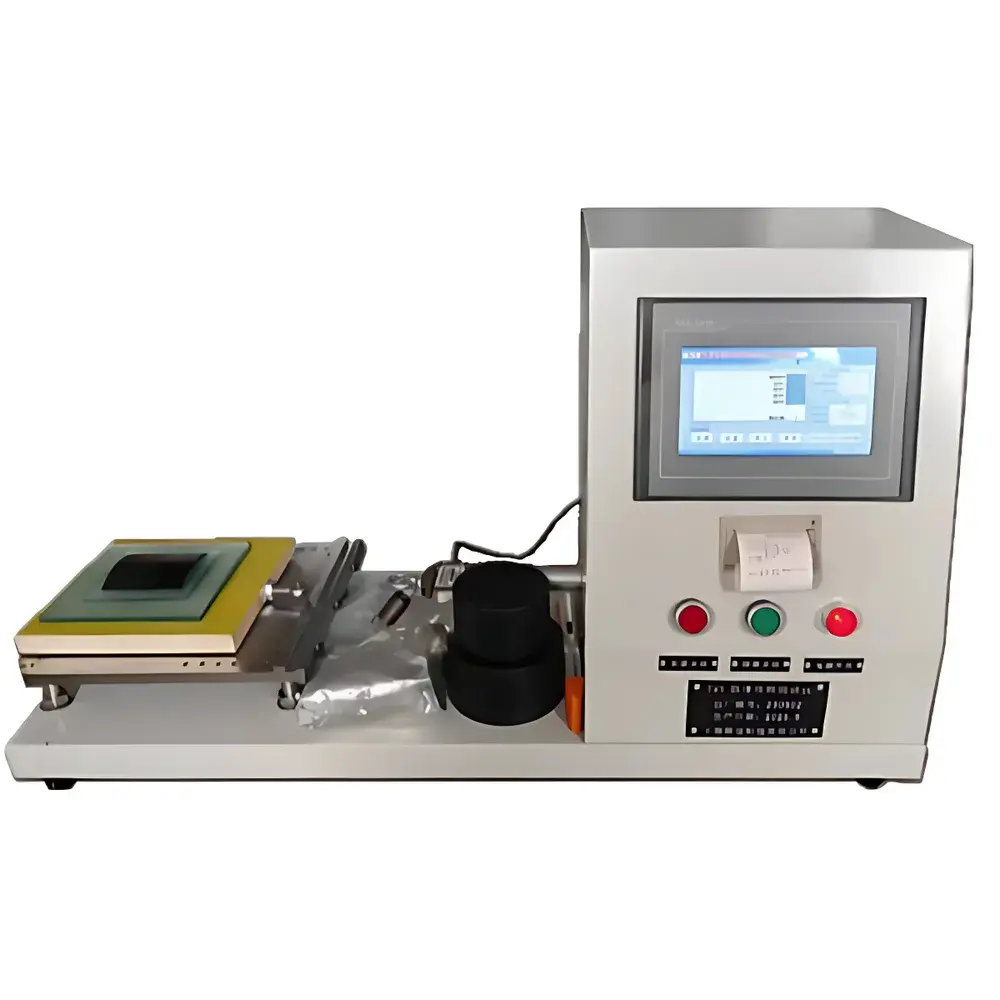
ZHENHUAFENXI DMY Static Coefficient of Friction Tester for Ceramic Tiles
| Brand | ZHENHUAFENXI |
|---|---|
| Origin | Hunan, China |
| Manufacturer Type | General Distributor |
| Country of Origin | Domestic (China) |
| Model | DMY |
| Pricing | Upon Request |
| Measuring Range | 0–490 N |
| Force Accuracy | ±0.3% F.S. |
| Force Display Resolution | 0.1 N |
| Display | 4-digit LED, unit selectable (N) |
| Sample Size | Three specimens, each 100 mm × 100 mm |
| Measurement Method | Static Sliding Block Method (per GB/T 4100–2015 & JC/T 1050–2007) |
| Automatic � | ₛ Calculation: Yes |
Overview
The ZHENHUAFENXI DMY Static Coefficient of Friction Tester is a dedicated physical property testing instrument engineered for the precise and repeatable determination of the static coefficient of friction (μs) on ceramic tile surfaces—both glazed and unglazed—as specified in GB/T 4100–2015 and JC/T 1050–2007. It operates on the fundamental principle of the static sliding block method: a standardized rubber slider (typically ASTM D2047 or ISO 8770 compliant) is placed on the conditioned tile surface and subjected to a gradually increasing horizontal pull force until motion initiates. The peak force recorded at the onset of slip is used to compute μs = Fmax/N, where N is the normal force exerted by the slider’s mass (typically 1.0 kg, yielding ~9.81 N). This method directly reflects the resistance to initial foot-slip under dry or wet conditions, making it essential for evaluating pedestrian safety performance in architectural flooring applications.
Key Features
- Integrated microprocessor-based force controller with real-time load monitoring and automatic μs calculation
- High-precision tension sensor with full-scale range of 0–490 N and accuracy of ±0.3% F.S., traceable to national metrological standards
- Four-digit LED display showing both instantaneous pull force (in N, resolution 0.1 N) and calculated static friction coefficient (μs, resolution 0.001)
- Dual-mode operation: manual initiation and programmable auto-hold function for consistent dwell time prior to pull initiation
- Modular test platform accommodating three standardized 100 mm × 100 mm tile specimens per test sequence, supporting statistical evaluation per ISO 5725–2
- Robust mechanical architecture with low-friction linear guide rails and calibrated mass loading system to ensure minimal parasitic torque and axial alignment fidelity
Sample Compatibility & Compliance
The DMY tester is validated for use with ceramic floor tiles conforming to GB/T 4100–2015 (equivalent to ISO 13006), including porcelain stoneware, fine ceramics, and non-vitreous types. It supports both dry and wet testing protocols when used with standardized conditioning procedures (e.g., water immersion per JC/T 1050–2007 Annex A). The instrument meets the mechanical and procedural requirements of ASTM C1028 (Standard Test Method for Determining the Static Coefficient of Friction of Ceramic Tile and Other Like Surfaces by the Horizontal Dynamometer Pull-Meter Method) and aligns with EN 1341:2012 (Paving flags – Requirements and test methods) for static friction assessment. While not certified to ISO/IEC 17025, its measurement chain is designed to support GLP-compliant data recording when integrated with external audit-trail-capable software.
Software & Data Management
The DMY operates as a standalone instrument with embedded firmware; no proprietary PC software is required for basic operation. However, its RS-232 serial interface enables direct data export to laboratory information management systems (LIMS) or Excel-compatible spreadsheets via standard terminal emulation. All test records—including timestamp, specimen ID, force curve peak value, computed μs, operator ID, and environmental notes (e.g., “wet condition, 23°C/50% RH”)—are stored internally for up to 200 test cycles. For regulated environments (e.g., third-party certification labs), optional USB-to-serial adapters and CSV loggers can be deployed to satisfy FDA 21 CFR Part 11 requirements for electronic record integrity, provided user-defined access controls and audit trails are implemented at the host system level.
Applications
- Quality assurance testing of ceramic tile batches during manufacturing and incoming inspection
- Comparative evaluation of anti-slip surface treatments (e.g., acid etching, nano-coatings, textured glazes)
- Research and development of high-friction tile formulations for commercial kitchens, hospitals, and public transit facilities
- Compliance verification for CE marking (under Construction Products Regulation EU No. 305/2011) and ANSI A137.1 certification
- Supporting due diligence documentation for LEED v4.1 MR Credit: Building Product Disclosure and Optimization – Sourcing of Raw Materials
- Custom test method development aligned with ASTM WK77211 (proposed revision to C1028 for dynamic friction correlation)
FAQ
What standards does the DMY tester comply with?
It is fully aligned with GB/T 4100–2015, JC/T 1050–2007, and technically compatible with ASTM C1028 and EN 1341 static friction test protocols.
Can the instrument measure dynamic (kinetic) coefficient of friction?
No—the DMY is specifically configured for static friction measurement using the sliding block initiation method; kinetic friction requires continuous velocity-controlled shear, which is outside its design scope.
Is calibration documentation included with shipment?
Yes—a factory calibration certificate traceable to China National Institute of Metrology (CNIM) is supplied, covering force sensor linearity, zero stability, and repeatability across the 0–490 N range.
What environmental conditions are recommended during testing?
Per GB/T 4100–2015, tests shall be conducted at (23 ± 2)°C and (50 ± 5)% relative humidity, with specimens conditioned for ≥24 h prior to measurement.
How is the rubber slider maintained for consistent results?
The standard slider (durometer 50 ± 5 Shore A, dimensions per ASTM D2047) must be cleaned with isopropyl alcohol before each test series and replaced after 100 test cycles or visible wear to ensure surface geometry and compliance remain within specification.



