
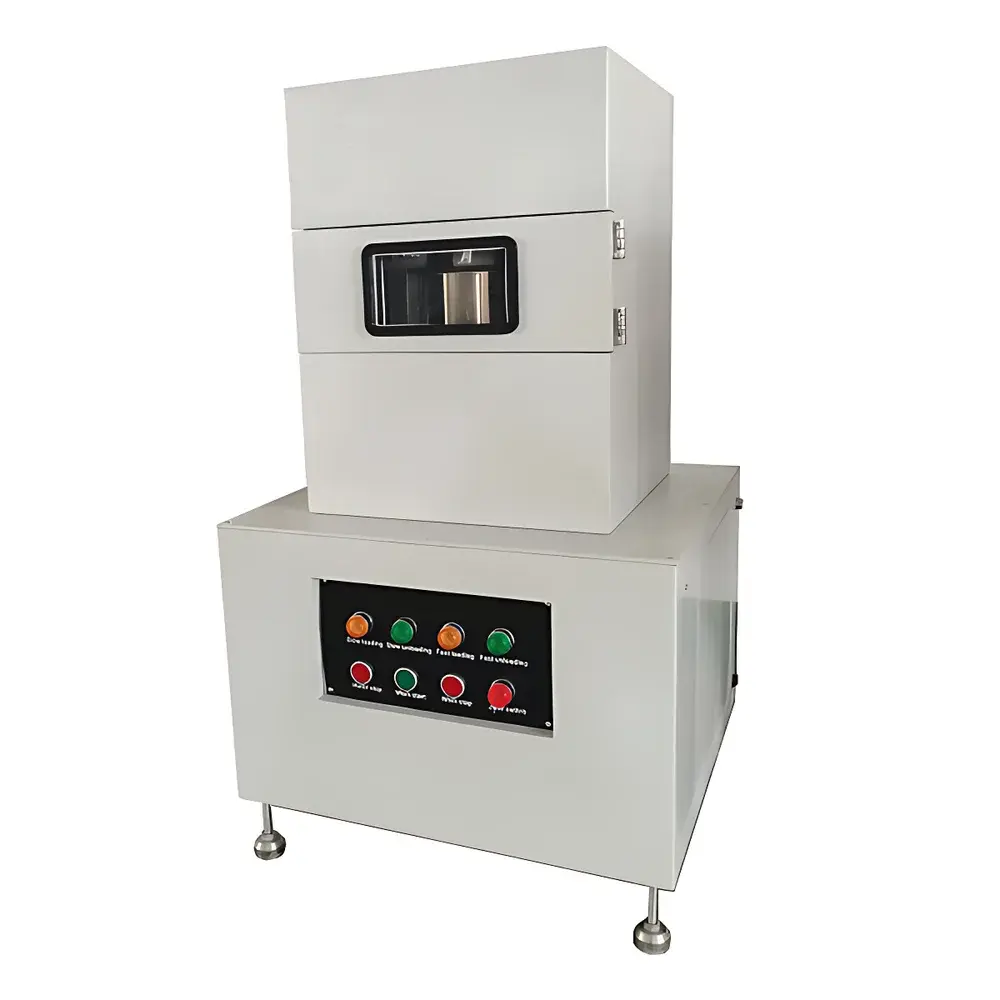
ZHENHUAFENXI DRX-II Thermal Conductivity Analyzer (Heat Flow Method)
| Brand | ZHENHUAFENXI |
|---|---|
| Origin | Hunan, China |
| Manufacturer Type | Authorized Distributor |
| Country of Origin | China |
| Model | DRX-II |
| Instrument Type | Heat Flow Method |
| Sample Capacity | Single sample per test |
| Test Environment | Ambient pressure |
| Thermal Conductivity Range | 0.015–50 W/(m·K) |
| Accuracy | ±3% |
| Repeatability | ±2% |
| Dimensions (L×W×H) | 550×500×850 mm |
| Temperature Range | RT to 200 °C |
| Sample Form | Solid (rigid or flexible sheets, discs, composites) |
| Standards Compliance | ASTM E1530, ASTM C518, ISO 8301, JIS A1412, DIN EN 12939, DIN EN 13163, DIN EN 12667, MIL-I-49456A |
| Software | Integrated automated thermal analysis platform with calibration management, temperature ramp programming, and GLP-compliant reporting |
Overview
The ZHENHUAFENXI DRX-II Thermal Conductivity Analyzer is a precision heat flow method instrument engineered for the steady-state measurement of thermal conductivity (λ), thermal resistance (R), and related thermophysical properties—including thermal diffusivity (α) and specific heat capacity (cp)—of solid and semi-rigid materials. Based on Fourier’s law of heat conduction, the system applies a controlled unidirectional temperature gradient across a planar sample sandwiched between two guarded hot plates and measures the resulting heat flux via calibrated heat flow sensors. This architecture ensures high reproducibility under defined boundary conditions and eliminates convective interference through rigorous plate parallelism control and ambient-pressure operation. Designed for laboratories requiring traceable, standards-aligned data, the DRX-II delivers quantitative results compliant with internationally recognized test protocols for insulating and moderately conductive materials.
Key Features
- Automated dual-plate positioning with motorized upper platen movement and integrated thickness measurement—enabling real-time correction for sample compression and contact resistance.
- Programmable temperature control system supporting up to 10 user-defined setpoints; configurable average temperature ranges include RT–100 °C, –30 °C to 90 °C, and –20 °C to 70 °C (optional cooling modules: forced-air, external water bath, or liquid nitrogen).
- High-resolution thermal sensing: temperature resolution of 0.01 °C; thermal resistance range: 0.1–8.0 m²·K/W.
- Flexible sample accommodation: accepts circular specimens from Ø10 mm to Ø30 mm and thicknesses from 0.02 mm to 50 mm (custom configurations available upon order specification).
- Embedded controller with optional PC-based interface; full operational sequence—from baseline stabilization to final report generation—is executed without manual intervention.
- Comprehensive calibration suite including reference material validation routines, drift compensation algorithms, and sensor response mapping across the operational temperature domain.
Sample Compatibility & Compliance
The DRX-II is optimized for rigid and semi-flexible solids including polymers, ceramics, composites, glass, elastomers, and metallic foils with thermal conductivity values spanning 0.015–50 W/(m·K). Thin films are measurable using multi-layer stacking techniques with interfacial resistance correction. Paste-like or low-viscosity materials may be evaluated in sealed, thermally stable containment cells designed to maintain dimensional integrity during testing. All measurements adhere strictly to the physical assumptions underlying ASTM C518 (Standard Test Method for Steady-State Thermal Transmission Properties by Means of the Heat Flow Meter Apparatus), ISO 8301 (Thermal insulation — Determination of steady-state thermal resistance and related properties — Heat flow meter apparatus), and DIN EN 12667 (Thermal performance of building materials and products — Determination of thermal resistance by means of guarded hot plate and heat flow meter methods). The system supports audit-ready documentation aligned with GLP and pre-GMP quality frameworks.
Software & Data Management
The DRX-II operates with a dedicated thermal analysis software platform that provides end-to-end workflow automation: test parameter definition, real-time monitoring of thermal equilibrium convergence, automatic calculation of λ, R, α, and cp, statistical evaluation of repeatability, and exportable reports in PDF and CSV formats. Calibration records—including date, operator ID, reference standard ID, and deviation logs—are time-stamped and stored with cryptographic integrity. Audit trail functionality complies with FDA 21 CFR Part 11 requirements for electronic records and signatures when configured with user access controls and digital signature modules. Raw data files retain full metadata (sensor voltages, plate temperatures, elapsed time, ambient conditions) for retrospective reprocessing or third-party verification.
Applications
This instrument serves quality control laboratories in aerospace composites manufacturing, building insulation certification, battery thermal interface material (TIM) development, polymer R&D, and electronics packaging design. It enables comparative screening of thermal barrier coatings, validation of ceramic matrix composite homogeneity, and regulatory submission support for ASTM E1530-compliant electrical insulation qualification. In academic settings, it supports fundamental studies on phonon transport mechanisms in nanostructured polymers and phase-change material behavior under quasi-steady-state conditions. Its compact footprint and minimal sample volume requirement (as low as 0.2 cm³ for Ø15 mm × 0.5 mm discs) make it suitable for resource-constrained labs conducting high-throughput screening.
FAQ
What standards does the DRX-II comply with for thermal conductivity measurement?
ASTM C518, ASTM E1530, ISO 8301, JIS A1412, DIN EN 12939, DIN EN 13163, DIN EN 12667, and MIL-I-49456A.
Can the DRX-II measure liquids or powders?
Not directly—but pastes, gels, and low-viscosity fluids may be tested using purpose-designed containment cells that preserve planar geometry and minimize lateral heat loss.
Is the system capable of GLP-compliant reporting?
Yes, when equipped with user authentication, electronic signature, and audit trail modules, the software meets core GLP documentation requirements for regulated environments.
What is the minimum required sample thickness?
0.02 mm for thin films; however, optimal accuracy is achieved at ≥0.5 mm for most solid polymers and ceramics.
Does the DRX-II support variable temperature gradients?
Yes—the system allows both fixed and programmable temperature differentials across the sample, enabling thermal resistance profiling over multiple ΔT steps within a single run.



