
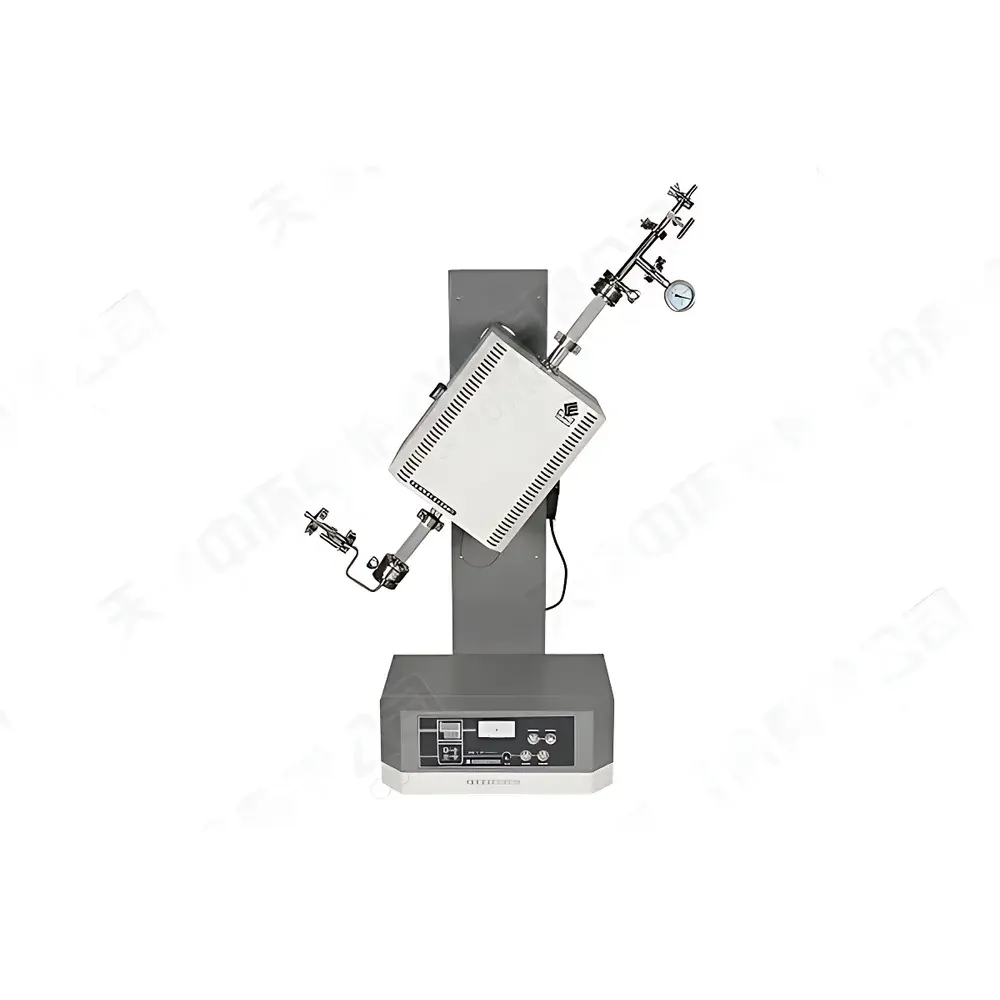
ZHK Series Multi-Station Vacuum & Atmosphere Tube Furnace (1200 °C) by Zhonghuan Furnace
| Brand | Zhonghuan Furnace |
|---|---|
| Origin | Tianjin, China |
| Model | ZHK-03123K-D / ZHK-04123K-D |
| Max Temperature | 1200 °C |
| Control Accuracy | ±1 °C |
| Rated Power | 1.2 kW |
| Heating Rate | 0–1000 °C ≤10 °C/min |
| Chamber Dimensions | 310 × 310 × 310 mm (L×W×H) |
| Heating Zone Length | 200 mm |
| Uniform Temperature Zone | 100 mm |
| Heating Element | OCr27Al7Mo2 high-resistance alloy wire |
| Tube Material | Fused quartz (Φ30/24×700 mm or Φ40/34×700 mm) |
| Tube Max Operating Temp | <1200 °C |
| Weight | 75 kg |
| Voltage | 220 V AC |
| Programmable Stages | 50 (domestic controller) / 40 (imported controller) |
| Communication Interface | RS-485 (optional PC software integration for up to 200 units) |
Overview
The ZHK Series Multi-Station Vacuum & Atmosphere Tube Furnace (1200 °C) is a precision-engineered laboratory furnace designed for controlled thermal processing under vacuum, inert, reducing, or reactive gas atmospheres. Built upon a robust dual-zone modular architecture, it integrates horizontal and vertical multi-position operation with programmable temperature profiling, enabling reproducible heat treatment, sintering, annealing, and calcination protocols across materials science, catalysis, battery R&D, and ceramic synthesis workflows. Its core thermal design employs high-purity fused quartz tubes sealed via double-ring flange technology, ensuring leak-tight integrity down to 10−3 mbar when paired with optional vacuum systems. The furnace operates on resistive heating via OCr27Al7Mo2 alloy wire embedded in a multi-crystalline mullite fiber insulation matrix—delivering rapid thermal response (<15 min to 1200 °C in empty chamber), exceptional energy efficiency (≈50% reduction vs. traditional refractory linings), and a uniform temperature zone of 100 mm at ±1 °C stability.
Key Features
- Multi-station positional flexibility: motorized lift-and-rotate mechanism supports horizontal, vertical, and inclined (0°–45°–90°) tube orientations—enabling simultaneous or sequential processing across multiple sample zones without manual reconfiguration.
- Modular split-controller design: detachable PID-based temperature controller increases vertical workspace clearance, facilitating seamless insertion and extraction of long quartz tubes (up to 700 mm).
- Quick-connect gas manifold: standardized VCR-style flanged interface with single-clamp coupling eliminates complex bolted assembly—reducing installation time and mitigating mechanical stress-induced tube fracture.
- Dual-loop safety architecture: includes automatic power cutoff upon furnace door opening, independent over-temperature cutout (hardware-limited at 1250 °C), and ground-fault circuit interruption (GFCI) compliant with IEC 61000-4-5 surge immunity standards.
- Intelligent thermal management: ambient-sensing fan activation triggers at surface temperature ≥50 °C, maintaining external casing below 60 °C during continuous 1200 °C operation per ISO 13732-1 ergonomic safety guidelines.
- RS-485 communication port: supports Modbus RTU protocol for integration into centralized lab automation networks—enabling remote monitoring, real-time data logging, audit-trail generation, and compliance with FDA 21 CFR Part 11 requirements when used with validated software.
Sample Compatibility & Compliance
The ZHK furnace accommodates standard cylindrical quartz tubes (Φ30/24×700 mm or Φ40/34×700 mm) rated for continuous operation below 1200 °C. Its sealed atmosphere capability meets ASTM E2922–22 (Standard Practice for Determining Leak Rates of Vacuum Systems) and ISO 20482:2021 (Vacuum Technology — Vocabulary). When equipped with mass flow controllers (MFCs) and vacuum pumps, it supports experiments compliant with USP (Thermal Analysis), ISO 11358 (Thermogravimetric Analysis), and GLP/GMP Annex 11 (Computerized Systems) frameworks. The furnace’s Class II electrical safety rating (IEC 61010-1) and CE marking confirm conformity with EU Machinery Directive 2006/42/EC and Low Voltage Directive 2014/35/EU.
Software & Data Management
The integrated RS-485 interface enables bidirectional communication with optional PC-based control software supporting Windows OS. Users can define up to 50 ramp-hold segments (domestic controller) or 40 segments (imported controller), with adjustable dwell times, rate limits, and event-triggered outputs (e.g., gas valve actuation at specific temperatures). Software features include real-time temperature graphing, exportable CSV/TXT logs with timestamps, password-protected user profiles, and electronic signature support for 21 CFR Part 11-compliant record retention. Batch-level metadata tagging (sample ID, operator, date/time, atmospheric conditions) ensures traceability across multi-furnace deployments.
Applications
- Solid-state synthesis of Li-ion cathode precursors (e.g., NMC, LFP) under argon or nitrogen atmospheres.
- Controlled oxidation/reduction of transition metal oxides for catalyst development (e.g., Co3O4 → CoO).
- Graphitization and annealing of carbon nanomaterials under vacuum or forming gas (N2/H2).
- Thermal gravimetric analysis (TGA) pre-conditioning of polymer composites prior to DSC testing.
- Low-pressure chemical vapor deposition (LPCVD) precursor decomposition studies.
- High-temperature aging tests for electronic packaging materials per JEDEC JESD22-A108F.
FAQ
What vacuum level can be achieved with the standard configuration?
The base system achieves ≤10−1 mbar with the included mechanical vacuum gauge; adding a turbomolecular pump enables high-vacuum operation down to 10−5 mbar.
Is the quartz tube included in the standard package?
Yes—one fused quartz tube (choice of Φ30/24×700 mm or Φ40/34×700 mm) and one pair of high-temperature insulated gloves are supplied as standard.
Can this furnace be integrated into an existing SCADA or LIMS environment?
Yes—via RS-485 Modbus RTU, it supports third-party SCADA drivers (e.g., Ignition, Siemens SIMATIC WinCC) and LIMS middleware with appropriate OPC UA translation layers.
Does the furnace meet electromagnetic compatibility (EMC) requirements for laboratory use?
Yes—it complies with EN 61326-1:2013 for laboratory equipment, including radiated/conducted emission limits (EN 55011) and electrostatic discharge immunity (IEC 61000-4-2 Level 3).
What maintenance intervals are recommended for long-term reliability?
Inspect quartz tube integrity and flange gaskets every 200 operating hours; recalibrate thermocouple input annually using NIST-traceable reference sources per ISO/IEC 17025 calibration procedures.



