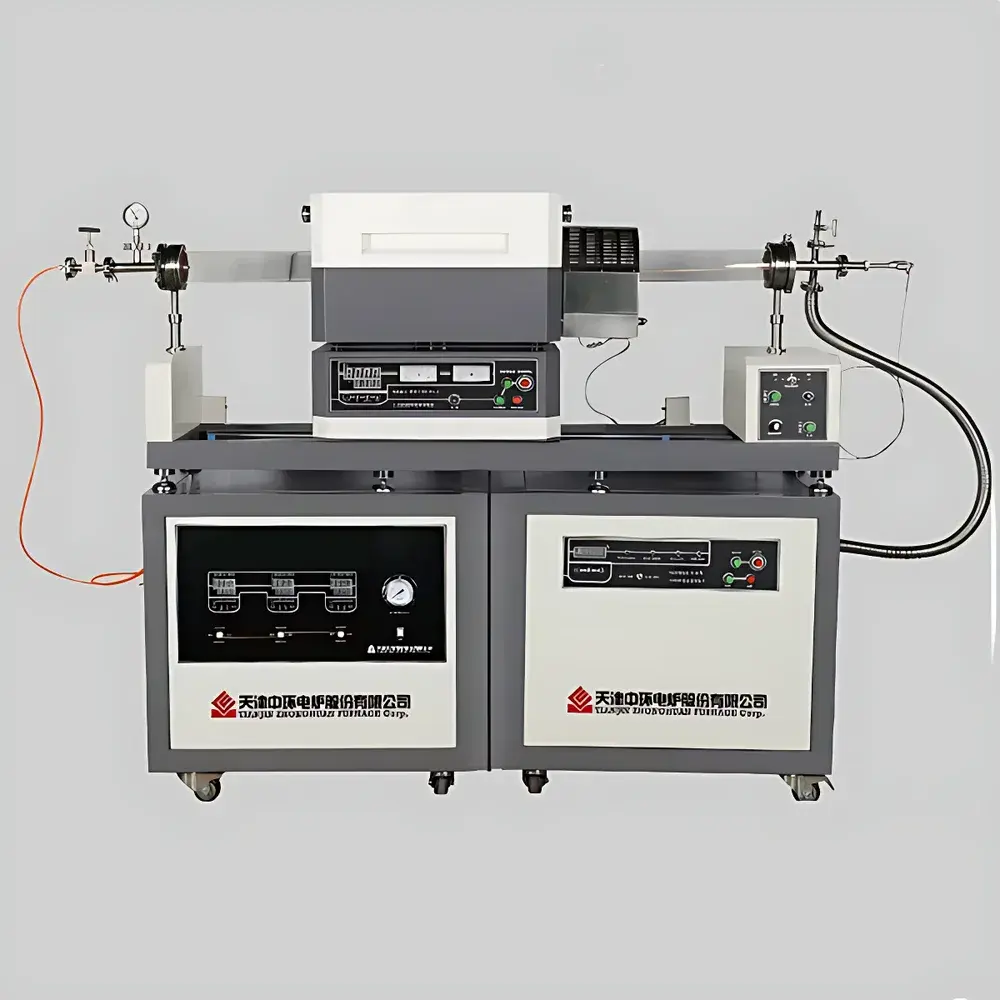
Zhonghuan Furnace 1200°C Sliding-Stage Chemical Vapor Deposition System
| Brand | Zhonghuan Furnace |
|---|---|
| Origin | Tianjin, China |
| Model | 1200°C Sliding-Stage CVD System |
| Heating Zone | Single or Multi-Zone Optional |
| Max Operating Temperature | 1200°C |
| Sliding Mechanism | Manual or Motorized with Position Limit Switches |
| Cooling Method | Integrated Forced-Air Quenching System |
| Gas Control | Multi-Channel Mass Flow Controller (MFC) System |
| Vacuum Capability | Medium-Vacuum (10⁻¹–10⁻³ Pa) or High-Vacuum (≤5×10⁻⁵ Pa) Configurable |
| Temperature Control Algorithm | Fuzzy PID Programmable Logic Controller |
| Vacuum Interface | Custom Quick-Connect Flange Assembly |
| Compliance | Designed for ISO/IEC 17025-aligned lab environments |
Overview
The Zhonghuan Furnace 1200°C Sliding-Stage Chemical Vapor Deposition System is a purpose-engineered platform for controlled thin-film synthesis and thermal processing under reactive or inert atmospheres. Built upon a robust open-ended tube furnace architecture, the system integrates precise temperature regulation, programmable mechanical translation, and modular gas/vacuum management to support reproducible CVD processes—including silicon carbide (SiC) epitaxial growth, ZnO nanowire array fabrication, ceramic substrate metallization, and atmosphere-controlled sintering of multilayer ceramic capacitors (MLCCs). Its core operational principle relies on thermally activated surface reactions between gaseous precursors—delivered via calibrated mass flow controllers—and heated substrates within a quartz or alumina reaction tube. The sliding-stage design enables rapid thermal quenching by physically removing the hot zone from the sample after process completion, eliminating reliance solely on passive cooling and significantly reducing cycle time while preserving microstructural integrity.
Key Features
- High-stability 1200°C open-ended tube furnace with optional single- or multi-zone heating configuration for axial thermal gradient control.
- Motorized or manual sliding stage with integrated position-limit switches and programmable translation speed (0.1–20 mm/s), ensuring repeatable sample insertion/extraction without mechanical impact.
- Fuzzy PID temperature controller delivering ±1°C setpoint stability over full operating range, minimal thermal overshoot, and low thermal inertia response—critical for ramp-hold-cool CVD cycles.
- Modular vacuum subsystem: medium-vacuum option includes automatic pressure band control (10⁻¹–10⁻³ Pa); high-vacuum variant employs oil-free turbo-molecular pumping with overpressure protection circuitry to prevent pump damage during accidental air ingress.
- Multi-channel MFC gas delivery system (up to 4 independent lines) with digital interface, enabling precise stoichiometric precursor mixing (e.g., SiH₄ + C₃H₈ for SiC; Zn(C₂H₅)₂ + H₂O for ZnO).
- Quick-connect flange assembly engineered for leak-tight, tool-free gas line attachment—reducing setup time and minimizing cross-contamination risk between experiments.
- Forced-air quenching module mounted adjacent to exit port, capable of achieving >100°C/s cooling rates for metastable phase retention and stress management in oxide and nitride films.
Sample Compatibility & Compliance
The system accommodates standard 25–100 mm OD quartz or high-purity alumina tubes and supports substrates up to 50 mm in diameter, including Si wafers, sapphire, SiC wafers, ceramic green tapes, and conductive oxide-coated glass. All wetted components comply with ASTM F2627-21 (Standard Specification for High-Purity Quartz for Semiconductor Applications) and meet material compatibility requirements for halogenated and oxygen-rich precursors. Vacuum and gas-handling subsystems are designed for traceability under GLP and pre-GMP laboratory practices; optional audit-trail logging (via RS485/Modbus interface) supports alignment with FDA 21 CFR Part 11 data integrity expectations when integrated with validated LIMS or ELN platforms.
Software & Data Management
Temperature and motion profiles are programmed via embedded 7-inch TFT touchscreen HMI with non-volatile memory for ≥100 user-defined recipes. Real-time data—including furnace zone temperatures, chamber pressure, MFC setpoints/actuals, and stage position—is logged at 1 Hz resolution and exportable as CSV. Optional Ethernet-enabled PLC integration allows remote monitoring and script-based automation using Python or LabVIEW. All system events—including door interlock status, overtemperature alarms, vacuum fault codes, and motion limit triggers—are timestamped and stored with configurable retention (default: 30 days), satisfying minimum record-keeping requirements per ISO/IEC 17025 Clause 7.5.2.
Applications
- Growth of wide-bandgap semiconductor thin films (SiC, GaN, AlN) via low-pressure CVD (LPCVD) or atmospheric-pressure CVD (APCVD).
- Controlled synthesis of 1D metal oxide nanostructures (ZnO, SnO₂, In₂O₃) for gas sensing and optoelectronic device prototyping.
- Atmosphere-specific sintering and annealing of MLCC stacks under N₂/H₂ or O₂/N₂ mixtures to optimize dielectric constant and aging behavior.
- Rapid thermal processing (RTP)-adjacent protocols for dopant activation, silicide formation, and interfacial layer engineering on Si and SOI substrates.
- Vacuum-assisted carburizing/nitriding of ceramic substrates for enhanced surface conductivity and wear resistance.
FAQ
What vacuum level is achievable with the high-vacuum configuration?
The high-vacuum option achieves base pressures ≤5×10⁻⁵ Pa using a magnetically levitated turbo-molecular pump with integrated foreline trap and auto-shutdown logic.
Can the system be upgraded from manual to motorized sliding post-purchase?
Yes—motorized slide kits including stepper motor, linear guide rail, limit switches, and controller firmware are available as field-installable retrofits.
Is the furnace tube included, and what materials are supported?
A standard 1000 mm × 60 mm OD fused quartz tube is supplied; high-temp alumina or recrystallized alumina tubes can be specified for oxidizing or halogen-rich chemistries.
Does the system support inert gas purging prior to vacuum evacuation?
Yes—the MFC system includes dedicated purge lines and programmable gas-switch sequences to enable inert gas pre-fill (e.g., Ar or N₂) before pump-down, minimizing oxidation during cool-down.
What safety certifications does the system meet?
Electrical design complies with IEC 61000-6-2/6-4 EMC standards and UL 61010-1 (3rd Ed.) for laboratory equipment; CE marking is provided for EU shipment.