
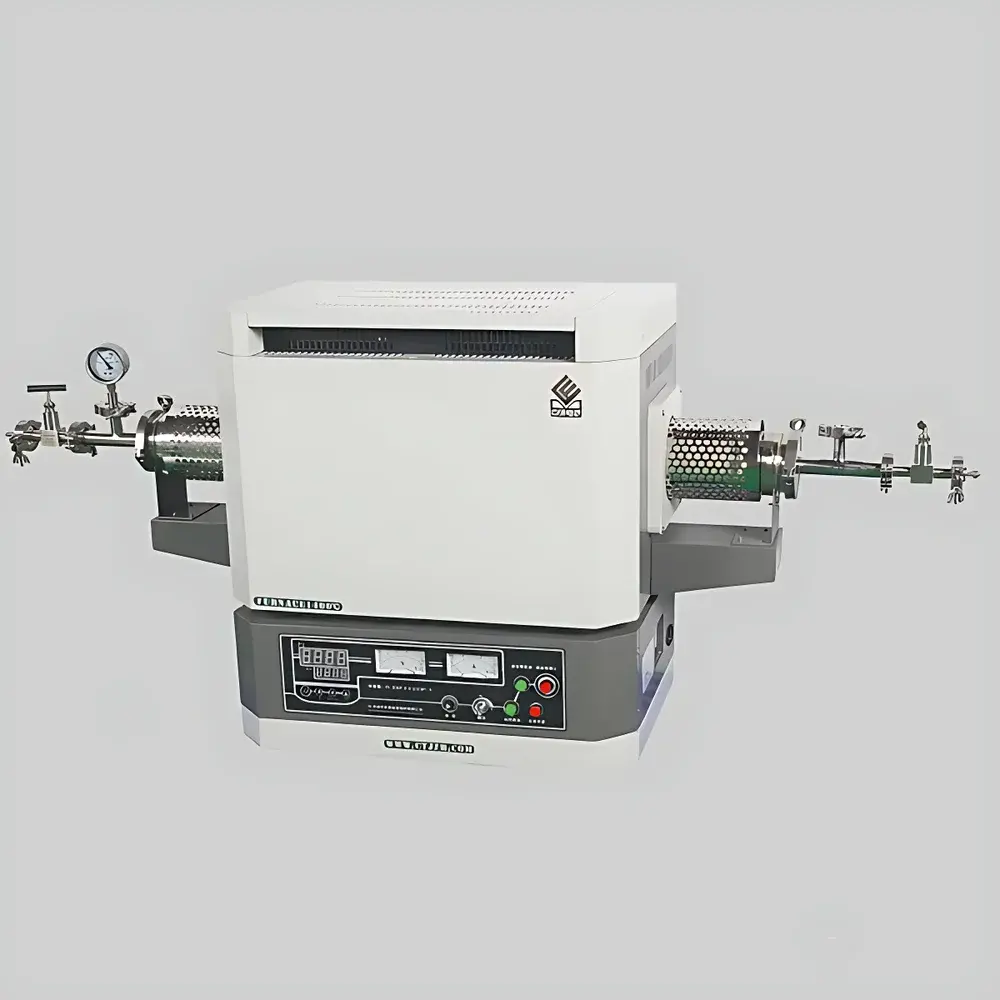
ZHONGHUAN FURNACE 1400°C Single-Zone Horizontal Tube Furnace
| Brand | ZHONGHUAN FURNACE |
|---|---|
| Origin | Tianjin, China |
| Model | 1400°C Single-Zone Tube Furnace |
| Max Temperature | 1400°C |
| Temperature Control Accuracy | ±1°C |
| Max Power | 5 kW |
| Heating Rate (to max temp) | ≤5°C/min (≤500°C), ≤10°C/min (500–800°C), ≤5°C/min (800–1000°C), ≤3°C/min (1000–1200°C), ≤2°C/min (1200–1400°C) |
| Heating Element | Silicon Carbide (SiC) Rods |
| Internal Chamber Dimensions | 600 × 660 × 1260 mm (L×W×H) |
| Heating Method | Resistive (SiC rods) |
| Sealing | Dual-ring flange system with adjustable gas inlet/outlet |
| Safety Features | Automatic power cutoff upon door opening, over-temperature cut-off with audible alarm, earth-leakage protection |
| Control System | AI-based PID controller with auto-tuning, programmable ramp/soak profiles (50 segments standard, 40 segments with optional imported controller) |
| Communication Interface | RS-485 for PC connectivity and multi-furnace networked control (up to 200 units) |
| Optional Accessories | Vacuum pumping system (low/medium/high vacuum), mass flow controllers (MFCs) or rotameters for precise gas atmosphere control |
Overview
The ZHONGHUAN FURNACE 1400°C Single-Zone Horizontal Tube Furnace is a precision-engineered thermal processing instrument designed for controlled-atmosphere and vacuum-based high-temperature synthesis, annealing, sintering, and heat treatment in research and development laboratories. It operates on resistive heating via high-purity silicon carbide (SiC) heating elements rated for continuous service up to 1500°C surface temperature, enabling stable and uniform thermal fields within the horizontal quartz or ceramic tube chamber. The furnace features a single-zone temperature profile optimized for reproducible thermal cycles across its full 1400°C operating range, with ±1°C steady-state control accuracy—critical for process-critical applications in semiconductor fabrication, nanomaterial synthesis (e.g., CNT growth, graphene annealing), carbon fiber stabilization, and solid-state battery cathode development. Its horizontal orientation and modular flange interface support seamless integration into inert or reactive gas lines, vacuum manifolds, and in-situ monitoring setups.
Key Features
- High-efficiency insulation using vacuum-formed polycrystalline mullite fiber lining—reducing thermal mass and energy consumption by ~50% versus traditional refractory brick designs.
- Dual-ring sealed flange assembly ensures leak-tight integrity at both ends of the tube, with independently adjustable inlet/outlet gas ports enabling precise control of gas residence time and partial pressure.
- Integrated air-cooling system with thermally triggered axial fans activates automatically when external casing surface temperature exceeds 50°C, maintaining operator safety and structural stability during prolonged high-temperature operation.
- Intelligent temperature controller with adaptive PID algorithm, fuzzy logic compensation, and self-tuning capability—supports complex multi-segment thermal profiles (50 programmable segments standard; optional 40-segment imported controller available).
- RS-485 serial interface compliant with Modbus RTU protocol enables centralized monitoring and synchronized control of up to 200 furnaces via industrial SCADA or custom LabVIEW-based software platforms.
- Fail-safe interlocks include mechanical door-open power cutoff, independent over-temperature limit controller with relay output, and residual-current circuit breaker (RCCB) for ground-fault protection.
Sample Compatibility & Compliance
The furnace accommodates cylindrical samples up to Ø60 mm × 1200 mm (or equivalent volume within 600 × 660 × 1260 mm internal cavity), compatible with fused silica, alumina, and recrystallized silicon carbide tubes. It supports ambient, inert (N₂, Ar), reducing (H₂/N₂ mixtures), oxidizing (O₂, air), and low-to-medium vacuum environments (10⁻³ to 10⁵ Pa) when paired with optional vacuum pumps and gauges. All electrical components meet IEC 61000-6-3 (EMI emission) and IEC 61000-6-2 (immunity) standards. The control architecture supports audit-ready data logging with timestamped setpoints, actual temperatures, and event flags—fully compliant with GLP documentation requirements and aligned with FDA 21 CFR Part 11 principles for electronic records when deployed with validated software.
Software & Data Management
The integrated RS-485 interface allows direct connection to Windows-based host systems running ZHONGHUAN’s proprietary FurnaceLink™ software or third-party platforms (e.g., MATLAB, Python with PyModbus). Real-time telemetry includes temperature, program stage, elapsed time, and alarm status. Historical datasets are stored in CSV or SQLite format with configurable sampling intervals (1–60 sec). Remote control functions include start/pause/resume, parameter modification, and emergency shutdown—all accessible via secure TCP/IP tunneling. Optional touchscreen HMI provides localized visualization: real-time trend curves, bar-graph thermal mapping, alarm history logs, and customizable report templates exportable as PDF or Excel.
Applications
- Synthesis of advanced ceramics and oxide-based functional materials under controlled oxygen partial pressure.
- Thermal decomposition and calcination of metal-organic frameworks (MOFs) and precursor salts for catalyst preparation.
- Graphitization and thermal reduction of graphene oxide films and carbon aerogels.
- Pre-oxidation and carbonization of polyacrylonitrile (PAN)-based fibers for carbon fiber R&D.
- Post-deposition annealing of thin-film photovoltaic absorbers (e.g., CIGS, perovskites) in nitrogen or forming gas.
- High-temperature aging studies of battery electrode materials (LiCoO₂, NMC, Si anodes) under inert atmospheres.
FAQ
What tube materials are compatible with this furnace?
Fused silica (up to 1100°C), high-purity alumina (up to 1600°C), and recrystallized silicon carbide (up to 1700°C) tubes are supported—selection depends on required atmosphere, temperature, and chemical compatibility.
Can the furnace operate under vacuum without additional accessories?
No. A vacuum pump (rotary vane or turbomolecular), vacuum gauge, and sealing-compatible flanges must be added separately; optional vacuum packages are available.
Is the temperature controller validated for GMP environments?
The base controller meets general laboratory accuracy requirements; full 21 CFR Part 11 compliance requires installation of ZHONGHUAN’s validated firmware package and associated electronic signature module.
How is thermal uniformity characterized across the hot zone?
Uniformity is specified as ±5°C over a 200 mm axial length at 1400°C, verified per ASTM E220-19 using calibrated N-type thermocouples at nine spatial points.
What maintenance is required for the SiC heating elements?
No routine replacement is needed under normal use; however, periodic visual inspection for surface cracking or oxidation-induced resistance drift is recommended every 500 operational hours.



