
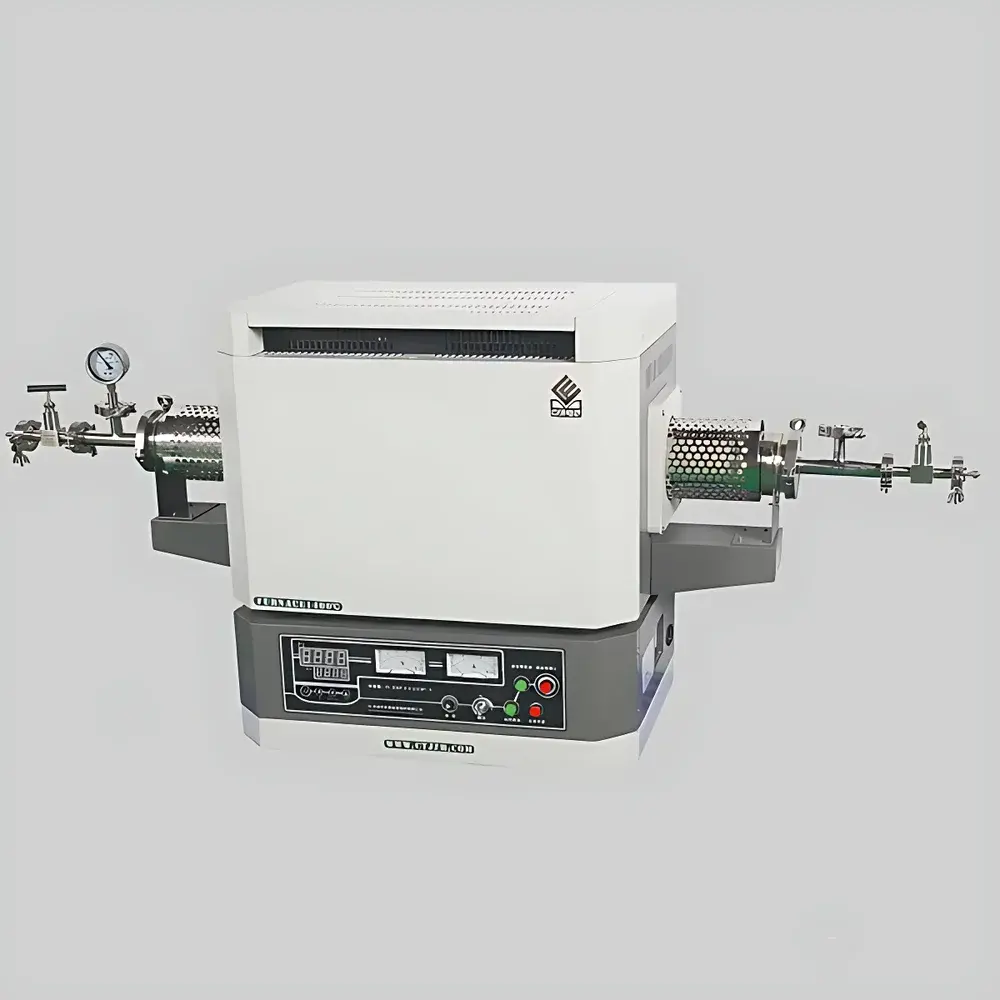
ZHONGHUAN FURNACE 1400°C Triple-Zone Vacuum & Atmosphere Tube Furnace
| Brand | ZHONGHUAN FURNACE |
|---|---|
| Origin | Tianjin, China |
| Model | 1400°C Triple-Zone Vacuum & Atmosphere Tube Furnace |
| Maximum Temperature | 1400°C |
| Temperature Control Accuracy | ±1°C |
| Rated Power | 8 kW |
| Heating Rate (to max temp) | ≤5°C/min below 500°C |
| Heating Element | Silicon Carbide (SiC) Rods |
| Internal Chamber Dimensions | 530 × 836 × 785 mm (W × H × D) |
| Furnace Type | Horizontal Tube Furnace |
| Compliance | Designed for ISO/IEC 17025 laboratory environments |
Overview
The ZHONGHUAN FURNACE 1400°C Triple-Zone Vacuum & Atmosphere Tube Furnace is a horizontally oriented, programmable high-temperature thermal processing system engineered for precise temperature zoning, controlled atmosphere operation, and vacuum compatibility. It employs three independently controlled heating zones—each driven by high-stability silicon carbide (SiC) heating elements rated to 1500°C surface temperature—to establish highly uniform axial thermal profiles across the 836 mm long tube chamber. The furnace operates on resistive heating principles, with thermal energy delivered via SiC rods embedded in a multi-crystalline mullite fiber insulation matrix. This architecture enables stable isothermal holds, gradient-based thermal treatments, and repeatable ramp-soak-cool cycles under inert, reducing, oxidizing, or vacuum conditions—critical for sintering, annealing, carburizing, CVD precursor decomposition, and crystal growth studies in advanced materials research.
Key Features
- Triple-zone independent PID control with auto-tuning capability, supporting complex multi-step thermal profiles with zone-specific ramp rates and dwell times.
- Quick-connect dual-ring flange system enabling tool-free vacuum and gas line attachment—reducing setup time and minimizing mechanical stress on quartz or alumina tubes.
- Multi-layer vacuum-formed mullite fiber insulation providing >50% energy savings versus traditional brick-lined furnaces and ensuring radial temperature uniformity within ±3°C across the hot zone.
- Integrated safety architecture including over-temperature cut-off (hardware-limited), earth-leakage circuit interruption, and surface temperature monitoring with automatic cooling fan activation at ≥50°C external skin temperature.
- RS-485 communication interface compliant with Modbus RTU protocol, enabling centralized monitoring and control of up to 200 units via SCADA or custom LabVIEW/Python-based platforms.
- Modular auxiliary integration: optional vacuum pumping stations (rotary vane + turbomolecular), mass flow controllers (MFCs) for N₂, Ar, H₂, NH₃, or forming gas, and digital pressure transducers for process traceability.
Sample Compatibility & Compliance
The furnace accommodates standard OD 60–120 mm tubular specimens (quartz, high-purity alumina, or recrystallized SiC) up to 800 mm in length. Its internal dimensions (530 mm W × 836 mm H × 785 mm D) permit vertical or horizontal sample loading configurations depending on accessory selection. Dual O-ring sealing with fluorosilicone gaskets ensures leak rates <1×10⁻⁶ mbar·L/s under vacuum, meeting ASTM E595 outgassing requirements for space-grade material testing. When operated with validated software and audit-trail-enabled controllers, the system supports compliance with FDA 21 CFR Part 11 electronic record integrity standards and ISO 17025 calibration traceability frameworks.
Software & Data Management
The standard controller supports 50-segment programmable profiles with real-time parameter logging (temperature, zone power, gas flow, vacuum level) at user-defined intervals (1–60 s). Optional touch-screen HMI offers graphical visualization—including live trend curves, historical overlay comparison, alarm event logs with timestamps, and exportable CSV reports. All data files are timestamped, digitally signed, and stored in non-volatile memory with backup to USB media. Remote access via Ethernet enables secure TLS-encrypted connections for off-site validation, trending analysis, and integration into LIMS or MES environments.
Applications
This furnace serves as a core platform for thermal process development in semiconductor device fabrication (e.g., dopant diffusion, oxide growth), carbon nanotube synthesis, ceramic matrix composite densification, solid-state battery cathode annealing, and catalytic material activation. Its triple-zone design facilitates zone-melting purification, directional solidification experiments, and gradient thermal stress testing. Researchers in university materials science departments and industrial R&D labs use it for DOE-based optimization of heat treatment parameters under reproducible gas partial pressures or dynamic vacuum ramps—supporting publications requiring full experimental transparency and instrument traceability.
FAQ
What vacuum levels can this furnace achieve with standard configuration?
With an optional two-stage rotary vane pump, base pressure reaches 10⁻² mbar; adding a turbomolecular pump extends capability to 10⁻⁵ mbar range.
Is the furnace compatible with hydrogen atmospheres?
Yes—when equipped with H₂-rated MFCs, explosion-proof solenoid valves, and leak-tested stainless-steel gas lines per CGA G-1.1 guidelines.
Can temperature uniformity be verified and documented?
Yes—using calibrated thermocouples and a certified DAQ system, users may perform ASTM E220-compliant uniformity mapping and generate validation reports.
Does the system support automated recipe execution with pass/fail criteria?
Yes—via optional software add-ons that enable conditional logic, endpoint detection (e.g., time-at-temperature), and automatic shutdown upon deviation from set tolerances.
What maintenance intervals are recommended for SiC heating elements and insulation?
SiC rods typically require inspection every 500 operational hours; mullite fiber insulation retains structural integrity beyond 2000 h at 1300°C with proper thermal cycling practices.



