
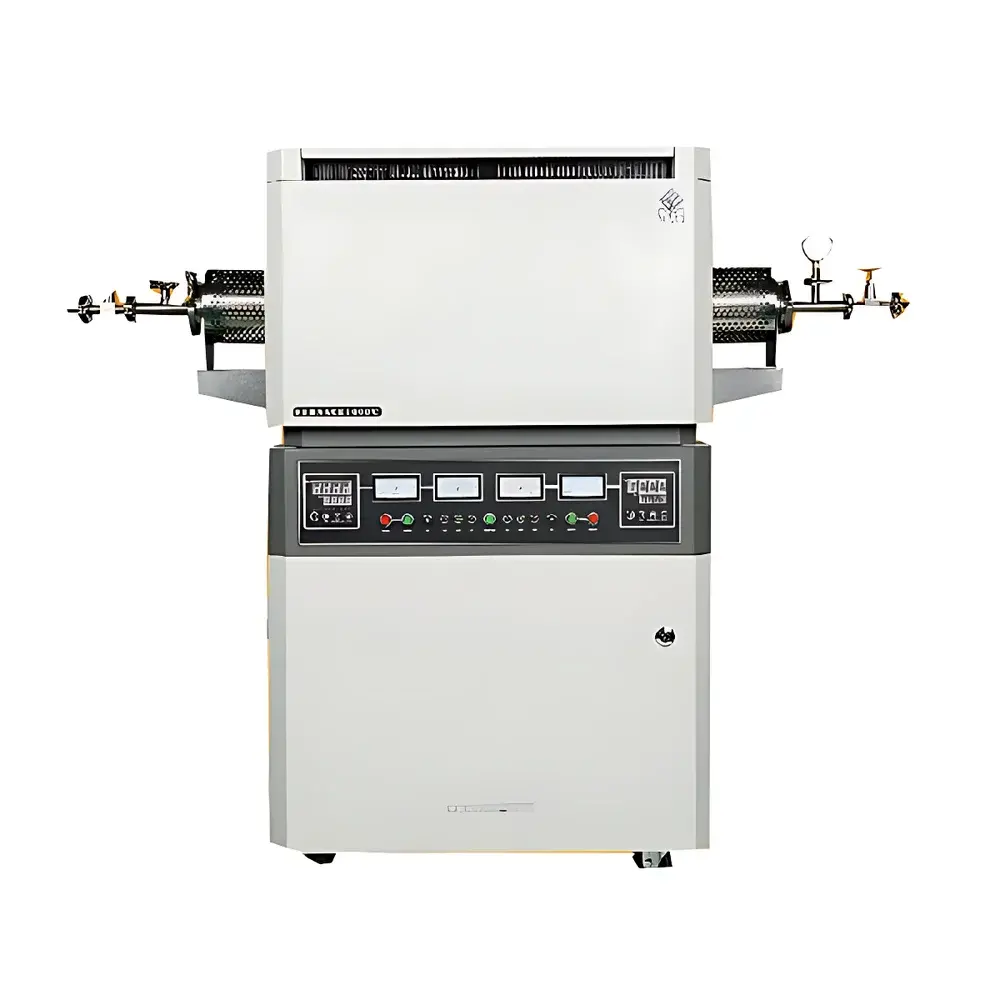
ZHONGHUAN FURNACE 1600℃ Dual-Zone Vacuum & Atmosphere Tube Furnace
| Brand | ZHONGHUAN FURNACE |
|---|---|
| Origin | Tianjin, China |
| Model | 1600℃ Dual-Zone Vacuum & Atmosphere Tube Furnace |
| Maximum Temperature | 1600℃ |
| Temperature Control Accuracy | ±1℃ |
| Rated Power | 8 kW |
| Heating Rate (to max temp) | ≤5℃/min (≤500℃), ≤10℃/min (500–800℃), ≤5℃/min (800–1000℃), ≤3℃/min (1000–1400℃), ≤2℃/min (1400–1600℃) |
| Heating Element | Silicon Molybdenum (MoSi₂) Rods |
| Internal Chamber Dimensions | 530 × 835 × 1425 mm (W × H × L) |
| Furnace Type | Horizontal Tube Furnace |
| Compliance | Designed for ASTM E1112, ISO 9001-compliant manufacturing processes |
| Software Interface | RS-485 port supporting Modbus RTU protocol for multi-furnace networked control |
Overview
The ZHONGHUAN FURNACE 1600℃ Dual-Zone Vacuum & Atmosphere Tube Furnace is a horizontally configured, high-temperature thermal processing system engineered for precise, repeatable heat treatment under controlled vacuum or reactive/inert gas atmospheres. It employs dual independent heating zones—each with dedicated MoSi₂ heating elements and thermocouple feedback—to enable axial temperature gradient control across the 1425 mm tube length. This architecture supports advanced thermal profiles required in materials synthesis, including zone melting, annealing, sintering, and chemical vapor transport. The furnace operates within a robust stainless-steel vacuum chamber rated to ≤10⁻³ Pa (with optional high-vacuum pumping), and integrates seamless gas inlet/outlet manifolds compatible with N₂, Ar, H₂, NH₃, CO, or forming gas mixtures. Its design conforms to fundamental safety and performance expectations for laboratory-scale high-temperature processing equipment used in R&D environments subject to GLP-aligned documentation practices.
Key Features
- Dual-zone independent PID temperature control with ±1℃ accuracy over full 1600℃ range, enabling programmable axial thermal gradients up to 200℃/cm.
- High-efficiency multi-crystalline mullite fiber insulation reduces standby heat loss by >50% versus traditional refractory brick linings, improving energy efficiency and surface temperature stability.
- Quick-connect double-o-ring flange system eliminates torque-sensitive bolted assembly; single clamp coupling ensures reproducible vacuum/gas seal integrity and minimizes mechanical stress on quartz or alumina tubes.
- Intelligent thermal management: integrated surface temperature sensor triggers automatic cooling fan activation at ≥50℃ external casing temperature, maintaining operator safety and structural longevity.
- Comprehensive safety interlocks include over-temperature cutoff (hardware-limited), earth leakage detection, and door-open thermal shutdown—fully compliant with IEC 61000-6-2 EMC and IEC 61000-6-4 emission standards.
- RS-485 Modbus RTU interface enables centralized monitoring and control of up to 200 units via SCADA or custom LabVIEW/Python-based acquisition systems.
Sample Compatibility & Compliance
The furnace accommodates standard OD 60–120 mm tubular samples (quartz, high-purity alumina, or recrystallized silicon carbide) up to 835 mm in height and 1425 mm in length. Its dual-zone configuration supports heterogeneous sample loading—e.g., precursor powder in Zone 1 and substrate in Zone 2—for sequential pyrolysis–deposition protocols. Gas flow control is compatible with mass flow controllers (MFCs) meeting ISO 6358 standards, permitting precise stoichiometric tuning in CVD, carburization, or nitridation studies. Vacuum integrity meets ASTM E1112 requirements for residual gas analysis compatibility, and the system’s construction adheres to ISO 9001-certified production workflows. Optional accessories include water-cooled feedthroughs, optical viewports (250–2500 nm transmission), and integrated pressure transducers traceable to NIST standards.
Software & Data Management
The embedded controller supports 50-segment ramp-hold thermal programming with user-defined rate limits, dwell times, and event-triggered outputs (e.g., gas valve actuation at specific temperatures). Data logging records temperature, power draw, and alarm status at configurable intervals (1 s to 60 min), stored internally for ≥30 days or streamed in real time via RS-485. Export formats include CSV and Excel-compatible .xls for post-processing in MATLAB or OriginLab. When deployed in regulated environments (e.g., university core facilities under FDA 21 CFR Part 11 guidelines), optional audit-trail firmware provides timestamped user login logs, parameter change history, and electronic signature support—meeting ALCOA+ data integrity principles for GMP-aligned material qualification workflows.
Applications
This furnace serves critical roles in academic and industrial materials research, including but not limited to: synthesis of SiC and GaN wide-bandgap semiconductors; graphitization and stabilization of PAN-based carbon fibers; solid-state reaction studies of cathode materials (e.g., NMC, LFP); low-pressure annealing of perovskite thin films; and controlled oxidation/reduction of transition metal oxides for catalysis development. Its dual-zone capability is particularly valuable in directional solidification experiments, zone refining of thermoelectric alloys (e.g., Bi₂Te₃), and graded-interface fabrication for thermal barrier coatings. Users in national labs and semiconductor pilot lines routinely employ it for process validation prior to scale-up in continuous furnaces.
FAQ
What vacuum level can this furnace achieve with standard configuration?
With included mechanical rotary vane pump, base pressure reaches ≤5×10⁻² Pa. With optional turbomolecular pump package, ultimate vacuum improves to ≤1×10⁻⁴ Pa.
Is the tube orientation horizontal or vertical?
The furnace features a horizontal tube configuration with front-loading access and gravity-assisted sample insertion.
Can both zones operate at different setpoints simultaneously?
Yes—each zone has independent thermocouple input, SSR output, and programmable PID parameters, allowing sustained differential temperature operation (e.g., 1200℃/zone1, 1450℃/zone2).
Does the system support inert gas purging before vacuum initiation?
Yes—the integrated gas manifold includes separate inlet/outlet ports with needle-valve-controlled flow regulation, enabling pre-purge sequences per ASTM F519 or ISO 14644-8 cleanroom-compatible protocols.
Are calibration certificates available for temperature sensors?
NIST-traceable calibration reports for Type S thermocouples are available upon request, aligned with ISO/IEC 17025-accredited third-party verification.



