
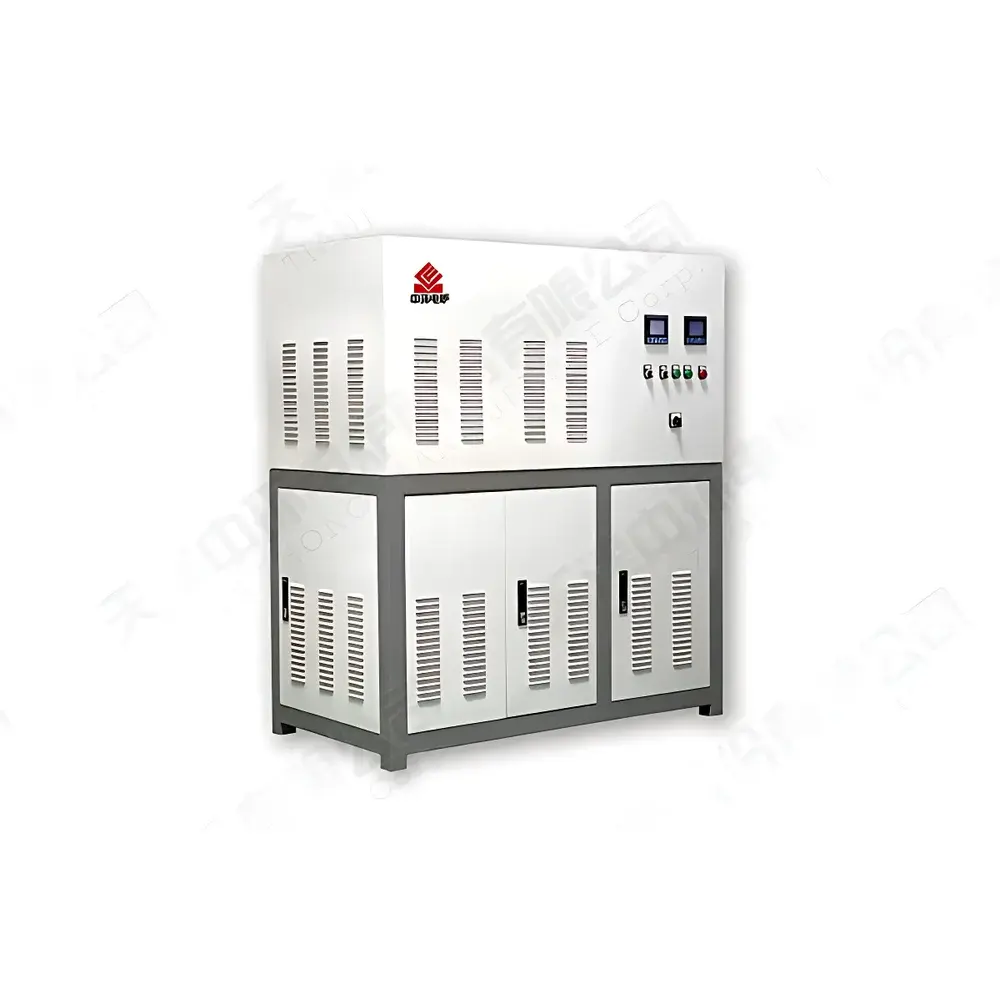
ZHONGHUAN FURNACE 1800°C Integrated Lift-Type Sintering & Annealing Furnace
| Brand | ZHONGHUAN FURNACE |
|---|---|
| Origin | Tianjin, China |
| Model | Integrated Lift-Type Sintering & Annealing Furnace (1800°C) |
| Furnace Type | Box-Type Muffle Furnace |
| Max Temperature | 1800°C |
| Temperature Control Accuracy | ±0.5°C |
| Max Power | 14 kVA |
| Heating Element | U-Shaped Molybdenum Disilicide (MoSi₂) Rods |
| Internal Chamber Dimensions | 400 × 240 × 240 mm |
| Heating Method | Radiant Resistance Heating |
| Chamber Lining | High-Purity Alumina-Silica Ceramic Fiber Insulation |
| Door Operation | Motor-Driven Vertical Lift Mechanism |
| Control System | PID-Based 100-Step Programmable Controller with Over-Temperature & Thermocouple Break Protection |
| Compliance | Designed for GLP-compliant thermal processing environments |
Overview
The ZHONGHUAN FURNACE 1800°C Integrated Lift-Type Sintering & Annealing Furnace is a high-temperature box-type muffle furnace engineered for precision thermal treatment of advanced inorganic materials under controlled atmospheric conditions. It operates on the principle of radiant resistance heating via U-shaped molybdenum disilicide (MoSi₂) heating elements, which provide stable and repeatable heat generation up to 1800°C in air atmosphere. The furnace employs a fully integrated furnace-and-controller architecture, eliminating external control cabinets and reducing footprint while enhancing system coherence. Its design prioritizes thermal uniformity, operational safety, and long-term stability—critical attributes for sintering single-crystal substrates (e.g., sapphire boules and wafers), densifying ultra-refractory ceramics (e.g., ZrO₂, SiC, AlN), and performing high-fidelity annealing protocols in research and quality assurance laboratories.
Key Features
- Motor-driven vertical lift door mechanism enables hands-free, repeatable access to the hot zone—minimizing operator exposure and ensuring consistent loading/unloading alignment.
- 100-segment programmable PID temperature controller supports complex multi-step thermal profiles, including ramp-hold-cool sequences with user-defined rate limits and dwell times.
- Over-temperature cutoff and thermocouple break detection provide dual-layer hardware safety interlocks compliant with IEC 61000-6-2/6-4 electromagnetic compatibility standards.
- High-density alumina-silica ceramic fiber chamber lining offers low thermal mass, rapid heating response, and negligible outgassing—ensuring clean processing environments for optoelectronic and semiconductor-grade materials.
- Peripherally mounted MoSi₂ heating rods generate uniform radial heat flux; measured axial and radial temperature gradients remain ≤ ±3°C across the full working volume at 1800°C (per ASTM C1040-22 calibration protocol).
- Modular heating element replacement path—accessible from the furnace base—eliminates need to disassemble insulation or remove top panels, reducing maintenance downtime by >70% versus conventional designs.
Sample Compatibility & Compliance
This furnace accommodates crucibles and fixtures up to 400 mm (W) × 240 mm (D) × 240 mm (H), supporting quartz, alumina, molybdenum, and graphite containers. It is routinely deployed in applications requiring adherence to ISO 17025-accredited thermal processing workflows—including sapphire wafer annealing per SEMI F29-0212, ceramic green-body sintering per ISO 2738-2, and refractory metal heat treatment per ASTM B386. The unit’s low external surface temperature (<55°C at 1800°C hold) meets EN 60519-2 occupational safety requirements. All electrical components conform to CE marking directives (2014/35/EU Low Voltage Directive and 2014/30/EU EMC Directive).
Software & Data Management
The embedded controller logs real-time temperature, setpoint, power output, and alarm status with timestamp resolution of 1 second. Data export is supported via RS-485 Modbus RTU protocol for integration into LabArchives, DeltaV, or custom SCADA systems. Optional USB data logger firmware enables CSV export for audit-ready records satisfying FDA 21 CFR Part 11 requirements—supporting electronic signatures, audit trails, and data integrity validation. All thermal cycles are stored with unique identifiers and can be recalled, duplicated, or modified without reprogramming.
Applications
- Thermal annealing of sapphire crystal ingots and epitaxial wafers to reduce dislocation density and improve optical transmission.
- Sintering of transparent ceramics (e.g., YAG, spinel) and structural ceramics (e.g., silicon nitride, zirconia-toughened alumina) under ambient air or inert gas purge.
- Heat treatment of high-purity graphite molds and crucibles used in semiconductor crystal growth processes.
- Calibration of high-temperature reference materials and thermocouples (Types B, R, S) per NIST traceable procedures.
- Thermal aging studies of aerospace-grade composites and nuclear fuel matrix materials under accelerated isothermal holds.
FAQ
What atmosphere options are supported?
The furnace operates in ambient air by default; optional flange-mounted gas inlet/outlet ports enable continuous nitrogen, argon, or forming gas purging (flow rate: 0.5–5 L/min). Vacuum operation requires external pump integration and is not natively supported.
Is remote monitoring available?
Yes—via optional Ethernet-to-Modbus gateway, enabling integration with building management systems (BMS) or centralized lab monitoring platforms using standard TCP/IP protocols.
How is temperature uniformity verified?
Uniformity is validated per ASTM E220-20 using a 9-point thermocouple mapping grid during commissioning; a certificate of uniformity (±3°C at 1800°C) is provided with each unit.
What maintenance intervals are recommended?
Visual inspection of MoSi₂ rods every 200 operating hours; ceramic fiber integrity assessment annually or after 1,000 thermal cycles above 1500°C.
Can this furnace be integrated into automated sample handling systems?
Yes—the motorized lift mechanism includes limit switch feedback and 24 VDC control interface, allowing synchronization with robotic arms or conveyor-linked loading stations via dry-contact I/O signals.



