
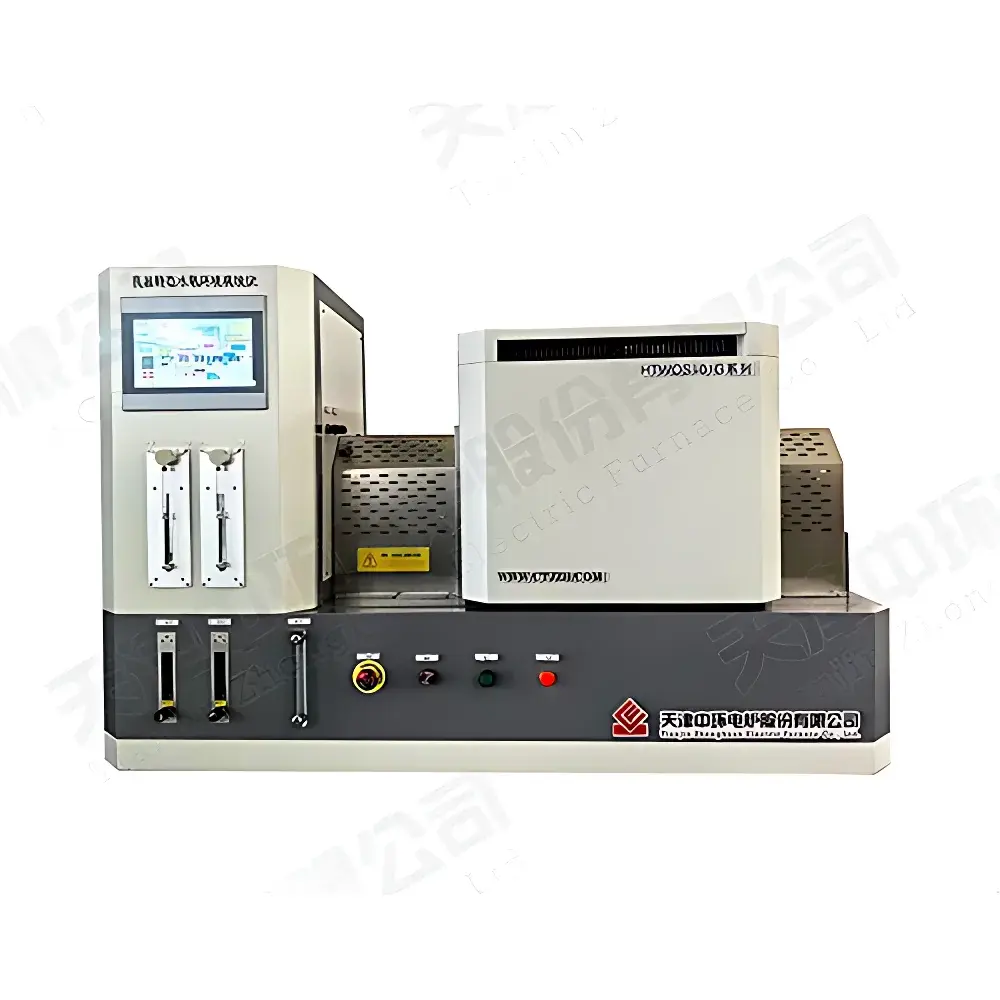
Zhonghuan Furnace HTWOS-01G High-Temperature Static Water-Oxygen Corrosion Test System
| Brand | Zhonghuan Furnace |
|---|---|
| Origin | Tianjin, China |
| Model | HTWOS-01G |
| Max Operating Temperature | 1600 °C |
| Reaction Chamber Diameter | Φ50 mm / Φ70 mm (optional) |
| Effective Chamber Length | 100 mm |
| Sample Dimensions | 30 × 20 × 4 mm |
| Sample Mounting Angle | 30°–45° (adjustable) |
| Heating Element | Silicon Molybdenum (MoSi₂) Rods |
| Heating Zone Material | Alumina (Al₂O₃) Tube |
| Steam Generation Range | 5–100% RH (or arbitrary humid gas mixture) |
| Evaporator Temp Limit | ≤150 °C |
| Trace Gas Line Heat Tracing | ≤120 °C |
| Max Steam Flow Rate | 30 L/min |
| Max Steam Velocity | 160 m/s |
| Carrier Gas Control | Mass Flow Controller (MFC), 5 L/min full scale |
| Operating Pressure | Ambient (1 atm) |
| Control Interface | 10.4″ Industrial Touchscreen HMI with PLC-based Multi-Module Architecture |
| Temperature Control Accuracy | ±1 °C |
| Programmable Ramp/Soak Profiles | 50-segment |
| Data Logging | Real-time Trend Curves & Exportable CSV Reports |
Overview
The Zhonghuan Furnace HTWOS-01G High-Temperature Static Water-Oxygen Corrosion Test System is an engineered platform for controlled simulation of aggressive high-temperature, high-humidity oxidative environments—specifically targeting thermochemical degradation mechanisms in advanced structural and functional materials. Unlike conventional oxidation furnaces, the HTWOS-01G integrates precision steam generation, dynamic gas mixing, and spatially stabilized thermal gradients to replicate the synergistic effects of elevated water vapor partial pressure, temperature, and convective mass transfer observed in real-world service conditions—such as those encountered by turbine components in next-generation aero-engines and land-based power systems. The system operates on a static (non-rotating, non-flow-through) exposure principle, where samples are held stationary within a precisely heated alumina reaction chamber while exposed to a continuously regenerated, compositionally stable humid gas stream. This configuration enables quantitative assessment of parabolic oxidation kinetics, protective scale adhesion, volatile hydroxide formation, and interfacial degradation at the coating–substrate interface under isothermal or programmed thermal profiles.
Key Features
- Modular steam generation architecture: Dual-stage liquid dosing pump + heated evaporator (≤150 °C) ensures reproducible, pulse-free water vapor delivery with <±0.5% RH stability over extended test durations.
- Independent thermal management: Separate PID-controlled heating zones for steam lines (≤120 °C), mixing chamber, and reaction zone eliminate condensation and ensure uniform vapor-phase residence time.
- Alumina reaction tube (Φ50/Φ70 mm, 100 mm effective length) with MoSi₂ heating elements provides rapid thermal response and long-term stability up to 1600 °C under oxidizing atmospheres.
- 10.4″ industrial touchscreen HMI with embedded PLC logic supports 50-segment programmable temperature ramps, real-time humidity/flow/temperature trending, and automated data export (CSV) with timestamped metadata.
- Adjustable sample mounting fixture (30°–45° inclination) accommodates standardized coupon geometries (30 × 20 × 4 mm) and enables orientation-dependent corrosion studies relevant to directional gas impingement.
- Mass flow-controlled carrier gas (N₂, Ar, or synthetic air) integration allows precise stoichiometric tuning of O₂/H₂O partial pressures—critical for isolating water-vapor-specific degradation pathways per ASTM G174 and ISO 20480.
Sample Compatibility & Compliance
The HTWOS-01G is validated for testing ceramic matrix composites (CMCs), environmental barrier coatings (EBCs), thermal barrier coatings (TBCs), ultra-high-temperature ceramics (UHTCs), and Ni-/Co-based superalloys—including single-crystal substrates and bond coat systems. Its design conforms to key material qualification protocols used in aerospace and energy sectors: sample exposure geometry aligns with ASTM C1360 (standard test method for oxidation resistance of refractory ceramics), while humidity control repeatability supports GLP-compliant data generation for regulatory submissions. The system’s ambient-pressure operation and traceable calibration paths (temperature via dual Pt/Rh thermocouples; flow via NIST-traceable MFC) facilitate audit readiness under ISO/IEC 17025 and FDA 21 CFR Part 11–aligned electronic record workflows when paired with optional audit-trail software modules.
Software & Data Management
The embedded control firmware implements deterministic real-time scheduling for synchronized acquisition of up to eight analog inputs (thermocouple voltages, pressure differentials, MFC outputs, RH sensor signals) at 1 Hz resolution. All operational parameters—including setpoints, actual values, alarm states, and user actions—are logged with millisecond timestamps and stored locally on industrial-grade SSD memory. Trend visualization includes overlay-capable multi-axis plots (e.g., mass gain vs. time, T vs. RH, ΔT across zones). Export functions generate ISO 8601–formatted CSV files compatible with MATLAB, Python (pandas), and commercial statistical analysis packages. Optional OPC UA server integration enables seamless connection to enterprise MES or LIMS platforms for centralized test campaign tracking and cross-instrument correlation.
Applications
This system supports fundamental and applied research into water-vapor-accelerated oxidation, particularly where hydrolytic breakdown of SiO₂- or Al₂O₃-based protective scales dominates failure modes. Typical use cases include: evaluating EBC durability on SiC/SiC composites under simulated turbine exhaust conditions (1200–1400 °C, p(H₂O) = 10–30 kPa); quantifying the transition from metastable mullite to stable cristobalite in YSZ–mullite hybrid coatings; assessing interdiffusion kinetics at NiAl/TBC interfaces under cyclic humid heat; and benchmarking novel rare-earth silicate formulations against industry-standard barium strontium aluminosilicates (BSAS). It also serves as a qualification tool for DOE-funded projects on hydrogen-compatible nuclear fuel cladding materials exposed to steam at >1000 °C.
FAQ
What standards does the HTWOS-01G support for corrosion testing?
It enables execution of ASTM G174 (standard guide for evaluating water-vapor effects on high-temperature oxidation), ISO 20480 (corrosion testing in humid high-temperature environments), and custom protocols aligned with GE Aviation SAE AMS2750E pyrometry requirements.
Can the system operate under reduced or elevated pressure?
No—the HTWOS-01G is designed exclusively for ambient-pressure operation. For sub-atmospheric or high-pressure variants, consult engineering support for custom reactor head and sealing modifications.
Is remote monitoring supported?
Yes—via optional Ethernet/IP or Modbus TCP gateway modules that expose live process variables and alarm status to SCADA or cloud-based dashboards.
How is calibration traceability maintained?
Temperature sensors are calibrated annually against NIST-traceable reference thermocouples; mass flow controllers are certified per ISO 6946 with documented uncertainty budgets available upon request.
What maintenance intervals are recommended?
Evaporator cleaning every 200 h of cumulative steam operation; alumina tube inspection after 500 h at >1400 °C; MoSi₂ element resistance checks prior to each 1000 h cycle. Full maintenance logs are auto-generated and exportable.
Related Products





