
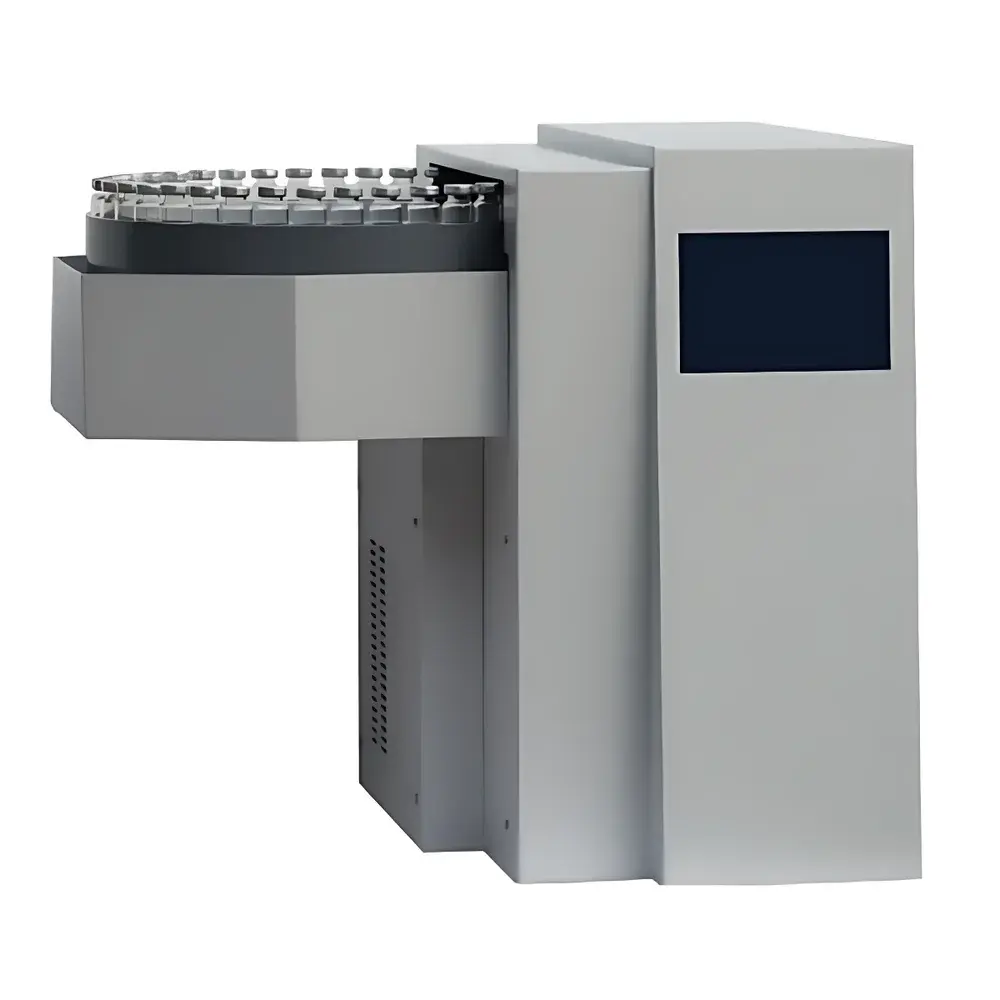
Zhonhuipu HS-40 Fully Automated Static Headspace Sampler
| Brand | Zhonhuipu |
|---|---|
| Origin | Beijing, China |
| Manufacturer Type | Direct Manufacturer |
| Instrument Type | Static Headspace Sampler |
| Automation Level | Fully Automated |
| Sample Tray Capacity | 40 positions |
| Simultaneous Heating Positions | 12 |
| Vial Sizes Supported | 10 mL and 20 mL |
| Oven Temperature Range | 40–200 °C (optional up to 300 °C) |
| Valve & Transfer Line Temperature Range | 40–200 °C (optional up to 330 °C) |
| Quantitative Loop Volume | 1 mL (customizable up to 3 mL) |
| Temperature Control Accuracy | ±1 °C |
| Equilibration Time | 0–99.9 min |
| Pressurization Time | 0–9.99 min |
| Sampling Time | 0–9.99 min |
| Loop Equilibration Time | 0–9.99 min |
| Injection Time | 0–9.99 min |
| Analysis Time | 0–99.9 min |
| RSD | <1.2% (for 100 ppm ethanol in water) |
| Power Consumption | Peak 450 W |
| Dimensions (L×W×H) | 500 × 575 × 505 mm |
| Net Weight | ~36 kg |
Overview
The Zhonhuipu HS-40 is a fully automated static headspace sampler engineered for high-throughput, reproducible analysis of volatile and semi-volatile organic compounds (VOCs and SVOCs) in complex matrices. It operates on the principle of static headspace equilibrium—where a sealed sample vial is heated to promote partitioning of analytes between the condensed phase (liquid or solid) and the gas phase above it. Following thermal equilibration, a precise volume of headspace vapor is withdrawn via a pressurized, heated six-port valve and quantitative loop system, then transferred directly into a gas chromatograph (GC) or GC-MS inlet. This method eliminates matrix interference, reduces column contamination, and delivers superior sensitivity and precision—particularly critical for trace-level quantitation in regulated environments.
Key Features
- Fully automated 40-position sample carousel with independent microprocessor control; supports concurrent heating of up to 12 vials to maximize instrument uptime and throughput.
- Air-bath heating system—identical in design to standard GC oven architecture—ensures uniform thermal distribution across all vials, minimizing inter-vial temperature gradients and enhancing method reproducibility compared to metal-block alternatives.
- Three programmable vibration modes (low/medium/high intensity) accelerate mass transfer during equilibration, reducing required incubation time without compromising equilibrium integrity.
- Heated six-port valve and stainless-steel transfer lines (RESTEK Siltek®/Sulfinert®-treated 316L) maintain full thermal continuity from vial to GC inlet—eliminating cold spots and preventing condensation or adsorption of polar, acidic, or sulfur-containing compounds.
- Positive-pressure sampling mechanism enables robust analysis of both liquid and solid samples; achieves detection limits as low as 1 ppb for benzene in aqueous matrices with baseline stability under constant carrier flow.
- Integrated 7-inch capacitive touchscreen interface with intuitive navigation; supports standalone operation or seamless integration with third-party GC data systems via RS-232 or Ethernet.
- Comprehensive fault detection logic—including motor stall sensing, positional error monitoring, and mechanical collision avoidance—triggers automatic shutdown and diagnostic alerts to protect hardware and preserve sample integrity.
- Vial return-to-origin functionality ensures post-analysis traceability and safeguards limited or irreplaceable samples—critical for forensic, clinical, and reference material applications.
Sample Compatibility & Compliance
The HS-40 accommodates standard 10 mL and 20 mL crimp-top headspace vials and is compatible with a wide range of sample types: aqueous solutions (e.g., blood ethanol), pharmaceutical formulations, polymer packaging materials, environmental solids (soil, sediment), food matrices, and cosmetic emulsions. Its inert flow path—validated per ASTM D3699 and ISO 11843-2—supports compliance with pharmacopeial methods including USP , EP 2.4.24, and JP 6.20. The system’s deterministic timing control, audit-trail-capable method storage (up to 40 preloaded protocols), and hardware-level synchronization with GC readiness signals align with GLP and GMP documentation requirements. While not inherently 21 CFR Part 11 compliant, its PC-controlled operation supports integration with validated LIMS or chromatography data systems that provide electronic signature, user access control, and change history tracking.
Software & Data Management
The HS-40 communicates bidirectionally with GC workstations via industry-standard protocols. Its embedded firmware stores complete method parameters—including equilibration, pressurization, sampling, loop equilibration, injection, and analysis timing—alongside real-time status telemetry (temperature, valve position, vial ID, cycle progress). All methods are editable via touchscreen or remote PC interface; no proprietary drivers are required for integration with Agilent, Thermo Fisher, Shimadzu, or PerkinElmer GC platforms. Optional software modules enable batch scheduling, QC flagging (e.g., RSD >1.2% triggers alert), and CSV export of run logs for external QA review. Firmware updates are delivered via USB or network, preserving configuration integrity across revisions.
Applications
- Forensic Toxicology: Quantitative ethanol determination in whole blood per SWGTOX guidelines, with automated calibration bracketing and duplicate analysis support.
- Pharmaceutical Quality Control: Residual solvent testing in APIs and excipients per ICH Q3C, including Class 1–3 solvents (e.g., chloroform, methanol, toluene) in lyophilized powders and blister-packaged tablets.
- Environmental Monitoring: EPA Method 502.2 and 8260D-compliant analysis of VOCs in groundwater, surface water, and solid-phase microextraction (SPME)-compatible soil extracts.
- Food & Flavor Chemistry: Dynamic profiling of volatile aroma compounds (e.g., esters, aldehydes, terpenes) in beverages, dairy products, and fermented foods—enabling shelf-life and authenticity studies.
- Medical Device Safety: Extraction and quantification of leachable ethylene oxide, isopropanol, or hexane residues from sterilized polymeric components per ISO 10993-12.
FAQ
Is the HS-40 compatible with my existing GC or GC-MS system?
Yes—the HS-40 features universal pneumatic and electrical interfaces. It connects directly to any GC using standard 1/16″ PTFE-lined stainless-steel transfer tubing and synchronizes start commands via TTL or contact closure signals. No hardware modification to the GC is required.
Can I upgrade the temperature ranges after purchase?
Heating modules for vial oven, valve, and transfer line are field-replaceable. Optional high-temp configurations (300 °C vial oven; 330 °C valve/line) can be installed by certified service personnel with firmware reconfiguration.
What maintenance is required to ensure long-term accuracy?
Routine maintenance includes quarterly verification of temperature calibration (NIST-traceable thermometer), annual leak testing of the pressurized loop system, and biannual replacement of septa and O-rings. All diagnostics and calibration routines are accessible via the maintenance mode menu.
Does the system support unattended overnight operation?
Yes—full 40-vial batch runs with customizable delay intervals between injections are supported. The instrument enters low-power standby between cycles and resumes automatically upon scheduled trigger or GC readiness signal.
How is carryover prevented between analyses?
The Siltek®/Sulfinert®-passivated stainless-steel flow path, combined with programmable purge cycles (carrier gas flush of loop and lines post-injection), ensures <0.01% carryover for high-concentration standards. Validation data for carryover is included in the factory performance qualification report.




