
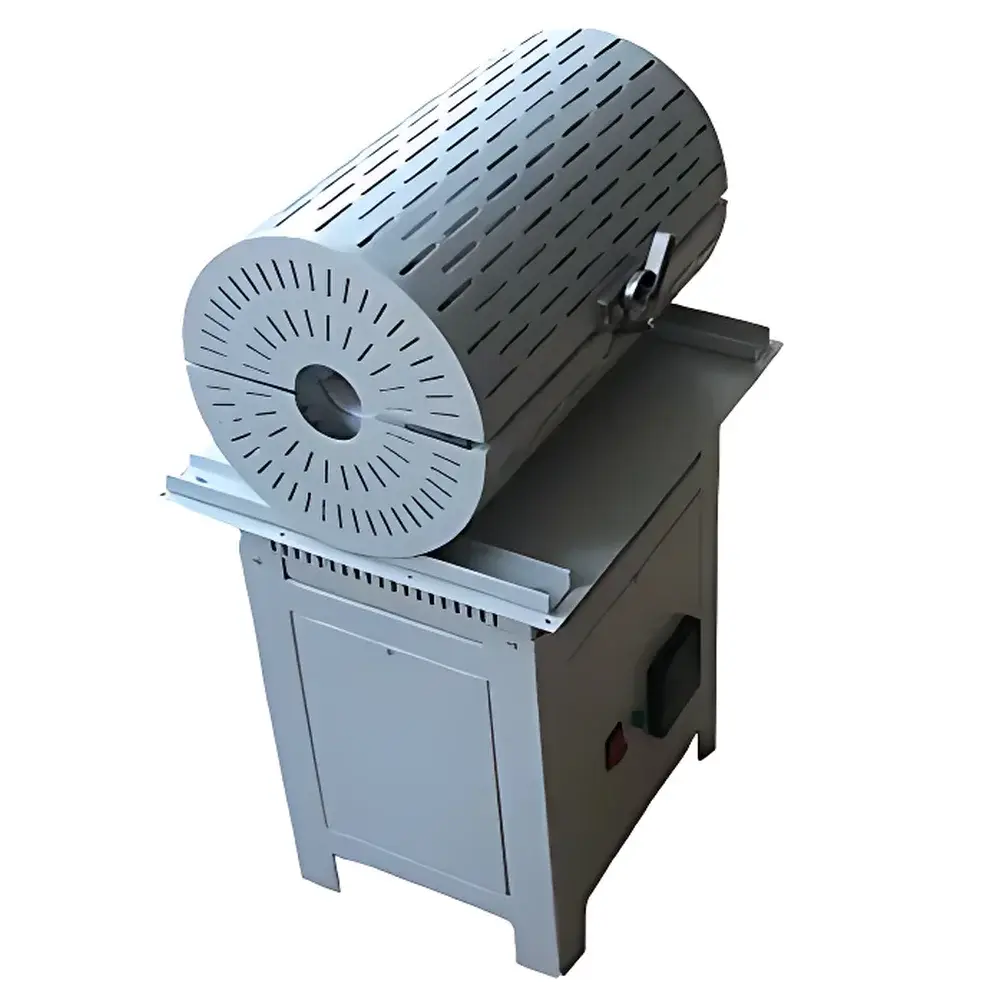
Zhuochi 30165-10 Horizontal Split-Type Programmable Tube Furnace
| Brand | Zhuochi |
|---|---|
| Origin | Zhejiang, China |
| Type | Horizontal Split-Type Tube Furnace |
| Max Temperature | 1000 °C |
| Temperature Uniformity (Steady-State) | ±1 °C |
| Display Resolution | 1 °C |
| Heating Rate (to Max Temp) | ≤50 °C/min |
| Rated Power | 2.5 kW |
| Internal Chamber Dimensions | Ø50 × 300 mm |
| Heating Zone Length | 200 mm |
| Compatible Tube Size | Ø50 × 400–910 mm |
| Heating Element | High-Temperature Resistance Wire |
| Insulation | Lightweight Ceramic Fiber Composite (Dual Semi-Cylindrical Modules) |
| Cooling Method | Air Cooled |
| Thermocouple Type | K-Type (NiCr–NiSi) |
| Controller | LTDE Programmable PID Controller with Ramp/Soak Profiles |
| Safety | Dual-Stage Over-Temperature Protection |
| Power Supply | 220 V, 50 Hz |
| Net Weight | ~20 kg |
Overview
The Zhuochi 30165-10 is a horizontal split-type programmable tube furnace engineered for precise thermal processing in research laboratories, materials science labs, and small-scale production environments. Its defining structural feature—a dual semi-cylindrical ceramic fiber furnace chamber that opens laterally—enables rapid, tool-free access to the heating zone without disturbing installed reaction tubes or sample fixtures. This architecture supports seamless integration with external quartz or high-purity alumina tubes (Ø50 mm, length 400–910 mm), facilitating controlled-atmosphere experiments including vacuum annealing, inert gas purging (e.g., N₂, Ar), and reactive gas treatments (e.g., H₂/N₂ mixtures under monitored flow). The furnace operates on resistive heating via embedded high-temperature alloy resistance wire, delivering stable thermal output across its 100–1000 °C range. With a nominal heating zone of 200 mm and internal cavity dimensions of Ø50 × 300 mm, it balances compact footprint with sufficient axial uniformity for reproducible thermal treatment of catalysts, thin films, nanomaterials, and ceramic precursors.
Key Features
- Split-Cylinder Design: Two independently hinged, lightweight ceramic fiber modules allow full lateral exposure of the heating zone—ideal for mounting/unmounting tubes, inserting thermocouples, or adjusting sample positioning mid-experiment.
- Precision Temperature Control: Equipped with a K-type thermocouple and LTDE programmable PID controller supporting up to 30 segment ramp-soak profiles; steady-state temperature stability maintained within ±1 °C, with display resolution of 1 °C.
- Energy-Efficient Thermal Architecture: Ultra-low thermal mass ceramic fiber insulation reduces power consumption to approximately one-third that of conventional refractory-brick tube furnaces; air-cooled metal housing ensures safe surface temperatures during extended operation.
- Programmable Thermal Sequencing: Full control over heating rate (adjustable from <1 to ≤50 °C/min), hold duration (0–9999 min per segment), and cooling initiation—enabling complex protocols such as multi-step sintering, crystallization annealing, or oxidative/reductive cycling.
- Dual-Layer Safety System: Primary temperature regulation is backed by an independent secondary over-temperature cutoff circuit, compliant with IEC 61000-4-5 surge immunity and EN 60519-1 electrical safety standards for industrial heating equipment.
Sample Compatibility & Compliance
The 30165-10 is designed for use with standard Ø50 mm quartz or fused silica tubes (length ≥400 mm), accommodating common laboratory configurations for gas-flow reactors, CVD precursors, and solid-state synthesis. Its open architecture permits direct coupling to vacuum manifolds (via ground-glass or O-ring sealed flanges) and mass flow controllers for atmosphere control. While not certified to UL or CE as a standalone appliance, the furnace meets functional requirements aligned with ASTM E220 (Standard Test Method for Calibration of Thermocouples), ISO/IEC 17025 clause 6.4.8 (equipment verification), and general GLP laboratory infrastructure guidelines. All electrical components—including solid-state relays, contactors, and cooling fans—comply with RoHS Directive 2011/65/EU. No built-in data logging or 21 CFR Part 11 compliance; external DAQ integration is supported via analog voltage output (0–5 V) from the controller.
Software & Data Management
The LTDE controller provides local interface-only operation via membrane keypad and LED display; no embedded software, USB port, or network connectivity is included. Process parameters (setpoints, ramp rates, soak times) are stored in non-volatile memory and retained after power loss. For traceable recordkeeping, users may connect an external data acquisition system to the controller’s analog output (proportional to measured temperature) or utilize optional RS485 Modbus RTU communication (requires add-on module, sold separately). Raw thermal profiles can be exported for post-processing in MATLAB, Python (NumPy/Pandas), or LabVIEW. Audit trails and electronic signatures are not natively supported; manual logbooks or LIMS-integrated external recording are recommended for regulated environments.
Applications
- Controlled-atmosphere annealing of semiconductor wafers and transparent conductive oxides (e.g., ITO, FTO)
- Thermal decomposition studies of metal-organic frameworks (MOFs) and battery cathode precursors (e.g., LiCoO₂, NMC)
- Inert-gas sintering of nanopowders and ceramic green bodies
- Catalyst activation and regeneration under H₂/N₂ or CO/CO₂ mixtures
- Graphitization and carbonization of polymer-derived ceramics and electrospun fibers
- Calibration reference source for thermocouple validation in metrology labs (within 100–1000 °C range)
FAQ
Can this furnace operate under vacuum?
Yes—when paired with a compatible vacuum-rated quartz tube (e.g., fused silica with ground-glass or metal-sealed end caps) and connected to a mechanical pump or turbomolecular system via standard NW25/KF25 fittings.
What is the maximum recommended tube length for optimal temperature uniformity?
For ±1 °C uniformity across the central 200 mm heating zone, use tubes ≥600 mm in length to ensure adequate thermal isolation beyond the heated region.
Is the furnace suitable for hydrogen atmosphere applications?
It supports H₂ atmospheres only when used with H₂-compatible tubing (e.g., quartz or high-purity alumina), proper leak-checked gas lines, and external explosion-proof ventilation—hydrogen service requires user-conducted risk assessment per NFPA 55.
Does the controller support real-time data export during operation?
No native real-time export; analog output (0–5 V) enables third-party DAQ sampling at user-defined intervals, but timestamps and metadata must be managed externally.
What maintenance is required for long-term accuracy?
Annual verification of thermocouple calibration against a NIST-traceable reference source is recommended; ceramic fiber integrity should be visually inspected for cracking or compression before each high-temperature cycle.



