
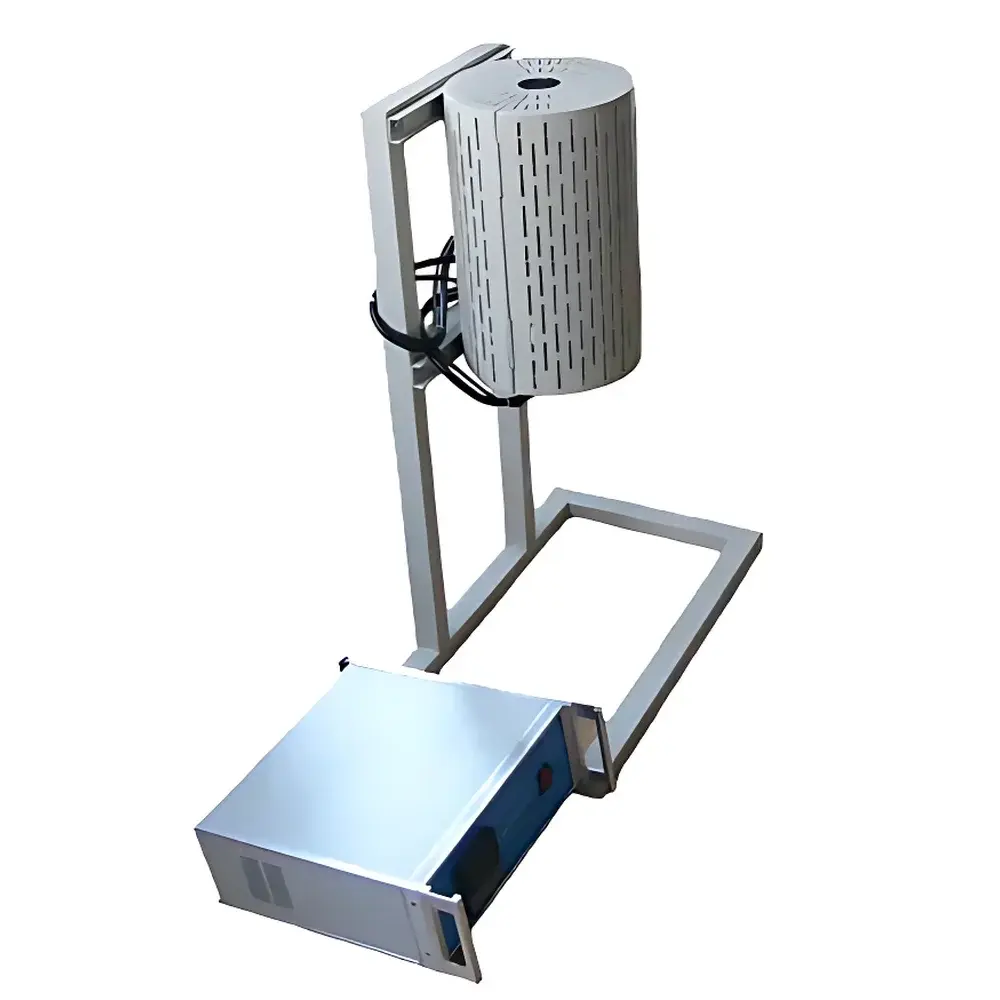
Zhuochi 30165-10A Vertical Split-Type Programmable Tube Furnace
| Brand | Zhuochi |
|---|---|
| Origin | Zhejiang, China |
| Model | 30165-10A (Vertical) |
| Instrument Type | Tube Furnace |
| Max Temperature | 1000 °C |
| Temperature Control Accuracy | ±1 °C |
| Max Power | 2.5 kW |
| Heating Rate (to Max Temp) | ≤50 °C/min |
| Heating Method | Resistance Wire Heating |
| Internal Chamber Dimensions | φ50 × 300 mm |
| Furnace Weight | ~10 kg |
| Power Supply | 220 V, 50 Hz |
| Temperature Sensor | K-type Thermocouple |
| Controller | LTDE Programmable PID Controller |
| Insulation | High-Efficiency Ceramic Fiber (Dual Semi-Cylindrical Modules) |
| Cooling Method | Air Cooling |
| Safety | Dual-Stage Over-Temperature Protection |
| Compliance | Designed for GLP-compliant lab environments |
Overview
The Zhuochi 30165-10A is a vertical split-type programmable tube furnace engineered for precision thermal processing in research laboratories, materials science departments, and quality control facilities. Unlike conventional monolithic tube furnaces, its dual semi-cylindrical ceramic fiber chamber design enables rapid, tool-free access to the heating zone—facilitating seamless integration with external reaction systems, quartz tubes (φ50 × 400–910 mm), or custom reactor assemblies. The furnace operates on resistive heating via embedded high-temperature resistance wire, delivering uniform axial temperature distribution across a 200 mm effective heating zone. With a maximum operating temperature of 1000 °C and thermal stability maintained at ±1 °C under steady-state conditions, it meets the stringent repeatability requirements of sintering, annealing, calcination, and controlled-atmosphere synthesis protocols. Its air-cooled metal enclosure—constructed from phosphate-treated cold-rolled steel with electrostatic gray powder coating—ensures mechanical robustness and long-term thermal cycling reliability.
Key Features
- Split-shell architecture: Two interlocking semi-cylindrical ceramic fiber modules allow full lateral access without disassembling tubing or fixtures—ideal for in-situ sample loading/unloading and real-time process intervention.
- High-efficiency insulation: Ultra-lightweight, low-thermal-mass ceramic fiber lining reduces energy consumption by up to 67% compared to traditional refractory brick furnaces, enabling faster ramp rates and lower standby losses.
- Precision temperature control: LTDE-series programmable PID controller with K-type thermocouple input offers 1 °C display resolution, adjustable ramp/soak profiles (up to 30 segments), and automatic termination logic upon completion of time-temperature sequences.
- Dual-stage over-temperature protection: Independent hardware-based cutoff (stage one) and software-monitored safety limit (stage two) prevent thermal runaway during unattended operation.
- Modular mounting compatibility: Standardized flange interface and optional vertical support bracket enable secure installation on laboratory stands, glovebox feedthroughs, or custom motion stages.
- GLP-ready instrumentation: Controller logs timestamped setpoint/actual temperature data with audit trail capability; firmware supports manual calibration offset entry per ISO/IEC 17025 documentation standards.
Sample Compatibility & Compliance
The 30165-10A accommodates cylindrical samples and reactors up to φ50 mm outer diameter and 300 mm length within its heated zone. It is routinely deployed with fused silica, alumina, or quartz tubes rated for inert, reducing, or vacuum atmospheres (≤10⁻³ mbar with auxiliary pumping). All electrical components—including solid-state relays, contactors, and cooling fans—comply with IEC 61000-6-3 EMC emission limits and IEC 61000-4-5 surge immunity requirements. While not CE-marked as a complete system, the furnace conforms to essential safety principles outlined in EN 61010-1:2010 for laboratory electrical equipment. When paired with NIST-traceable thermocouples and validated calibration procedures, it supports compliance with ASTM E220 (Standard Test Method for Calibration of Thermocouples By Comparison Techniques) and FDA 21 CFR Part 11–aligned data integrity practices where electronic records are generated.
Software & Data Management
The LTDE controller provides standalone programmability without PC dependency: users define multi-step thermal profiles (ramp rate, target temperature, dwell duration) via membrane keypad navigation. Real-time temperature curves are viewable on the 4-digit LED display, with status indicators for heating, soaking, cooling, and fault conditions. Optional RS485 serial interface (MODBUS RTU protocol) enables integration into SCADA or LIMS platforms for centralized monitoring, remote parameter adjustment, and automated data export to CSV or Excel formats. All profile executions are timestamped and stored in non-volatile memory (100-cycle retention); event logs record over-temperature alarms, power interruptions, and manual overrides—supporting 21 CFR Part 11 audit trail requirements when used with appropriate validation documentation.
Applications
- Materials synthesis: Controlled pyrolysis of MOFs, carbonization of polymer precursors, and oxide phase formation in battery cathode materials (e.g., LiCoO₂, NMC).
- Thermal analysis pre-treatment: Sample conditioning prior to TGA, DSC, or XRD—ensuring consistent dehydration, decomposition, or crystallization history.
- Catalyst activation: Reduction of transition metal oxides (e.g., NiO, CuO) under H₂/N₂ mixtures; sulfidation of CoMo/Al₂O₃ catalysts.
- Thin-film processing: Annealing of spin-coated sol-gel films (TiO₂, ZnO) on substrates inserted through the open chamber.
- Calibration reference: Serving as a stable, reproducible heat source for verifying infrared thermometer accuracy or validating thermocouple drift in metrology labs.
FAQ
What tube diameters and lengths are compatible with the 30165-10A?
Standard quartz or ceramic tubes with outer diameters of φ50 mm and lengths between 400 mm and 910 mm are supported; minimum usable length is determined by the 200 mm active heating zone.
Can the furnace operate under vacuum or reactive gas environments?
Yes—when sealed with appropriate end caps and gas/vacuum feedthroughs; ensure tube material compatibility (e.g., fused silica for vacuum, alumina for reducing atmospheres) and verify O-ring ratings for intended pressure range.
Is the ±1 °C accuracy specified at all temperatures or only at 1000 °C?
The ±1 °C control accuracy applies across the full operating range (100–1000 °C) under stabilized conditions; actual thermal uniformity within the 200 mm zone is ±3 °C per ASTM E220 Annex A3.
Does the unit include calibration certification?
No factory calibration certificate is supplied; however, the controller accepts user-entered thermocouple offset values, and third-party accredited calibration services can be performed using standard fixed-point cells or reference thermometers.
What maintenance is required for long-term reliability?
Annual inspection of ceramic fiber integrity, thermocouple junction condition, and electrical connections is recommended; avoid thermal shock by limiting ramp rates below 30 °C/min during initial startup cycles.



