
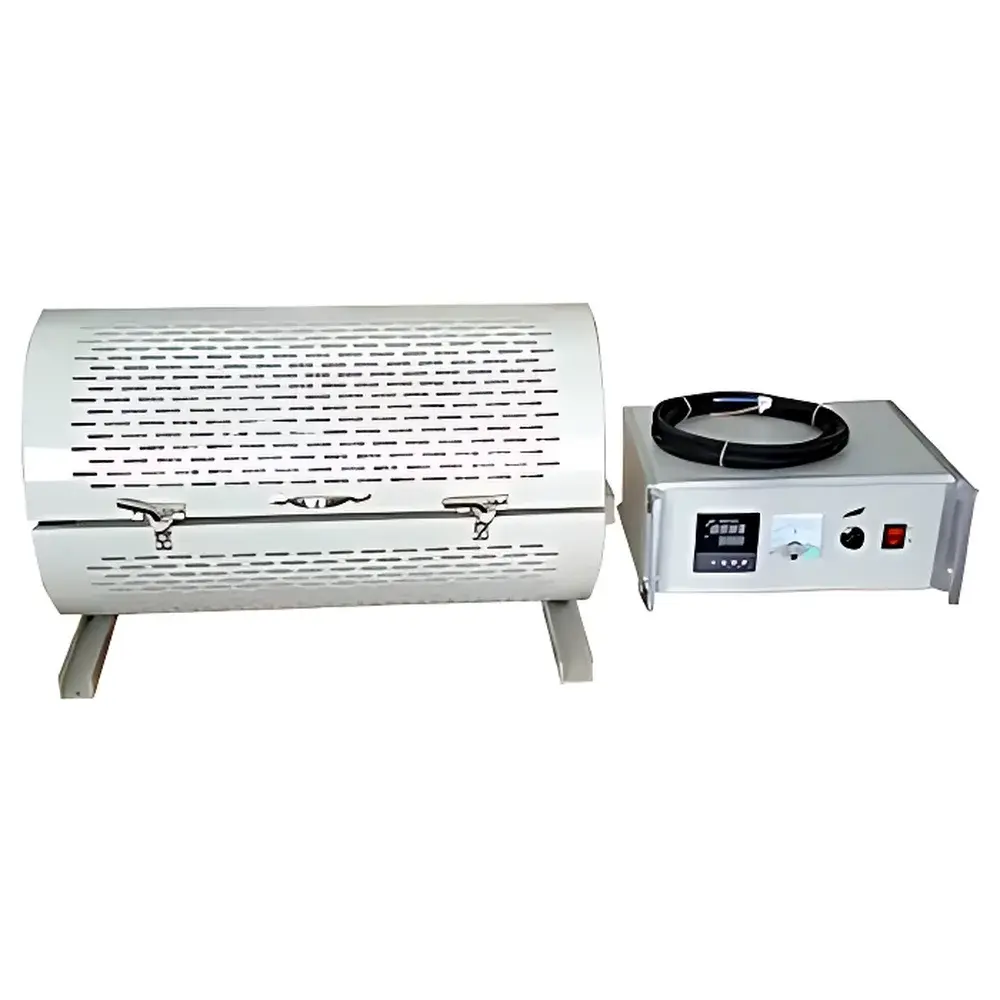
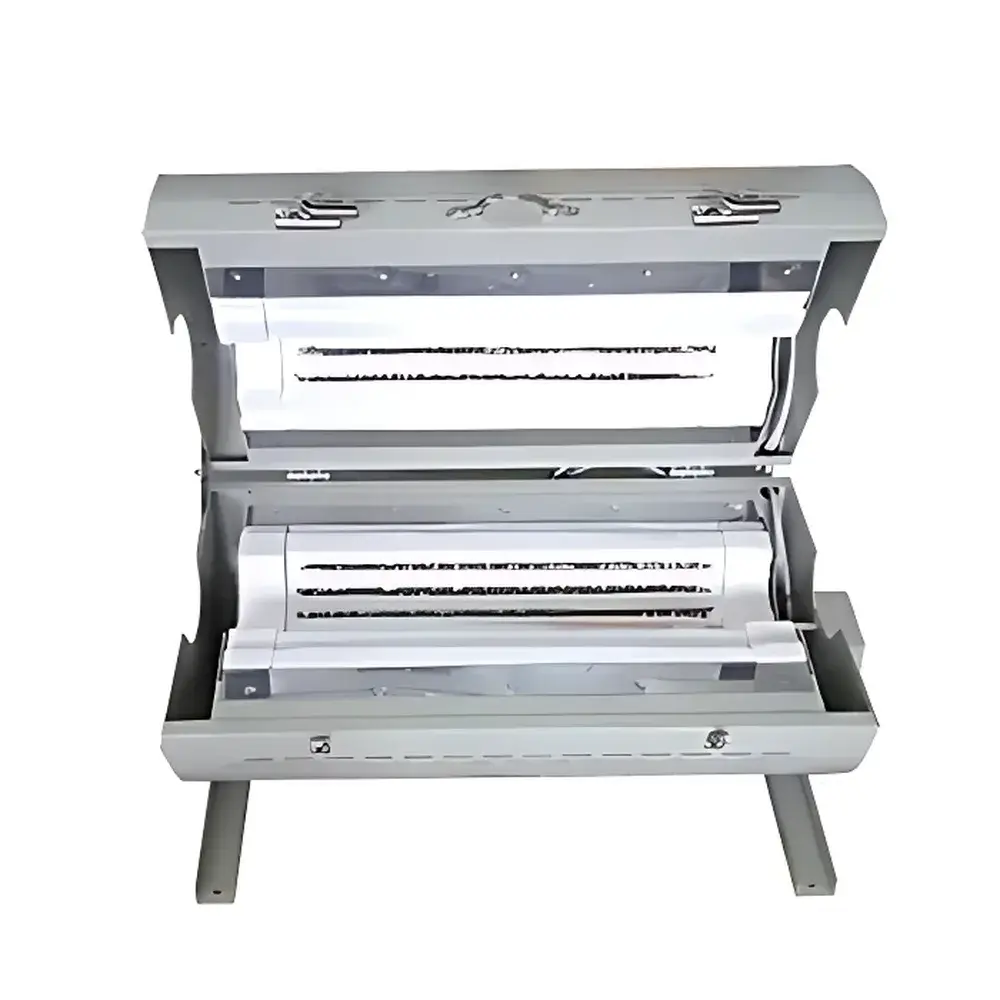
Zhuochi 60250-12-6 Open-Style Programmable Tube Furnace
| Brand | Zhuochi |
|---|---|
| Model | 60250-12-6 |
| Temperature Range | 100–1200 °C |
| Max. Temp | 1200 °C |
| Control Accuracy | ±1 °C |
| Display Resolution | 1 °C |
| Max. Power | 3 kW |
| Heating Rate (to max temp) | ≤50 °C/min |
| Heating Element | High-Temperature Resistance Wire |
| Chamber Dimensions | Ø60 × 600 mm |
| Effective Heating Zone | 500 mm |
| Compatible Tube Size | Ø60 × 610–1110 mm |
| Insulation | Dual-Half-Circle Ceramic Fiber Modular Liner |
| Cooling Method | Air Cooling |
| Thermocouple Type | S-Type Platinum-Rhodium/Platinum |
| Controller | LTDE Programmable PID Controller with Ramp/Soak Profiles |
| Safety Features | Dual-Stage Over-Temperature Protection |
| Power Supply | 220 V, 50 Hz |
| Net Weight | ~25 kg |
Overview
The Zhuochi 60250-12-6 Open-Style Programmable Tube Furnace is an engineered solution for high-precision thermal processing in research and industrial laboratories. Designed around a split-body (dual-hemispherical) ceramic fiber chamber architecture, it enables rapid, tool-free access to the heating zone without compromising thermal integrity or operational safety. Unlike conventional monolithic tube furnaces, this open-style configuration supports direct integration with existing reactor systems—eliminating the need for full tube replacement during experimental setup or maintenance. The furnace operates on resistive heating via embedded high-temperature resistance wire, delivering uniform axial temperature distribution across its 500 mm effective heating zone. With a maximum operating temperature of 1200 °C and a control accuracy of ±1 °C under steady-state conditions, it meets stringent requirements for materials synthesis, annealing, sintering, and controlled-atmosphere reactions. Its thermally optimized design—featuring low-heat-capacity ceramic fiber insulation—reduces energy consumption to approximately one-third that of traditional refractory-lined furnaces, supporting both cost-efficiency and environmental compliance in continuous-use environments.
Key Features
- Split-body modular construction: Two semi-cylindrical ceramic fiber chambers clamp together, enabling instant access to samples or reaction tubes without disassembly or cooldown.
- Programmable thermal profiles: LTDE-based PID controller supports multi-segment ramp-soak programs, adjustable heating rates (0.1–50 °C/min), and automatic termination upon completion of scheduled cycles.
- Dual-stage over-temperature protection: Independent hardware-level cutoff (Stage 1) and software-monitored alarm (Stage 2) ensure fail-safe operation during unattended runs.
- High-fidelity temperature sensing: S-type platinum-rhodium/platinum thermocouple integrated at the furnace mouth provides traceable, NIST-compatible measurement with 1 °C display resolution.
- Air-cooled metal enclosure: Powder-coated cold-rolled steel housing with phosphate conversion treatment ensures long-term corrosion resistance and mechanical stability.
- Universal tube compatibility: Accommodates quartz, alumina, or stainless-steel tubes from Ø60 × 610 mm to Ø60 × 1110 mm; optional ground-glass end caps enable vacuum sealing or inert gas purging (N₂, Ar, forming gas).
Sample Compatibility & Compliance
The 60250-12-6 is routinely deployed in applications requiring precise thermal history control under non-oxidizing or reactive atmospheres. Its open design allows seamless coupling with standard Schlenk lines, vacuum manifolds, and gas-mixing systems—enabling experiments compliant with ASTM E1113 (standard test method for calibration of thermocouples), ISO 8573-1 (compressed air purity), and USP environmental controls for sterile compounding support equipment. When operated with certified quartz tubing and appropriate gas delivery infrastructure, the system supports GLP- and GMP-aligned workflows, including batch record generation with time-stamped temperature logs. All electrical components—including solid-state relays, contactors, and cooling fans—meet CE and RoHS directives. No internal lubricants or organic binders are used in the ceramic fiber liner, ensuring ultra-low outgassing (<10⁻⁶ Torr after bakeout), critical for thin-film deposition and catalyst activation protocols.
Software & Data Management
While the LTDE controller operates as a standalone unit with front-panel programming, optional RS485/Modbus RTU interface enables integration into centralized lab automation platforms (e.g., LabVIEW, DeltaV, or custom SCADA). Real-time temperature data, program status, and fault codes can be streamed at user-defined intervals (1–60 s). For regulated environments, optional firmware upgrade supports 21 CFR Part 11-compliant audit trails—including operator ID, parameter changes, start/stop timestamps, and electronic signatures—when paired with validated third-party data acquisition software. All program files are stored in non-volatile memory with battery-backed retention (>10 years), eliminating data loss during power interruption. Calibration constants for the S-type thermocouple may be adjusted via password-protected service mode, maintaining metrological traceability per ISO/IEC 17025 requirements.
Applications
- Controlled-atmosphere annealing of semiconductor wafers and thin-film substrates
- Thermal decomposition studies (TGA-like protocols) using quartz reaction tubes
- Catalyst calcination and regeneration under N₂/H₂ mixtures
- Carbonization and graphitization of polymer-derived ceramics
- Low-pressure CVD precursor pyrolysis with inline mass spectrometry coupling
- Material phase transformation analysis (e.g., martensitic transitions, polymorph screening)
- Pre-treatment of electrodes for battery R&D (Li-ion, solid-state)
FAQ
What tube materials are compatible with the 60250-12-6?
Quartz (fused silica), high-purity alumina, and Inconel 600 tubes are verified for use up to 1200 °C. Borosilicate glass is not recommended above 550 °C.
Can the furnace operate under vacuum?
Yes—when fitted with vacuum-rated quartz tubing and a ground-glass or metal-flange end cap, it achieves base pressures down to 10⁻³ Torr with standard two-stage rotary vane pumps.
Is the temperature uniformity profile documented?
A radial uniformity of ±3 °C and axial uniformity of ±5 °C across the 500 mm hot zone is validated per ASTM E220 at 1000 °C and 1200 °C.
Does the controller support external thermocouple inputs for sample monitoring?
Yes—the LTDE unit includes one auxiliary thermocouple input channel for independent sample temperature feedback, configurable as a secondary control or monitoring loop.
What maintenance is required for long-term reliability?
Annual verification of thermocouple drift and visual inspection of ceramic fiber integrity are recommended. No lubrication or consumable parts are required within the heating chamber.



