
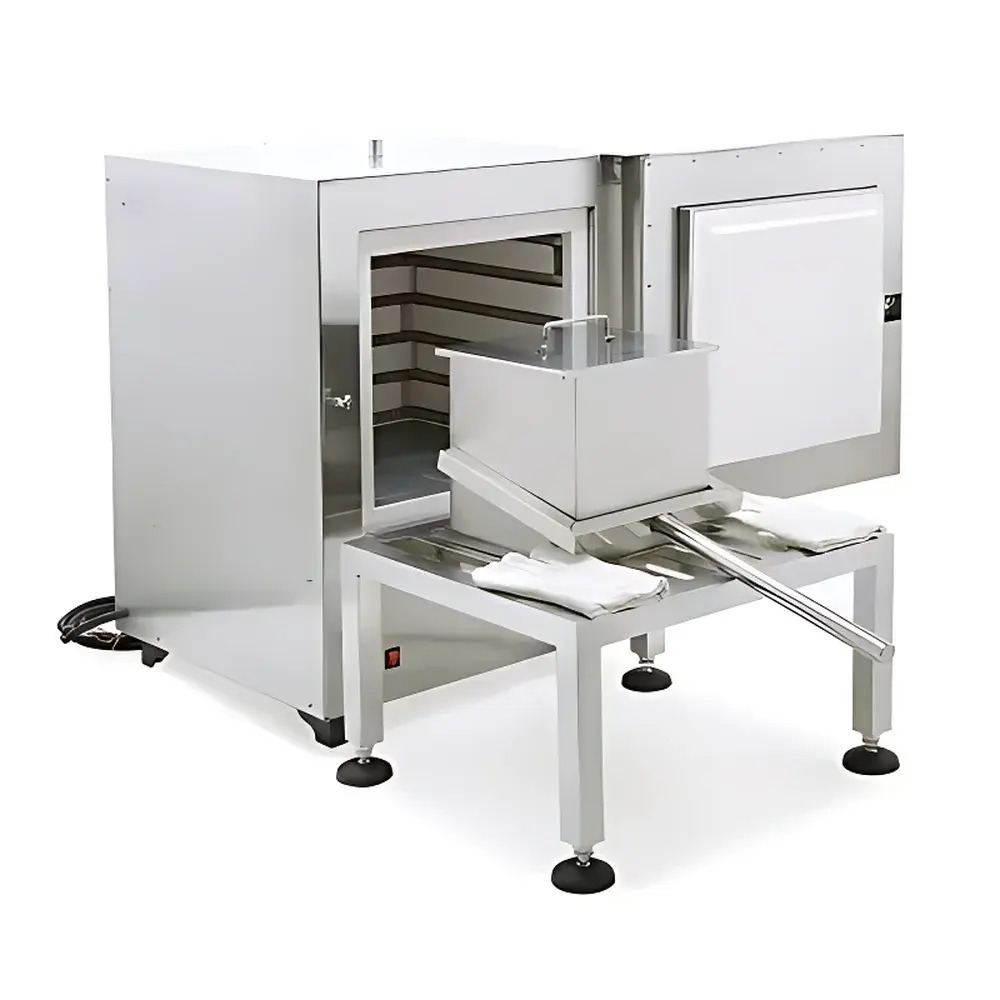
Zhuochi GMP8-10 Pharmaceutical Calcination Furnace (Box-Type Muffle Furnace)
| Brand | Zhuochi |
|---|---|
| Origin | Zhejiang, China |
| Model | GMP8-10 |
| Instrument Type | Box-Type Muffle Furnace |
| Max Temperature | 50–1000 °C |
| Temperature Control Accuracy | ±1 °C |
| Display Resolution | 1 °C |
| Internal Chamber Dimensions | 400 × 400 × 400 mm |
| External Dimensions | 690 × 610 × 810 mm |
| Rated Power | 8 kW |
| Heating Rate (to max temp) | ≤60 °C/min (adjustable) |
| Heating Element | High-Temperature Resistance Wire |
| Thermal Sensor | K-Type Nickel-Chromium/Nickel-Silicon Thermocouple |
| Control System | LTDE Programmable PID Controller with Ramp/Soak Programming |
| Safety Features | Dual-Stage Over-Temperature Protection |
| Insulation | High-Emissivity, Low-Heat-Capacity Ceramic Fiber Lining (Six-Sided Modular Assembly) |
| Enclosure Options | Cold-Rolled Steel with Epoxy Powder Coating OR 304 Stainless Steel Fully Sealed Housing |
| Weight | ~80 kg |
| Compliance | Designed to Support GMP Documentation Requirements (21 CFR Part 11 Readiness via Optional Audit Trail Logging) |
Overview
The Zhuochi GMP8-10 Pharmaceutical Calcination Furnace is a precision-engineered box-type muffle furnace designed specifically for thermal processing of traditional Chinese medicinal materials under Good Manufacturing Practice (GMP)-aligned laboratory and pilot-scale production environments. It operates on the principle of resistive heating via high-temperature resistance wire elements embedded within a six-sided modular ceramic fiber insulation chamber—ensuring rapid thermal response, minimal heat inertia, and uniform temperature distribution across the 400 × 400 × 400 mm working volume. The furnace supports three primary calcination modes: open-fire (ming duan), covered (an duan), and quenching post-calcination (duan cui), critical for mineral-based (e.g., hematite, magnetite, stalactite), shell-derived (e.g., oyster shell, mother-of-pearl), and animal-derived herbal substances requiring controlled oxidative decomposition, carbonization, or structural transformation. Its operational range (50–1000 °C), ±1 °C control stability, and programmable ramp/soak profiles enable reproducible thermal protocols compliant with pharmacopoeial monographs (e.g., Chinese Pharmacopoeia 2020 Edition, Section 0213) and internal quality standards.
Key Features
- Modular ultra-lightweight ceramic fiber lining with high emissivity and low thermal mass—enables ≤10-minute no-load heating to 500 °C, reducing energy consumption by >90% versus conventional refractory-lined furnaces of equivalent volume.
- LTDE-series programmable PID controller with 30-segment ramp/soak capability, real-time temperature display (1 °C resolution), and automatic termination upon completion of timed cycles.
- Dual-stage over-temperature protection system: primary electronic cutoff at setpoint +15 °C and secondary mechanical fuse at 1050 °C—meeting IEC 61000-4-5 surge immunity and EN 60519-1 electrical safety requirements for industrial heating equipment.
- Two enclosure configurations available: cold-rolled steel housing with epoxy powder coating (for cost-sensitive R&D labs) or fully sealed 304 stainless steel casing (for GMP-regulated cleanroom-adjacent installation).
- Top-mounted exhaust port (Φ80 mm) compatible with active fume extraction systems; optional stainless steel flat-bottom calcination pan (350 × 340 × 300 mm internal) included for direct material contact and efficient heat transfer during batch processing.
- Integrated cooling fan and solid-state relay-driven power modulation ensure stable operation at low-temperature holds (<200 °C) and prevent thermal overshoot during rapid transitions.
Sample Compatibility & Compliance
The GMP8-10 accommodates heterogeneous solid samples including crushed mineral ores, pulverized shell fragments, dried animal tissues, and botanical rhizomes—compatible with both loose-fill and pan-contained loading formats. Its chamber geometry and airflow design minimize thermal stratification, supporting ASTM E1112-22 (Standard Practice for Calibrating Muffle Furnaces) traceable validation. While not pre-certified to ISO 13485 or FDA QSR, the furnace’s architecture—including segregated control wiring, accessible thermocouple calibration ports, and configurable data logging interfaces—facilitates IQ/OQ/PQ execution per EU Annex 15 and WHO TRS 986 guidelines. Optional audit trail modules support 21 CFR Part 11-compliant electronic records when integrated with validated SCADA platforms.
Software & Data Management
The LTDE controller provides local parameter configuration via membrane keypad and LED display. For enhanced traceability, optional RS485 Modbus RTU output enables integration with LabVIEW, MATLAB, or LIMS systems for automated temperature logging, alarm event capture, and cycle signature archiving. All programmable profiles are password-protected and retain settings after power loss. Firmware supports user-defined alarm thresholds (e.g., deviation >±3 °C for >60 s), email/SMS notification triggers (via external gateway), and CSV export of time-stamped temperature histories—supporting GLP documentation workflows and internal CAPA investigations.
Applications
- Pharmaceutical manufacturing: Calcination of mineral APIs (e.g., Fe₂O₃ from hematite), detoxification of heavy-metal-containing herbs, and preparation of catalytic excipients.
- Academic research: Kinetic studies of thermal decomposition pathways in TCM raw materials using TGA-correlated isothermal holds.
- Quality control laboratories: Batch verification of calcination endpoint (e.g., red-to-black color transition in magnetite, friability testing post-calcination).
- Chemical synthesis: Precursor annealing for metal oxide nanoparticle fabrication, catalyst support activation, and ash content determination per USP <281>.
- Food & nutraceutical processing: Mineral fortification matrix development and thermal stabilization of calcium-rich marine byproducts.
FAQ
What is the maximum recommended continuous operating temperature?
The furnace is rated for sustained operation up to 950 °C; 1000 °C is designated as short-term limit (≤30 min) to preserve thermocouple longevity and insulation integrity.
Can the stainless steel enclosure option be cleaned with ethanol or isopropyl alcohol?
Yes—the 304 SS surface is compatible with standard pharmaceutical-grade disinfectants; avoid chloride-containing cleaners to prevent pitting corrosion.
Is third-party temperature mapping validation supported?
Yes—four standardized thermocouple access ports (rear, top, left, right) allow for 9- or 16-point mapping per ISO 14644-3; validation kits with calibrated reference sensors are available separately.
Does the unit include a CE or UL mark?
It carries CE marking per Machinery Directive 2006/42/EC and EMC Directive 2014/30/EU; UL listing requires site-specific field evaluation due to regional voltage configuration (380 V / 50 Hz).
How is calibration traceability maintained?
Each unit ships with a factory calibration certificate referencing NIST-traceable standards; annual recalibration using a portable dry-block calibrator (e.g., Fluke 9143) is recommended per ISO/IEC 17025.



