
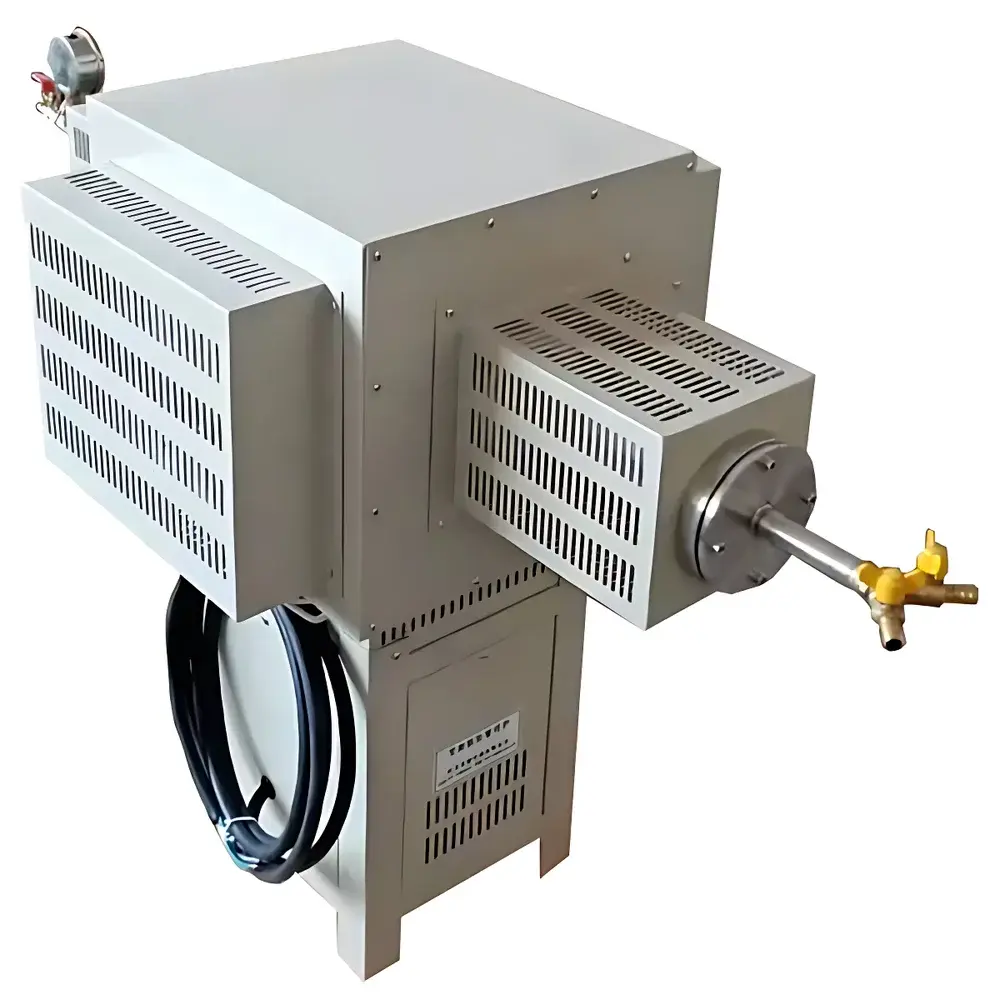
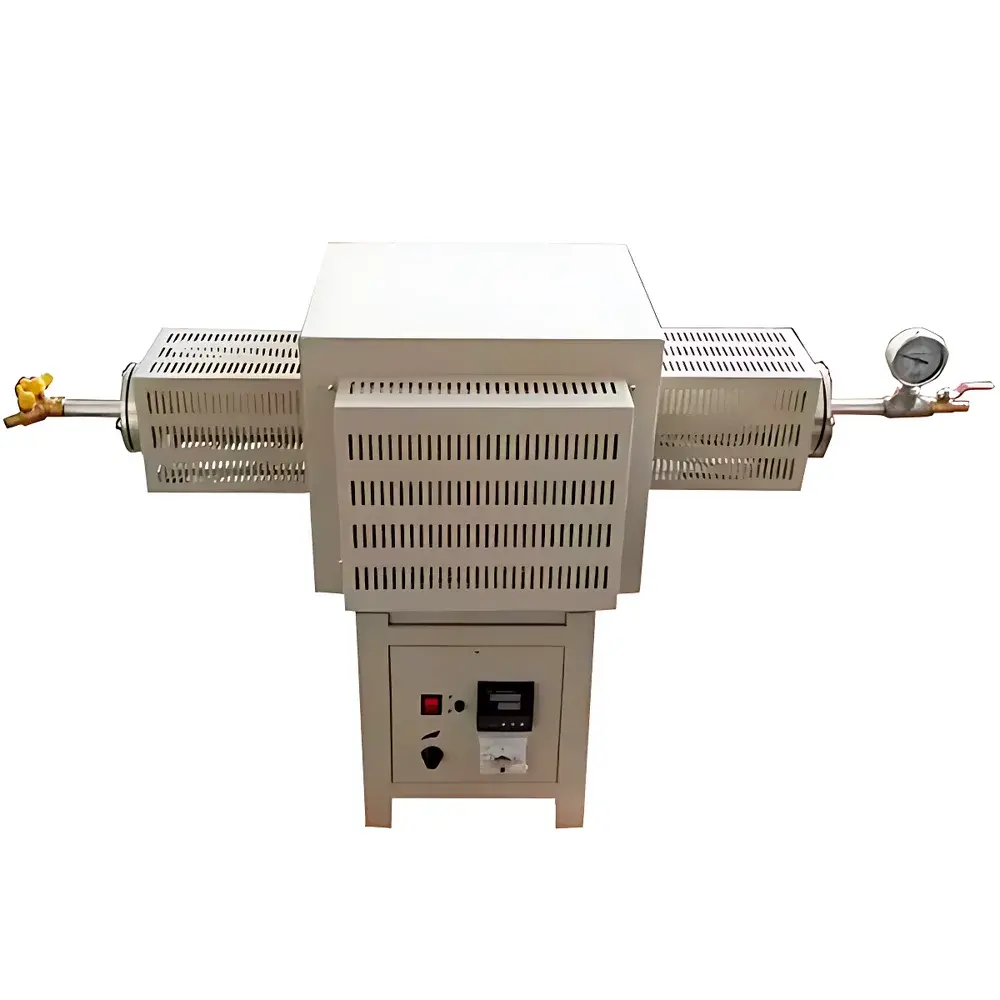
Zhuochi SK3-4-13-4 High-Temperature Tube Furnace for GB/T 43352–2023 Fluoride Extraction in Packaging Materials
| Brand | Zhuochi |
|---|---|
| Origin | Zhejiang, China |
| Model | SK3-4-13-4 |
| Instrument Type | Tube Furnace |
| Max Temperature | 1300 °C |
| Temperature Control Accuracy | ±1 °C |
| Max Power | 4 kW |
| Heating Time to Max Temp | 50 min |
| Heating Element | Silicon Carbide Rods |
| Internal Chamber Dimensions | 40 mm Ø × 380 mm L |
| Tube Dimensions | 40 mm Ø × 810 mm L |
| Heating Method | Resistive (SiC rod) |
| Insulation | Multi-layer Alumina Fiber Blanket + Lightweight Refractory Board |
| Thermocouple Type | S-type (PtRh10–Pt) |
| Control System | LTDE Programmable PID Controller with Ramp/Soak Profile Capability |
| Safety | Dual-stage Overtemperature Protection (Independent Limit Controller + Sensor Redundancy) |
| Weight | ~35 kg |
Overview
The Zhuochi SK3-4-13-4 high-temperature tube furnace is engineered for precise, reproducible thermal decomposition of packaging materials in accordance with the methodology specified in GB/T 43352–2023 — the Chinese national standard governing limits for heavy metals and specific substances (including fluorides) in express delivery packaging. This furnace enables controlled pyrolysis under oxidizing steam–oxygen atmosphere at 1250 °C for 15 minutes, a critical step in quantitative fluoride release prior to ion chromatographic analysis. Its design centers on thermal uniformity, process repeatability, and compliance-ready operation: the S-type thermocouple provides traceable temperature measurement per IEC 60584, while the LTDE programmable controller supports user-defined ramp/soak profiles with data logging capability suitable for GLP-aligned workflows.
Key Features
- Stable high-temperature operation up to 1300 °C, validated for sustained 1250 °C processing required by GB/T 43352–2023 Clause 7.3;
- ±1 °C control accuracy across the full operating range, achieved via dual-loop PID regulation with S-type thermocouple feedback and real-time compensation;
- High-purity alumina ceramic tube (99.5% Al2O3) with stainless steel flange sealing system ensures inert, leak-tight reaction environment during steam–O2 co-flow;
- Multi-zone insulation architecture: six-sided lightweight refractory fiber board core + high-density alumina fiber blanket minimizes thermal mass and improves energy efficiency;
- Dual-stage overtemperature protection: primary controller limit + independent mechanical cut-off relay prevents uncontrolled excursions beyond setpoint;
- Bottom-access configuration for thermocouple insertion, power terminals, and gas inlet/outlet ports simplifies integration with external gas manifolds and condensate collection systems.
Sample Compatibility & Compliance
The furnace accommodates standard quartz combustion boats (e.g., 25 × 80 mm) placed inside the 40 mm-diameter alumina tube. Sample preparation follows GB/T 43352–2023 Section 7: mixing test material with quartz sand, covering with additional quartz sand, and introducing controlled steam (via calibrated vapor generator) and oxygen (1.0 L/min, certified grade) through the sealed tube inlet. The system is compatible with ISO/IEC 17025-accredited laboratories performing fluoride speciation in polymeric, laminated, or coated packaging substrates. All electrical components meet CE low-voltage directive requirements; thermal insulation materials conform to GB/T 20285–2006 for non-combustibility classification.
Software & Data Management
The LTDE programmable controller supports up to 30 segment ramp/soak programs, with time-stamped event logging (start, hold, end, fault). While the unit does not include embedded Ethernet or USB export, its RS485 interface allows connection to external SCADA or LIMS platforms via Modbus RTU protocol. Audit trails—including parameter changes, profile execution history, and overtemperature alarms—are retained in non-volatile memory for ≥12 months. For FDA 21 CFR Part 11 compliance, optional third-party validation packages (IQ/OQ/PQ) are available through authorized service partners, including calibration certificates traceable to NIM (National Institute of Metrology, China).
Applications
- Fluoride extraction from fluorinated ethylene propylene (FEP), polytetrafluoroethylene (PTFE), and perfluoroalkyl substance (PFAS)-treated paperboard per GB/T 43352–2023;
- Thermal desorption of halogenated additives in plastic films prior to IC or IC-MS analysis;
- Controlled ashing of composite packaging layers for subsequent heavy metal digestion (Pb, Cd, Hg, Cr(VI));
- Method development for ISO 10390-based fluoride leaching protocols in food contact materials;
- Research-scale pyrolysis studies requiring inert-atmosphere stability at >1200 °C (with optional vacuum or purge gas retrofit).
FAQ
What gas flow rates and compositions are recommended for GB/T 43352–2023 fluoride extraction?
Oxygen flow must be maintained at 1.0 L/min ±0.05 L/min, with saturated steam introduced upstream using a temperature-controlled vaporizer (100 °C). Total gas residence time in the hot zone should exceed 30 seconds.
Is the alumina tube resistant to hydrofluoric acid (HF) formation during fluoropolymer decomposition?
Yes — 99.5% purity alumina exhibits excellent resistance to HF corrosion below 1300 °C; however, routine post-run cleaning with dilute NaOH solution is advised to remove residual fluorosilicates.
Can this furnace be used for ASTM D7348–18 (halogen content by oxygen bomb combustion)?
No — the SK3-4-13-4 is designed for atmospheric-pressure steam–oxygen pyrolysis, not high-pressure oxygen combustion. It does not meet ASTM D7348 pressure vessel or safety interlock requirements.
What maintenance intervals are recommended for the silicon carbide heating elements?
Under continuous 1250 °C operation, SiC rods typically retain nominal resistance for ≥2000 hours; visual inspection every 200 cycles and resistance measurement every 500 hours are advised.
Does the furnace support automated sample loading/unloading?
Not natively — it requires manual insertion of combustion boats via the tube ends. Robotic integration is possible via third-party linear stages with custom flange adapters.



