
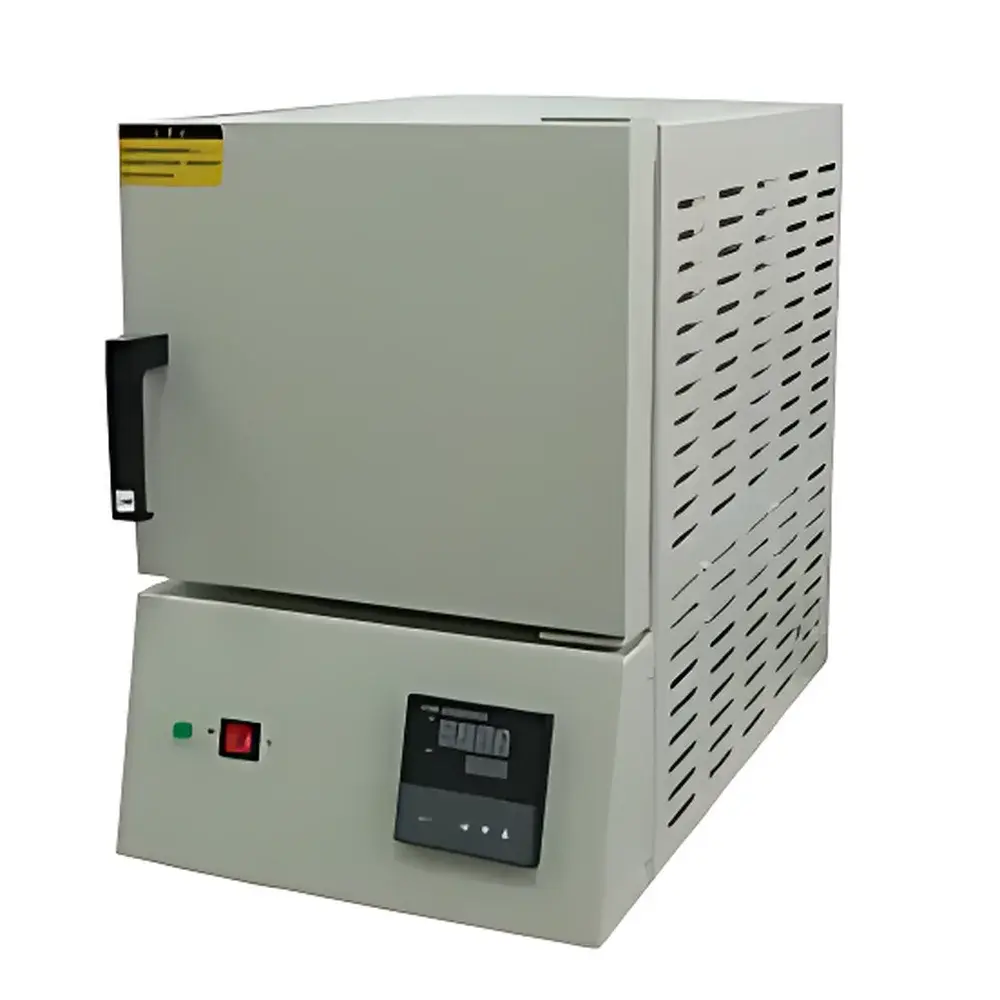
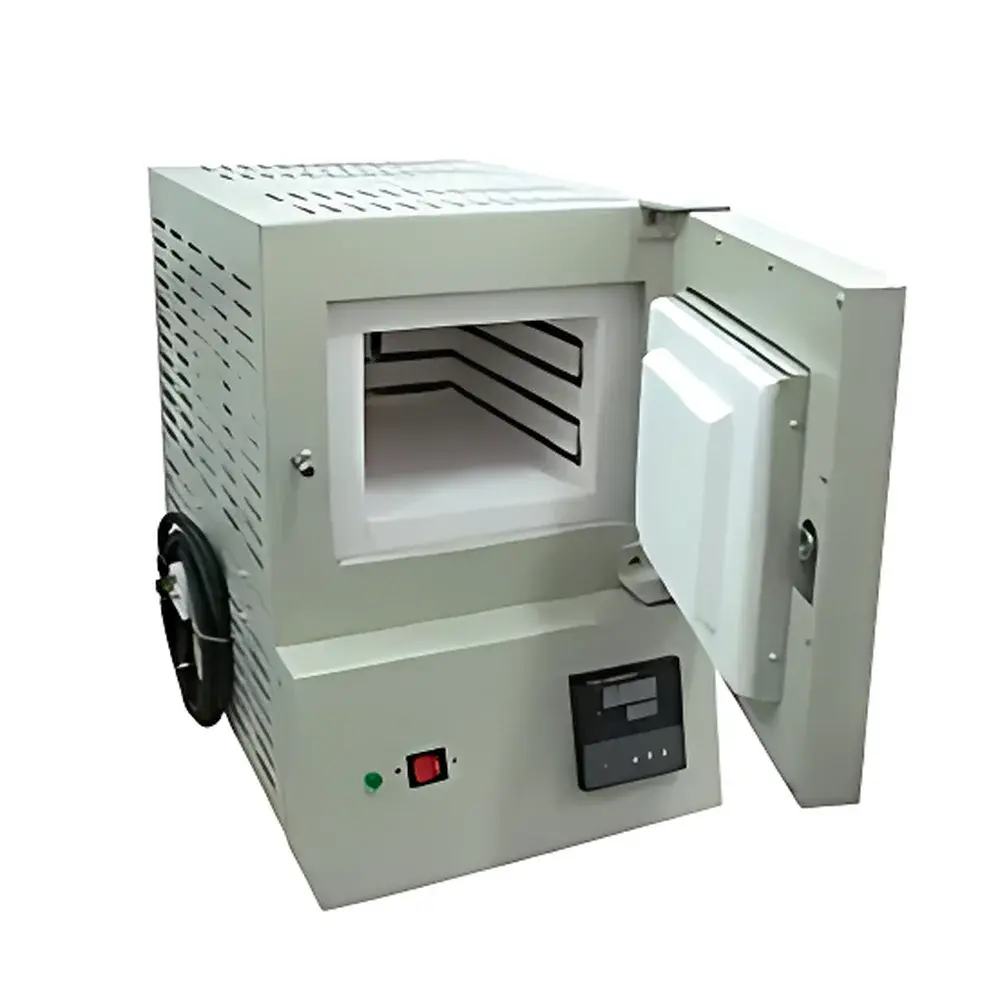
Zhuochi SX3-3-10 Ceramic Fiber Muffle Furnace
| Brand | Zhuochi |
|---|---|
| Origin | Zhejiang, China |
| Model | SX3-3-10 |
| Type | Box-type Muffle Furnace |
| Max Temperature | 1000 °C |
| Temperature Uniformity | ±1 °C |
| Display Resolution | 1 °C |
| Heating Element | High-Temperature Resistance Wire |
| Internal Chamber Dimensions | 300 × 200 × 150 mm |
| External Dimensions | 540 × 365 × 525 mm |
| Rated Power | 3 kW |
| Voltage/Frequency | 220 V, 50 Hz |
| Ramp Rate | Up to 50 °C/min (fully adjustable) |
| Net Weight | ~32 kg |
| Control System | LTDE 30-Stage Programmable PID Controller with Dual Over-Temperature Protection |
| Insulation | Six-Sided High-Emissivity Ceramic Fiber Board |
| Thermocouple Type | K-Type (Chromel–Alumel) |
Overview
The Zhuochi SX3-3-10 Ceramic Fiber Muffle Furnace is a compact, high-efficiency box-type laboratory furnace engineered for precise thermal processing in academic, industrial, and quality control environments. Designed around advanced ceramic fiber insulation technology, it operates on the principle of resistive heating via high-temperature resistance wire embedded within a low-thermal-mass chamber. Unlike traditional refractory brick furnaces, its six-sided ultra-lightweight ceramic fiber board construction minimizes heat storage, enabling rapid thermal response and exceptional energy efficiency—verified by independent testing showing up to 65% lower power consumption during equivalent soak cycles. The furnace achieves stable operation across a working range of 100 °C to 1000 °C, with temperature uniformity maintained at ±1 °C throughout the 300 × 200 × 150 mm workspace. Its integrated LTDE control architecture supports full programmability, making it suitable for standardized thermal protocols required in ASTM E1113 (heat treatment of metals), ISO 5660 (fire reaction testing), and USP heavy metal residue analysis.
Key Features
- Ultra-fast ramp capability: Reaches 1000 °C in under 20 minutes with fully adjustable heating rate (0.1–50 °C/min), supporting time-sensitive workflows such as ashing, calcination, and sintering pre-treatment.
- High-precision temperature control: K-type thermocouple feedback combined with PID + SSR regulation ensures repeatability within ±1 °C at setpoint, validated per IEC 60584-2 calibration standards.
- Modular ceramic fiber chamber: Constructed from high-radiation, low-thermal-accumulation fiberboard rated for continuous service at 1000 °C; withstands repeated thermal cycling without degradation or cracking.
- Pre-wired integrated design: Electrical interconnection between furnace body and controller is factory-completed; no field wiring or commissioning required—plug-and-play operation after grounding and voltage verification.
- Dual-stage over-temperature protection: Primary limit controlled by the LTDE system; secondary hardware cutoff activated independently at 1050 °C, compliant with EN 61000-6-2 electromagnetic compatibility and IEC 61000-6-4 emission requirements.
- Compact footprint with expanded usable volume: External dimensions of 540 × 365 × 525 mm enclose a chamber 50% larger than conventional furnaces of comparable outer size, optimizing benchtop space utilization.
Sample Compatibility & Compliance
The SX3-3-10 accommodates standard crucibles (alumina, quartz, stainless steel), ceramic tiles, powdered metallurgical samples, and polymer composites up to 3 L total volume. Its air-cooled shell design and rear-mounted thermocouple port ensure safe handling of volatile or reactive materials without external venting. The furnace meets essential safety and performance benchmarks including UL 61010-1 (Laboratory Equipment Safety), CE marking under the Low Voltage Directive 2014/35/EU, and RoHS 2011/65/EU material restrictions. For regulated environments, its LTDE controller logs timestamped temperature profiles and supports optional audit trail export—facilitating alignment with GLP documentation requirements and FDA 21 CFR Part 11 data integrity expectations when paired with validated software interfaces.
Software & Data Management
While the SX3-3-10 operates autonomously via its front-panel LTDE interface, it supports analog output (0–5 V or 4–20 mA) for connection to external data acquisition systems. The 30-segment programmable profile allows definition of ramp rates, hold durations, and cooling steps—including multi-step annealing sequences used in semiconductor substrate preparation or catalyst activation studies. All parameters are stored non-volatilely and retain settings after power interruption. Optional RS485 Modbus RTU communication enables integration into centralized lab management platforms for remote monitoring and batch record generation. Firmware updates are performed via USB port using manufacturer-provided configuration tools, ensuring long-term compliance with evolving instrumentation validation protocols.
Applications
- Residue analysis and ash content determination per AOAC 942.05 and ISO 2171.
- Thermal gravimetric pre-conditioning of catalyst supports prior to BET surface area measurement.
- Heat treatment of dental alloys and orthopedic implant prototypes under controlled oxidizing atmospheres.
- Pre-firing of ceramic green bodies in materials science R&D labs.
- Calibration verification of thermocouples and infrared pyrometers using fixed-point reference materials (e.g., Al, Zn, Sn).
- Accelerated aging tests for battery electrode materials under inert gas purge (when fitted with optional flange kit).
FAQ
What is the maximum recommended continuous operating temperature?
The SX3-3-10 is rated for continuous operation at 1000 °C. Prolonged use above this temperature may compromise fiber integrity and void warranty coverage.
Can the furnace be operated under inert or reducing atmospheres?
Standard configuration is for air atmosphere only. For inert or reducing gas applications, an optional sealed flange assembly with gas inlet/outlet ports and O-ring sealing must be installed—and gas flow rates must remain below 1 L/min to prevent convective heat loss and thermocouple drift.
Is the LTDE controller compatible with third-party SCADA systems?
Yes—via Modbus RTU over RS485, provided the host system implements standard function codes 03 (read holding registers) and 06 (write single register) as defined in Modbus Application Protocol v1.1b.
How often should the K-type thermocouple be recalibrated?
Annual calibration against NIST-traceable references is recommended for GMP/QC applications; biannual verification suffices for academic research where absolute accuracy is secondary to intra-experiment consistency.
Does the furnace include a certificate of conformance or factory calibration report?
Each unit ships with a signed CoC listing serial number, measured cold resistance of heating elements, and ambient-temperature thermocouple offset verification. Full calibration reports are available upon request at time of order.



