
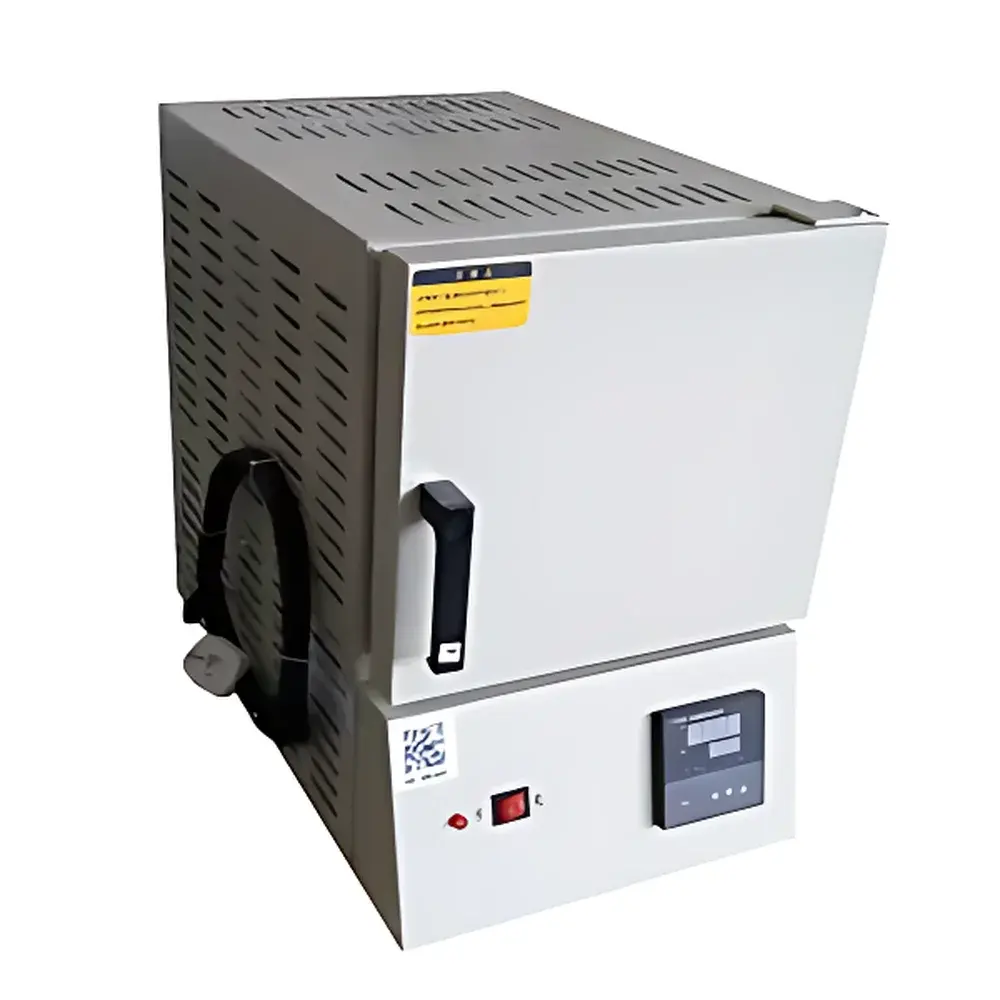
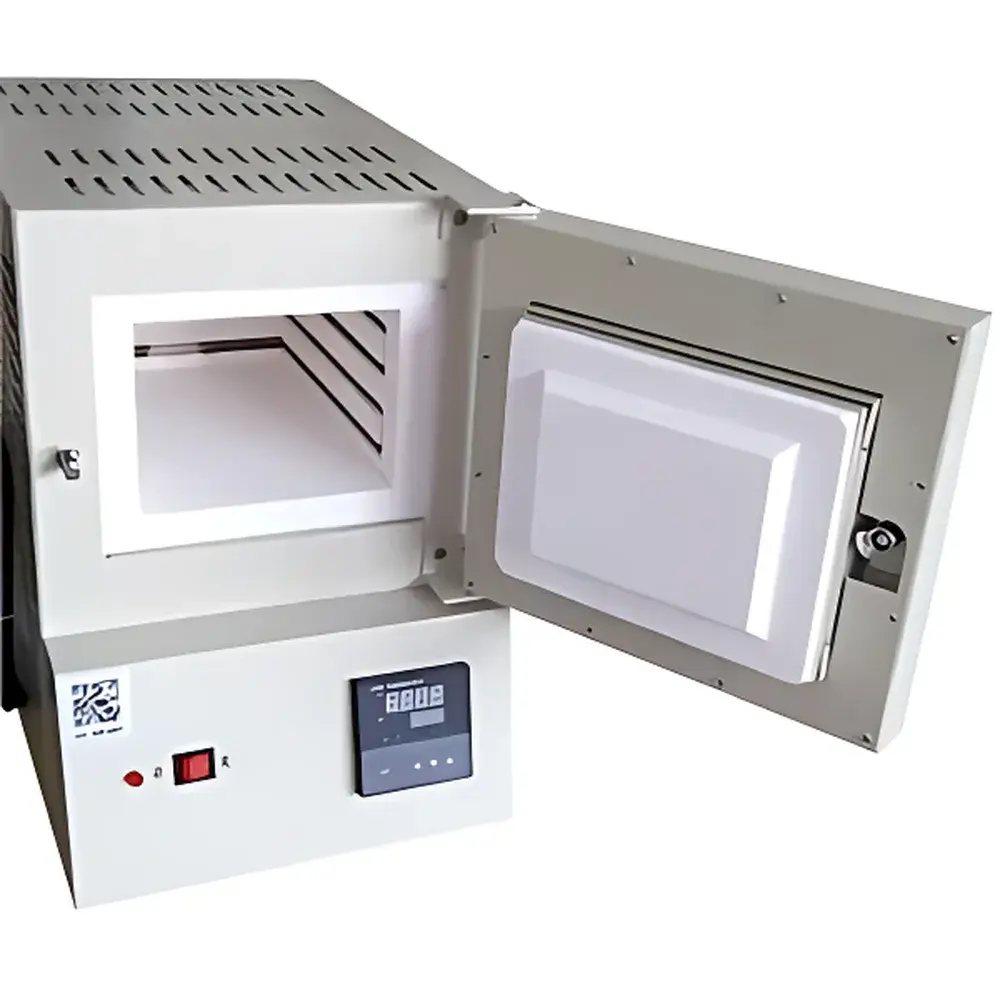
Zhuochi SX3-3-10 Ceramic Fiber Muffle Furnace for Tea Ash and Moisture Determination
| Brand | Zhuochi |
|---|---|
| Origin | Zhejiang, China |
| Model | SX3-3-10 |
| Instrument Type | Box-Type Muffle Furnace |
| Max Temperature | 1000 °C |
| Temperature Uniformity | ±1 °C |
| Heating Rate | Up to 50 °C/min (adjustable) |
| Power Rating | 3 kW |
| Internal Chamber Dimensions | 300 × 200 × 150 mm (L×W×H) |
| Heating Element | High-Temperature Resistance Wire |
| Insulation Material | Lightweight Ceramic Fiber Board |
| Weight | ~32 kg |
| Power Supply | 220 V, 50 Hz |
| Control System | LTDE 30-Stage Programmable PID Controller with Dual Over-Temperature Protection |
| Compliance | Designed for ASTM D3174, ISO 287, ISO 15171, and GB/T 8306–2013 (Tea – Determination of Ash) |
Overview
The Zhuochi SX3-3-10 Ceramic Fiber Muffle Furnace is a precision-engineered laboratory furnace specifically configured for standardized ash content and moisture determination in tea and other botanical materials. It operates on the principle of controlled high-temperature calcination (for ash analysis per ASTM D3174 or ISO 287) and gravimetric loss-on-drying (LOD) protocols (aligned with ISO 15171 and Chinese national standard GB/T 8306–2013). Unlike conventional refractory brick muffle furnaces, this unit employs a six-sided modular ceramic fiber chamber—offering rapid thermal response, minimal thermal mass, and exceptional energy efficiency. Its maximum operating temperature of 1000 °C enables complete organic matrix combustion while preserving inorganic residue integrity for accurate ash quantification. The furnace integrates seamlessly into GLP-compliant workflows when paired with analytical balances and desiccators, supporting full traceability in food safety, quality control, and regulatory testing laboratories.
Key Features
- Ultra-lightweight ceramic fiber insulation reduces total unit mass by ~70% versus traditional muffle furnaces—enabling improved portability and reduced structural load in shared lab spaces.
- Programmable 30-segment LTDE controller supports complex thermal profiles: ramp-hold-cool sequences essential for method validation, inter-laboratory reproducibility, and multi-step ashing protocols (e.g., pre-charring at 105 °C followed by final ashing at 550 °C).
- PID + SSR temperature regulation ensures stable setpoint maintenance within ±1 °C across the full 100–1000 °C range, critical for compliance with USP & AOAC moisture/ash methodology requirements.
- Dual-stage over-temperature protection (mechanical and electronic) meets IEC 61000-4-2 safety standards and mitigates risk during unattended operation.
- Pre-wired integrated architecture eliminates field wiring errors; power connection only is required—reducing commissioning time and minimizing electrical hazards.
- Optimized chamber geometry (300 × 200 × 150 mm) accommodates multiple porcelain crucibles (e.g., 20 × 30 × 60 mm boats), enabling parallel sample processing without compromising thermal uniformity.
Sample Compatibility & Compliance
The SX3-3-10 is validated for use with standard ashing vessels including porcelain crucibles, alumina boats, and silica dishes—compatible with ISO/IEC 17025-accredited test methods for tea, herbs, spices, and agricultural commodities. Its calibrated thermal field satisfies the spatial uniformity requirement (±5 °C across working zone per ISO 9001 Annex A.3) necessary for accredited ash determination. When operated in conjunction with Class I analytical balances (0.1 mg readability), desiccators, and silica gel indicators, the system fulfills the procedural rigor outlined in FDA Bacteriological Analytical Manual (BAM) Chapter 1 and EU Regulation (EC) No 882/2004 for feed and foodstuff analysis. All electrical components comply with CE marking directives (EMC Directive 2014/30/EU and Low Voltage Directive 2014/35/EU).
Software & Data Management
While the LTDE controller operates as a standalone hardware interface, its 30-stage programmable memory logs timestamped temperature events—including ramp rates, dwell durations, and shutdown triggers—for manual audit trail reconstruction. For full 21 CFR Part 11 compliance, integration with external LIMS or ELN platforms is supported via RS485 serial output (optional MODBUS RTU firmware upgrade). Audit-ready records include operator ID input fields, method version tagging, and digital signature prompts when linked to compliant PC-based acquisition software. Firmware updates preserve calibration history and retain user-defined profiles across power cycles.
Applications
- Routine ash content analysis in green, black, oolong, and white tea according to GB/T 8306–2013 and ISO 15171.
- Moisture loss-on-drying (LOD) testing of dried botanicals prior to packaging or export certification.
- Residue-on-ignition (ROI) assessment in herbal extracts and dietary supplements under USP & EP monographs.
- Preparation of inorganic reference materials via controlled calcination of certified standards.
- Thermal decomposition studies in food chemistry research labs investigating Maillard reaction kinetics or mineral stability.
FAQ
What temperature uniformity can be expected across the chamber at 550 °C?
At 550 °C, the furnace maintains ±3 °C uniformity across the usable volume, verified per ISO/IEC 17025 internal calibration procedure using three calibrated K-type thermocouples.
Is the furnace compatible with automated sample handling systems?
Yes—the unit features a standardized 4–20 mA analog output and Modbus-compatible digital interface for integration with robotic gripper platforms and conveyor-linked ashing stations.
Does the system support GLP-compliant electronic record retention?
When paired with optional data logging software and digital signature modules, it satisfies ALCOA+ principles (Attributable, Legible, Contemporaneous, Original, Accurate) for regulated environments.
Can the heating rate be precisely controlled below 10 °C/min?
Yes—ramp rates are fully adjustable from 0.1 to 50 °C/min in 0.1 °C/min increments via the LTDE controller’s programming interface.
What maintenance is required for long-term thermal accuracy?
Annual verification of thermocouple calibration and visual inspection of ceramic fiber integrity are recommended; no routine replacement of heating elements is anticipated under normal usage (≥5,000 h MTBF).



