
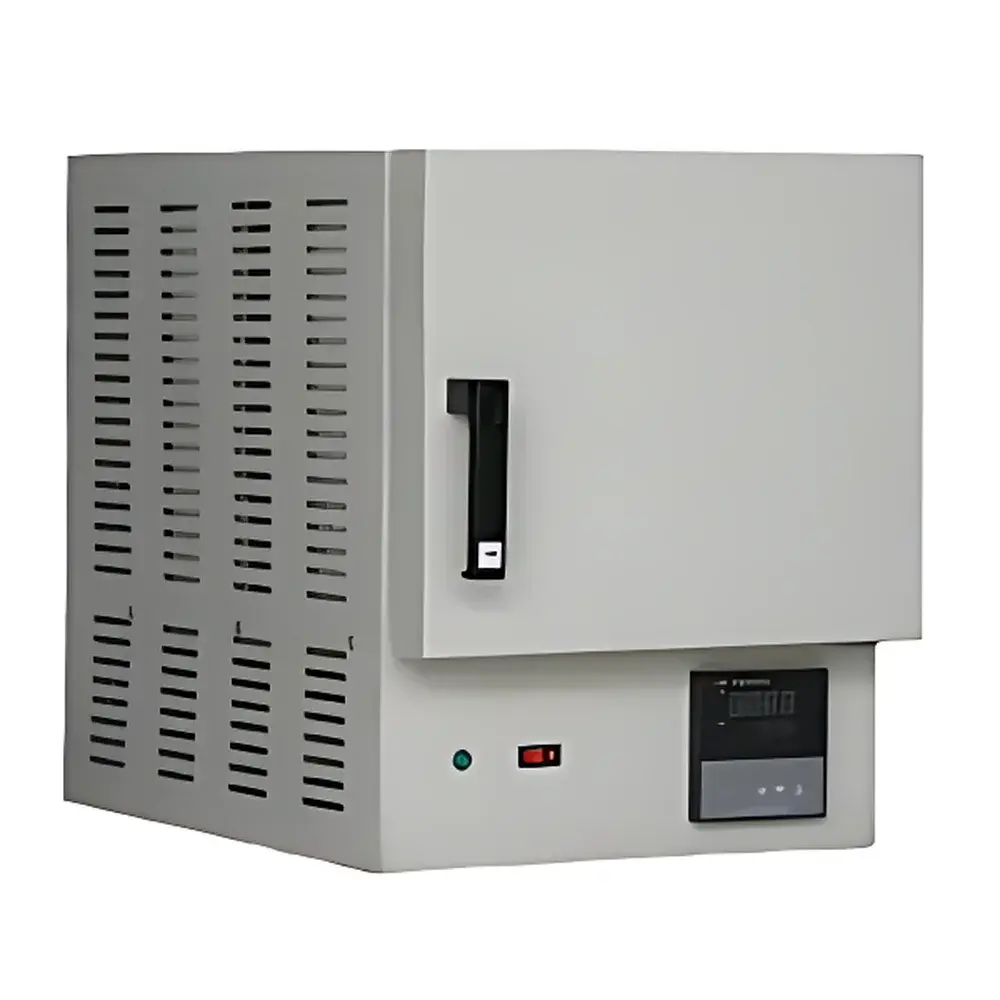
Zhuochi SX3-3-10 Ceramic Fiber Muffle Furnace
| Brand | Zhuochi |
|---|---|
| Origin | Zhejiang, China |
| Model | SX3-3-10 |
| Chamber Dimensions | 300 × 200 × 150 mm |
| Max Operating Temperature | 1000 °C |
| Rated Power | 3 kW |
| Voltage/Frequency | 220 V / 50 Hz |
| Heating Element | U-shaped Silicon Carbide Rods |
| Insulation | Dual-shell Construction with High-Purity Ceramic Fiber |
| Temperature Uniformity | ±1 °C |
| Ramp Rate Adjustable | 1.5–10 °C/min |
| Control System | LTDE-Based 30-Stage Programmable PID Controller with Auto-Hold, Auto-Shutdown, and Slope Compensation |
Overview
The Zhuochi SX3-3-10 Ceramic Fiber Muffle Furnace is a high-efficiency, laboratory-grade thermal processing instrument engineered for precise, repeatable heat treatment applications in materials science, metallurgy, ceramics, and quality control laboratories. Unlike traditional refractory-brick muffle furnaces, this model employs ultra-lightweight, high-purity ceramic fiber insulation—reducing thermal mass by over 80% compared to conventional designs. Its low thermal inertia enables rapid heating rates (up to 10 °C/min) and significantly lower energy consumption, achieving up to 50% power savings at equivalent operating temperatures. The furnace operates on the principle of resistive heating via U-shaped silicon carbide (SiC) rods, delivering uniform radiant heat distribution across the chamber. The dual-shell structural design enhances thermal containment, minimizes external surface temperature rise, and improves operator safety during extended operation.
Key Features
- Ultra-lightweight construction: Ceramic fiber chamber lining reduces total unit weight to approximately 20% of equivalent brick-lined furnaces—enabling easier benchtop integration and reduced floor-load requirements.
- Programmable LTDE control system: Supports up to 30 independent temperature segments with customizable ramp rates, dwell times, and cooling profiles; includes slope correction, output power limiting (%), and real-time deviation compensation.
- PID temperature regulation with ±1 °C accuracy: Maintains setpoint stability under dynamic load conditions through adaptive algorithm tuning and continuous feedback from a calibrated K-type thermocouple.
- Dual-shell housing with air-gap insulation: Outer steel shell isolates internal thermal gradients, ensuring external surface temperatures remain below 60 °C at maximum operating temperature—compliant with IEC 61000-3-2 harmonic emission guidelines for laboratory equipment.
- Plug-and-play operation: Pre-wired terminal block and integrated power cord eliminate field wiring complexity; requires only single-phase 220 V / 50 Hz supply connection for immediate commissioning.
Sample Compatibility & Compliance
The SX3-3-10 accommodates crucibles, boats, and sample holders up to 300 × 200 × 150 mm in volume, supporting standard alumina, quartz, and silicon carbide ware. It is suitable for ashing organic matrices (e.g., ASTM D3174, ISO 1171), calcination of catalyst precursors, pre-sintering of ceramic green bodies, and thermal gravimetric sample conditioning per USP and EP 2.2.25. The furnace meets CE marking requirements for electromagnetic compatibility (EMC Directive 2014/30/EU) and low-voltage safety (LVD Directive 2014/35/EU). While not certified to UL or CSA standards out-of-the-box, its electrical architecture conforms to IEC 61010-1:2010 Class II protection principles and supports GLP-compliant audit trails when paired with optional data logging modules.
Software & Data Management
The LTDE controller provides native RS485 Modbus RTU interface (optional USB-to-RS485 adapter required) for integration into centralized lab management systems. Third-party SCADA platforms—including LabVIEW, Ignition, and Siemens SIMATIC WinCC—can acquire real-time temperature, power output, and program status via standard protocol commands. Optional firmware upgrades enable CSV export of full thermal cycle logs with timestamps, enabling traceability for ISO/IEC 17025-accredited testing environments. All programmable parameters are stored in non-volatile memory with battery-backed retention (>10 years), and the system supports user-defined password protection for critical settings modification.
Applications
- Residue ash determination in food, feed, and pharmaceutical raw materials per AOAC 942.05 and USP .
- Thermal decomposition studies of polymers and composites under controlled oxidative or inert atmospheres (when used with purge gas manifold).
- Pre-firing of ceramic substrates prior to sintering, including LTCC and HTCC tape casting workflows.
- Heat treatment of metallographic specimens for microstructural homogenization prior to etching and microscopy.
- Calibration verification of thermocouples and RTDs using fixed-point reference materials (e.g., Zn, Al, Cu freezing points) within the 1000 °C range.
FAQ
What is the maximum recommended continuous operating temperature?
The SX3-3-10 is rated for continuous operation at 1000 °C. Extended use above 950 °C may reduce SiC rod service life; periodic visual inspection of heating elements is advised.
Can the furnace be operated under inert or reducing atmospheres?
Yes—when equipped with an optional gas inlet/outlet port kit and compatible flow controller, it supports N₂, Ar, or forming gas (5% H₂/95% N₂) purging. Note that ceramic fiber insulation is not chemically resistant to halogens or strong reducing agents at elevated temperatures.
Is the temperature uniformity verified per ASTM E220?
Uniformity mapping is not factory-certified, but users may perform in-house validation using a multi-point thermocouple probe array per ASTM E220 Annex A3; typical measured uniformity across the working zone is ±3 °C at 1000 °C.
Does the controller support FDA 21 CFR Part 11 compliance?
The base LTDE controller does not include electronic signature, audit trail, or role-based access control. These features require integration with validated third-party software platforms such as Thermo Fisher SampleManager LIMS or LabWare LIMS.
What maintenance is required for long-term reliability?
Annual inspection of door gasket integrity, thermocouple calibration against a NIST-traceable reference, and cleaning of SiC rod terminals with isopropyl alcohol are recommended. Avoid thermal shock by limiting ramp rates during cooldown cycles.
Related Products



