
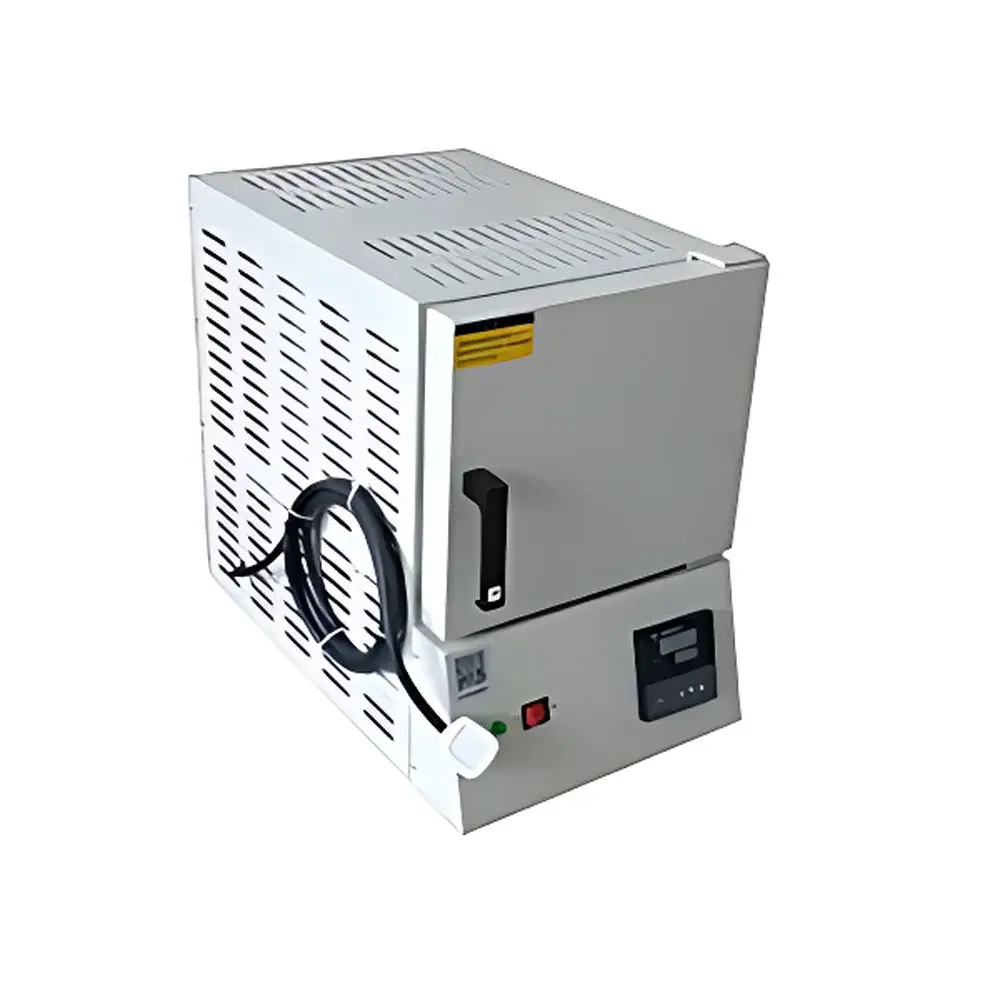
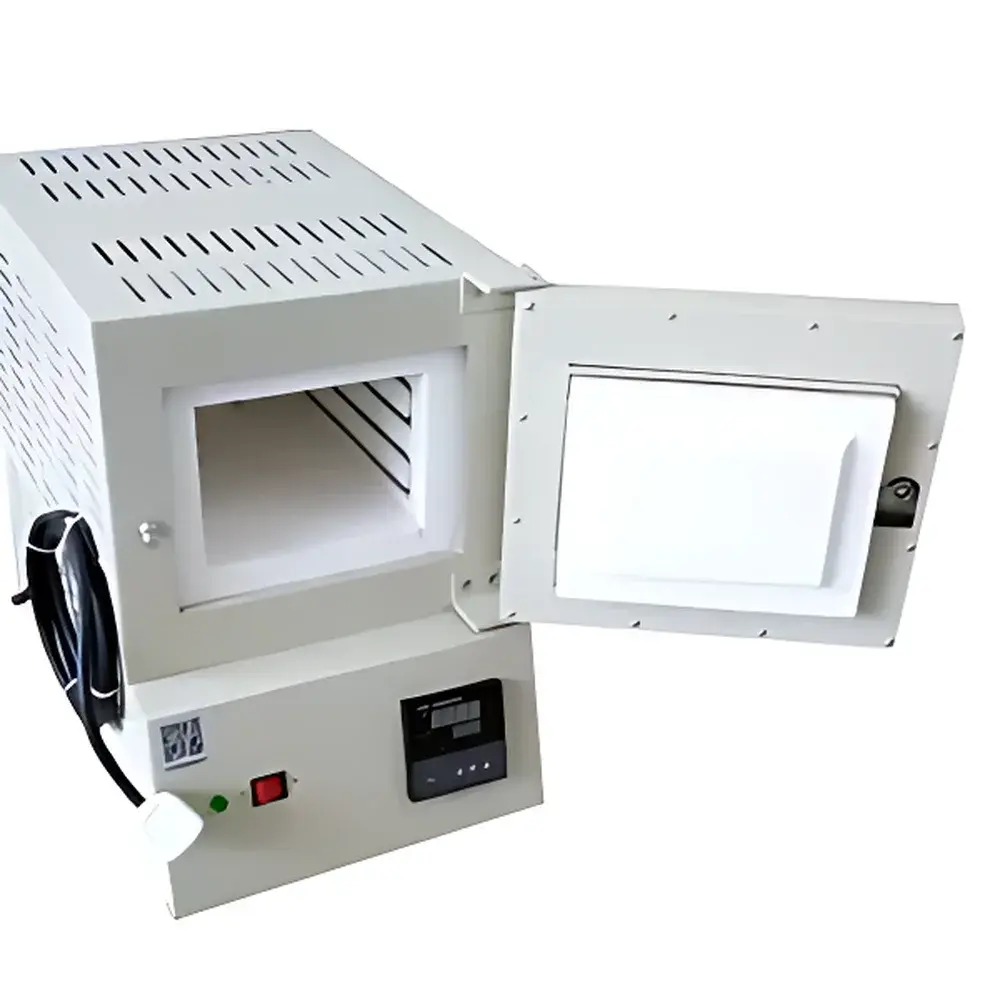
Zhuochi SX3-3-12 Ceramic Fiber Muffle Furnace
| Brand | Zhuochi |
|---|---|
| Origin | Zhejiang, China |
| Model | SX3-3-12 |
| Type | Box-Type Muffle Furnace |
| Max Temperature | 1200 °C |
| Temperature Uniformity | ±1 °C |
| Power Rating | 3 kW |
| Max Heating Rate | ≤50 °C/min |
| Internal Chamber Dimensions | 300 × 200 × 150 mm |
| Heating Element | High-Temperature Resistance Wire |
| Insulation Material | High-Emissivity, Low-Heat-Capacity Ceramic Fiber Board |
| Control System | LTDE Programmable PID Controller (30-Stage Ramp/Soak) |
| Voltage/Frequency | 220 V, 50 Hz |
| Net Weight | ~45 kg |
Overview
The Zhuochi SX3-3-12 Ceramic Fiber Muffle Furnace is a high-efficiency, precision-controlled box-type laboratory furnace engineered for rapid thermal processing in academic research, materials science, quality control, and industrial R&D environments. Unlike traditional refractory-brick muffle furnaces, this model employs a six-sided modular construction of ultra-lightweight, high-radiation ceramic fiber board—offering exceptional thermal insulation, minimal heat storage, and superior resistance to thermal shock. The furnace operates on the principle of resistive heating via high-purity alloy resistance wire, with temperature sensing performed by an S-type platinum-rhodium/platinum thermocouple (IEC 60584-1 compliant), ensuring traceable accuracy across its full operating range of 100–1200 °C. Its integrated design eliminates field wiring complexity: all electrical connections between the chamber and controller are pre-assembled at the factory, enabling immediate operation upon connection to a standard 220 V, 50 Hz supply.
Key Features
- Ultra-lightweight architecture: Total mass reduced to ~45 kg—70% lighter than equivalent brick-lined furnaces—facilitating lab relocation and benchtop integration.
- Rapid thermal response: Achieves 1000 °C in under 30 minutes; maximum programmable heating rate up to 50 °C/min, fully adjustable in real time.
- Precision temperature control: ±1 °C uniformity across the working zone at 1000 °C, verified per ASTM E220 calibration methodology; display resolution of 1 °C.
- LTDE-based 30-stage programmable controller: Supports complex thermal profiles including ramp-soak-cool sequences, automatic hold termination, and end-of-cycle shutdown.
- Dual-level overtemperature protection: Primary control loop with PID+SSR regulation; secondary independent safety cutoff triggered above user-defined threshold (adjustable).
- Robust mechanical construction: Cold-rolled steel outer casing treated with phosphate conversion coating and electrostatically applied matte gray powder finish (ISO 2093, ISO 27927 compliant).
- Optimized chamber-to-footprint ratio: 300 × 200 × 150 mm usable volume within compact external dimensions of 575 × 360 × 480 mm.
Sample Compatibility & Compliance
The SX3-3-12 accommodates crucibles, boats, and sample holders made from alumina, quartz, silicon carbide, or stainless steel—compatible with ashing, calcination, sintering, heat treatment, and pre-conditioning of catalysts, ceramics, polymers, and metallurgical samples. Its muffle configuration ensures complete thermal isolation of the sample from combustion byproducts and heating elements, satisfying requirements for ASTM D3174 (ash content), ISO 1171 (ash determination), and USP heavy metal testing procedures. The furnace meets CE marking requirements for electromagnetic compatibility (EN 61326-1) and low-voltage safety (EN 61010-1). While not certified to FDA 21 CFR Part 11 out-of-the-box, audit-ready features—including password-protected parameter modification, event logging, and non-volatile program memory—support GLP/GMP-aligned validation protocols when deployed with documented SOPs.
Software & Data Management
The embedded LTDE controller provides local data visibility via a high-contrast LED display but does not include native USB/Ethernet connectivity or PC-based software. All thermal programs, setpoints, and runtime logs are retained in non-volatile memory and accessible through the front-panel interface. For regulatory-compliant documentation, users may manually record cycle parameters and timestamps in lab notebooks or integrate external data loggers via the furnace’s analog output (0–5 V or 4–20 mA optional). The system supports configurable dwell timing, auto-restart after power interruption (optional firmware), and real-time deviation alerts—enabling reproducible execution of standardized thermal treatments across shifts and operators.
Applications
- Ash content analysis of coal, biomass, foodstuffs, and pharmaceutical excipients (per AOAC 942.05, ISO 21668).
- Calcination of metal oxides, battery cathode precursors, and nanomaterials prior to XRD or SEM characterization.
- Thermal gravimetric pre-treatment for TGA sample conditioning and binder burnout in ceramic green bodies.
- Heat treatment of small-scale metallurgical specimens, including stress-relieving and annealing of tool steels.
- Pre-drying and conditioning of reference standards, filter papers, and crucibles in analytical chemistry workflows.
- Research-scale sintering of functional ceramics, ferrites, and piezoelectric composites under controlled air atmosphere.
FAQ
What atmosphere options are supported?
The SX3-3-12 operates in ambient air only. It is not designed for inert gas purging, vacuum, or reducing atmospheres. Optional quartz tube inserts may be used for limited protective atmosphere trials, though no gas fittings or seals are supplied.
Is the thermocouple replaceable in the field?
Yes—the S-type thermocouple is accessed via a rear-mounted port and secured with a standard compression fitting. Replacement parts conform to IEC 60584-1 tolerance Class 1 specifications.
Can the furnace be validated for ISO/IEC 17025 compliance?
Yes—its ±1 °C uniformity, traceable thermocouple, and programmable repeatability support IQ/OQ/PQ protocols when combined with third-party calibration certificates and documented uncertainty budgets.
What maintenance is required?
Annual inspection of heating element continuity, thermocouple drift verification, and visual assessment of ceramic fiber integrity. No lubrication or consumable filters are required.
Does it meet energy efficiency standards for laboratory equipment?
Its ceramic fiber insulation achieves surface temperatures <45 °C at 1200 °C internal load—exceeding ENERGY STAR reference criteria for low-heat-loss laboratory ovens (v2.0, Section 4.3.1).



