
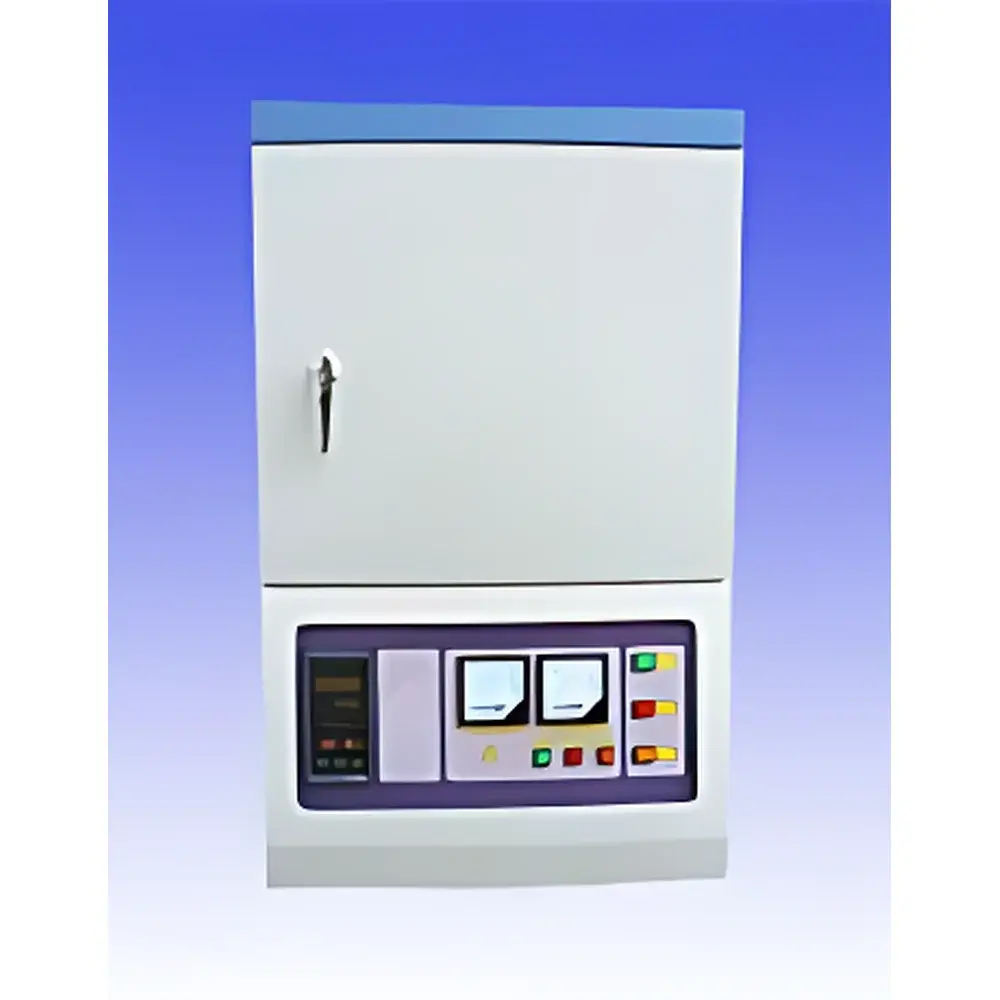
Zhuochi SX3-4-16 High-Temperature Ceramic Fiber Muffle Furnace
| Brand | Zhuochi |
|---|---|
| Origin | Zhejiang, China |
| Manufacturer Type | Authorized Distributor |
| Equipment Type | Box-Type Muffle Furnace |
| Model | SX3-4-16 |
| Max Temperature | 1600 °C |
| Temperature Control Accuracy | ±1 °C |
| Rated Power | 4000 W |
| Heating Element | Silicon Molybdenum (MoSi₂) Rods |
| Internal Chamber Dimensions | 200 × 150 × 150 mm |
| Voltage | 220 V, 50 Hz |
| Heating Rate to Max Temp | ~50 min |
| Control System | LTDE-Based 30-Stage Programmable PID Controller with Ramp/Soak, Power % Output, Slope Correction, Auto-Hold, and Auto-Shutdown |
Overview
The Zhuochi SX3-4-16 is a high-temperature ceramic fiber muffle furnace engineered for precision thermal processing in research laboratories, materials science departments, and quality control environments. Operating up to 1600 °C, it employs silicon molybdenum (MoSi₂) heating elements — selected for their exceptional oxidation resistance, structural stability, and long-term repeatability at elevated temperatures. Unlike traditional refractory brick furnaces, the SX3-4-16 utilizes ultra-lightweight, low-thermal-conductivity ceramic fiber insulation, reducing thermal mass by over 80% compared to conventional designs. This architecture enables rapid heat-up, minimized standby energy loss, and improved temperature uniformity across the working zone. The furnace complies with fundamental thermal safety and electromagnetic compatibility requirements per IEC 61000-6-3 and IEC 61000-6-4, and its construction supports GLP-aligned operation when integrated into validated laboratory workflows.
Key Features
- Ultra-low thermal mass chamber: 200 × 150 × 150 mm internal volume with high-purity alumina-silica ceramic fiber lining (density ≈ 128 kg/m³), enabling typical ramp rates of 1.5–10 °C/min (user-selectable)
- Precision temperature control: ±1 °C accuracy maintained over full range (room temperature to 1600 °C) via dual-sensor feedback and adaptive PID algorithm with slope correction and auto-tuning capability
- LTDE-based 30-segment programmable controller: Supports complex thermal profiles including multi-step ramp/soak sequences, power-limiting modes, and event-triggered shutdown
- Energy-efficient design: Achieves 1600 °C in approximately 50 minutes with only 4 kW input; wall surface temperature remains <60 °C under continuous operation at max setpoint
- Plug-and-play installation: Requires only single-phase 220 V, 50 Hz supply; no external cooling water or gas purge needed; factory-calibrated prior to shipment
- Robust mechanical architecture: Double-layer steel casing with reinforced door seal and integrated over-temperature cut-off (independent of main controller)
Sample Compatibility & Compliance
The SX3-4-16 accommodates crucibles, boats, and sintering fixtures made from high-purity alumina, silicon carbide, or molybdenum — compatible with air, inert (N₂, Ar), or weakly reducing atmospheres (e.g., forming gas). It is not rated for vacuum or strongly reducing (H₂-rich) or corrosive (HF, Cl₂) environments. While not certified to UL or CE as a standalone appliance, its electrical and thermal design adheres to baseline safety principles outlined in IEC 61010-1 (Safety Requirements for Electrical Equipment for Measurement, Control, and Laboratory Use). For regulated environments, users may implement procedural controls — including logbook entries, calibration traceability (via external reference thermocouples), and periodic verification per ASTM E220 — to support ISO/IEC 17025 or FDA 21 CFR Part 11 data integrity requirements.
Software & Data Management
The embedded LTDE controller provides local interface-only operation with real-time display of setpoint, process value, output power (%), and elapsed time. RS485 Modbus RTU communication port is standard, enabling integration with SCADA systems, LabVIEW, or custom Python-based monitoring scripts via optional USB-to-RS485 adapter. Data logging (temperature vs. time) is supported externally using third-party software; the controller itself retains profile memory and operational history (last 10 cycles) with timestamped start/stop events. Audit trail functionality is achievable through external historian systems configured to capture Modbus register reads at user-defined intervals — satisfying basic ALCOA+ (Attributable, Legible, Contemporaneous, Original, Accurate, Complete, Consistent, Enduring, Available) documentation expectations in GxP settings.
Applications
- Thermal gravimetric analysis (TGA) sample pre-treatment and residue ashing (e.g., ASTM D3174, ISO 1171)
- Sintering of advanced ceramics, ferrites, and metal oxide powders
- Heat treatment of metallurgical specimens (annealing, stress relieving)
- Calibration of thermocouples and RTDs per ITS-90 traceable protocols
- Combustion of organic matrices in environmental and food testing labs (e.g., AOAC 990.19)
- Pre-firing of catalyst supports and battery electrode materials
FAQ
What type of thermocouple is used for temperature sensing?
The furnace uses a Type S (Platinum/Rhodium 10%) thermocouple mounted in direct contact with the chamber wall near the center plane, providing traceable measurement within the 0–1600 °C range.
Can this furnace operate continuously at 1600 °C?
Yes, but continuous operation above 1500 °C is limited to ≤4 hours per cycle to preserve element longevity; recommended duty cycle is ≤6 hours total per day at peak temperature.
Is the controller compliant with FDA 21 CFR Part 11?
The native controller does not include electronic signature, audit trail, or role-based access control; however, full compliance can be achieved via validated external data acquisition systems interfacing via Modbus.
What maintenance is required?
Annual inspection of MoSi₂ rods for warping or surface pitting, cleaning of fiber insulation surfaces with dry air, and verification of door gasket compression force are recommended; no lubrication or consumable replacement is required under normal use.
Does the furnace include over-temperature protection?
Yes — an independent bimetallic thermal cutoff switch interrupts power if chamber temperature exceeds 1650 °C, regardless of controller status.



