
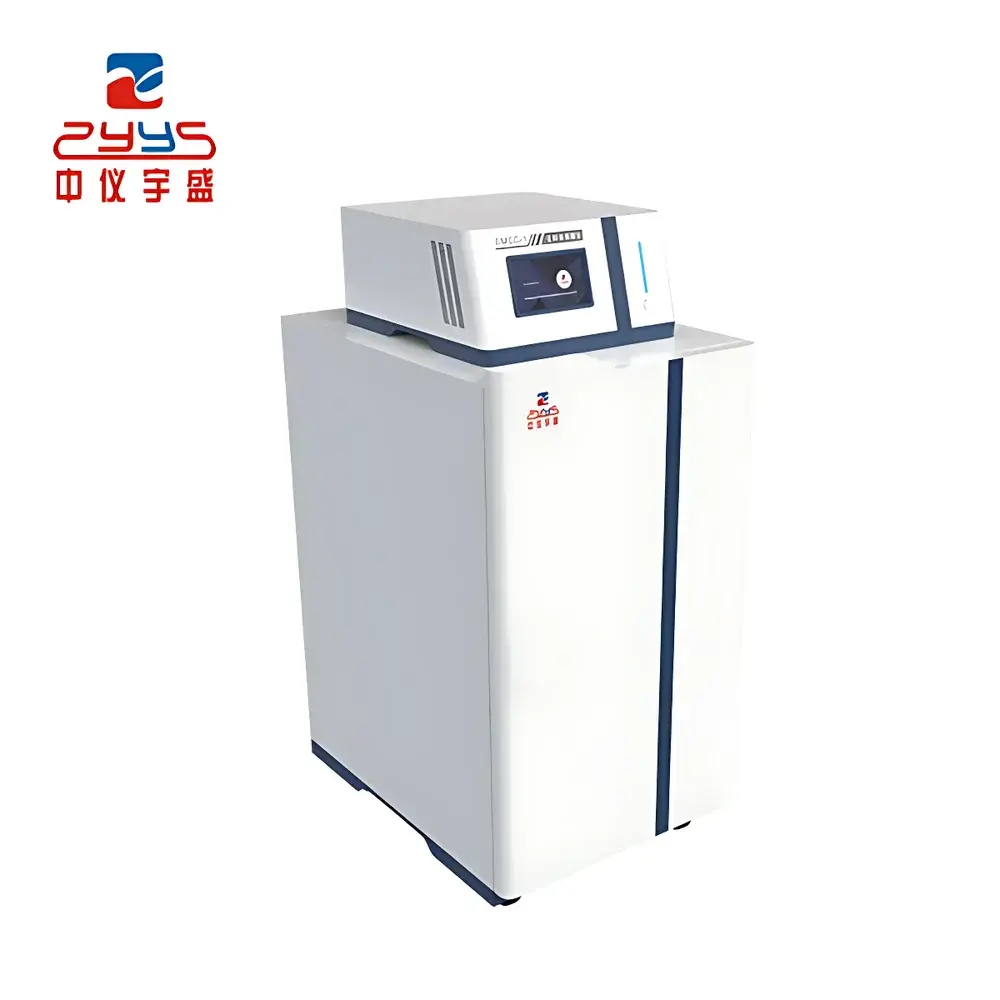
ZHYUSM SMCC-1 Automated Canister Cleaning System
| Brand | ZHYUSM |
|---|---|
| Model | SMCC-1 |
| Origin | Beijing, China |
| Manufacturer Type | Direct Manufacturer |
| Instrument Category | Domestic |
| Power | 400 W |
| Pump Type | Oil-Free Scroll Vacuum Pump |
| Ultimate Vacuum | <1.6 Pa (12 mTorr) |
| Pumping Speed | 250 L/min |
| Max Simultaneous Heating Capacity | 8 × 6 L Summa® Canisters |
| Cleaning Cycles | Programmable (1–99), Manual Mode Available |
| Humidification | Integrated High-Purity N₂ Humidifier |
| Surface Treatment | Silanized Gas Path Components |
| Control Interface | Capacitive Touchscreen with Method Storage |
| Leak Check | Automated Pre-Valve-Opening Vacuum Integrity Test |
| Thermal Uniformity | Forced-Air Circulation via Vortex Fan in Heated Chamber |
| Real-Time Monitoring | Pressure, Temperature, Elapsed Time, Valve Status |
| Cooling | Active Heat Dissipation System |
| Mobility | Heavy-Duty Swivel Casters |
Overview
The ZHYUSM SMCC-1 Automated Canister Cleaning System is an engineered solution for the rigorous decontamination and reconditioning of inert gas sampling containers used in ambient air, emission source, and indoor air quality monitoring programs. Designed specifically for Summa®-type electropolished stainless-steel canisters (1 L, 3 L, 6 L, and 15 L) and Tedlar® gas sampling bags, the SMCC-1 executes fully programmable cleaning protocols under controlled vacuum, inert gas purge, and optional humidity conditioning. Its operational principle relies on sequential high-vacuum evacuation (<1.6 Pa), precision-timed high-purity nitrogen (N₂) purging—either dry or humidified—and thermally stabilized chamber heating to accelerate desorption of volatile organic compounds (VOCs), semi-volatile organic compounds (SVOCs), and reactive trace gases adsorbed onto internal surfaces. This process ensures residual analyte carryover remains below method detection limits required by EPA TO-14A, TO-15, and ASTM D6196, supporting regulatory compliance in environmental laboratories operating under ISO/IEC 17025 and U.S. EPA Contract Laboratory Program (CLP) guidelines.
Key Features
- Oil-free scroll vacuum pump architecture eliminates hydrocarbon contamination risk and reduces maintenance intervals; single-pump design prevents cascading failure scenarios common in two-stage systems.
- High-throughput thermal cleaning: simultaneous heating and evacuation of up to eight 6 L Summa® canisters at uniform temperature (programmable range: ambient to 120 °C), enabled by vortex-fan-assisted forced-air circulation within the insulated chamber.
- Integrated humidification module delivers precisely metered moisture content into high-purity N₂ streams, enhancing removal efficiency for polar VOCs (e.g., aldehydes, ketones, organic acids) and improving reproducibility across matrix-varied samples.
- Automated pre-cycle vacuum integrity verification: system performs real-time leak rate calculation prior to valve actuation, flagging compromised seals or faulty fittings before initiating cleaning—critical for audit-ready GLP workflows.
- Capacitive touchscreen interface supports creation, naming, versioning, and secure storage of multiple cleaning methods—including cycle count, dwell time per purge stage, temperature ramp profiles, and humidity setpoints—with timestamped execution logs.
- All wetted surfaces—including valves, regulators, manifolds, and internal tubing—are silanized to minimize active sites for analyte adsorption and ensure long-term surface inertness per EPA Method TO-15 Appendix A specifications.
- Active thermal management system maintains stable internal ambient during extended operation, preventing thermal drift and ensuring consistent desorption kinetics across multi-batch runs.
Sample Compatibility & Compliance
The SMCC-1 accommodates standard Summa® canisters (1 L, 3 L, 6 L, 15 L), SilcoCan® variants, and Tedlar® gas sampling bags (up to 10 L volume). It meets mechanical and procedural requirements outlined in U.S. EPA Compendium Method TO-14A (Determination of Volatile Organic Compounds [VOCs] in Ambient Air), TO-15 (Determination of Volatile Organic Compounds [VOCs] in Air Collected in Specially-Prepared Canisters and Analyzed by Gas Chromatography/Mass Spectrometry [GC/MS]), and ASTM D6196-22 (Standard Practice for Selecting and Using Solvents for Cleaning Sampling Equipment Used in Ambient Air Monitoring). The system’s vacuum integrity test, pressure-controlled purge timing, and temperature-stabilized heating align with data integrity expectations under FDA 21 CFR Part 11 when paired with validated electronic record-keeping software.
Software & Data Management
The embedded control firmware records all operational parameters—including vacuum decay curves, pressure vs. time traces, valve actuation timestamps, temperature profiles, and user authentication IDs—for each cleaning cycle. Exportable CSV logs support integration into LIMS platforms and are structured to satisfy audit trail requirements per ISO/IEC 17025:2017 Clause 7.5.2. Method files are encrypted and stored locally with write-protection options; no cloud connectivity is implemented by default, preserving data sovereignty in regulated environments. Firmware updates are delivered via USB drive with SHA-256 checksum validation.
Applications
- Pre-use cleaning of canisters prior to field deployment in ambient air monitoring networks (e.g., CASTNet, SEARCH, IMPROVE).
- Post-analysis regeneration of canisters following GC/MS or GC/FID analysis to eliminate cross-contamination between sample batches.
- Validation of cleaning efficacy through blank analysis per EPA Method TO-15 Section 8.2.2 (Method Detection Limit Verification using Triplicate Field Blanks).
- Supporting laboratory accreditation assessments where documented container cleanliness directly impacts measurement uncertainty budgets.
- Enabling cost-effective reuse of expensive electropolished canisters while maintaining traceability and chain-of-custody integrity.
FAQ
What vacuum level does the SMCC-1 achieve, and how is it verified?
The system reaches an ultimate vacuum of <1.6 Pa (12 mTorr) using its oil-free scroll pump. Vacuum performance is continuously monitored via a calibrated capacitance manometer, and the pre-cycle leak check quantifies system integrity to ≤0.5 mPa·L/s.
Can the SMCC-1 clean both Summa® canisters and Tedlar® bags simultaneously?
Yes—the manifold configuration supports mixed loading, though optimal cleaning uniformity is achieved when similar container types are grouped. Custom adapters are available for non-standard bag fixtures.
Is humidified nitrogen required for all cleaning protocols?
No—dry N₂ purging is sufficient for non-polar VOCs (e.g., BTEX, alkanes); humidified mode is recommended only when analyzing oxygenated VOCs or working with high-humidity ambient samples.
How is temperature uniformity validated inside the heated chamber?
Factory calibration includes multi-point thermocouple mapping across the chamber volume at three setpoints (50 °C, 80 °C, 100 °C); deviation is maintained within ±1.5 °C across all loaded positions.
Does the SMCC-1 support remote diagnostics or network connectivity?
No Ethernet or Wi-Fi interface is included. Remote support is limited to secure screen-sharing sessions initiated voluntarily by authorized users via USB-connected diagnostic port.
Related Products







