
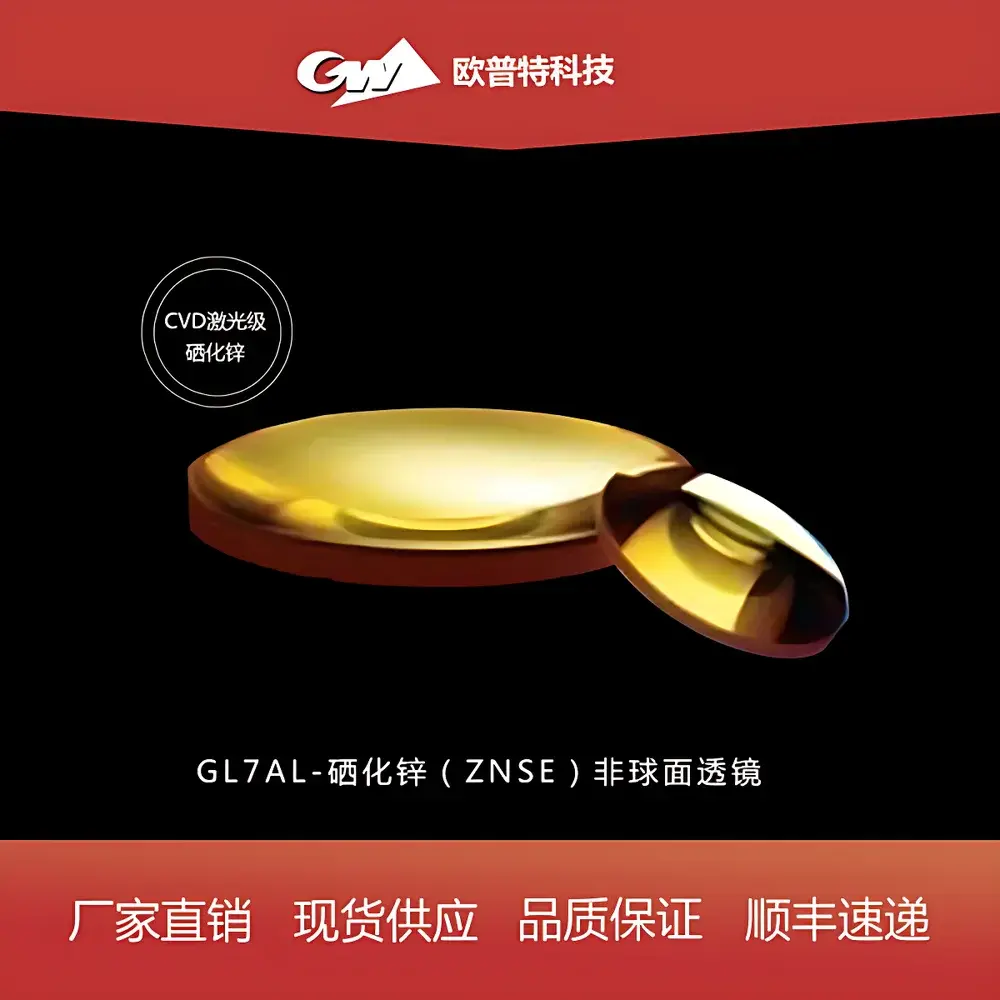
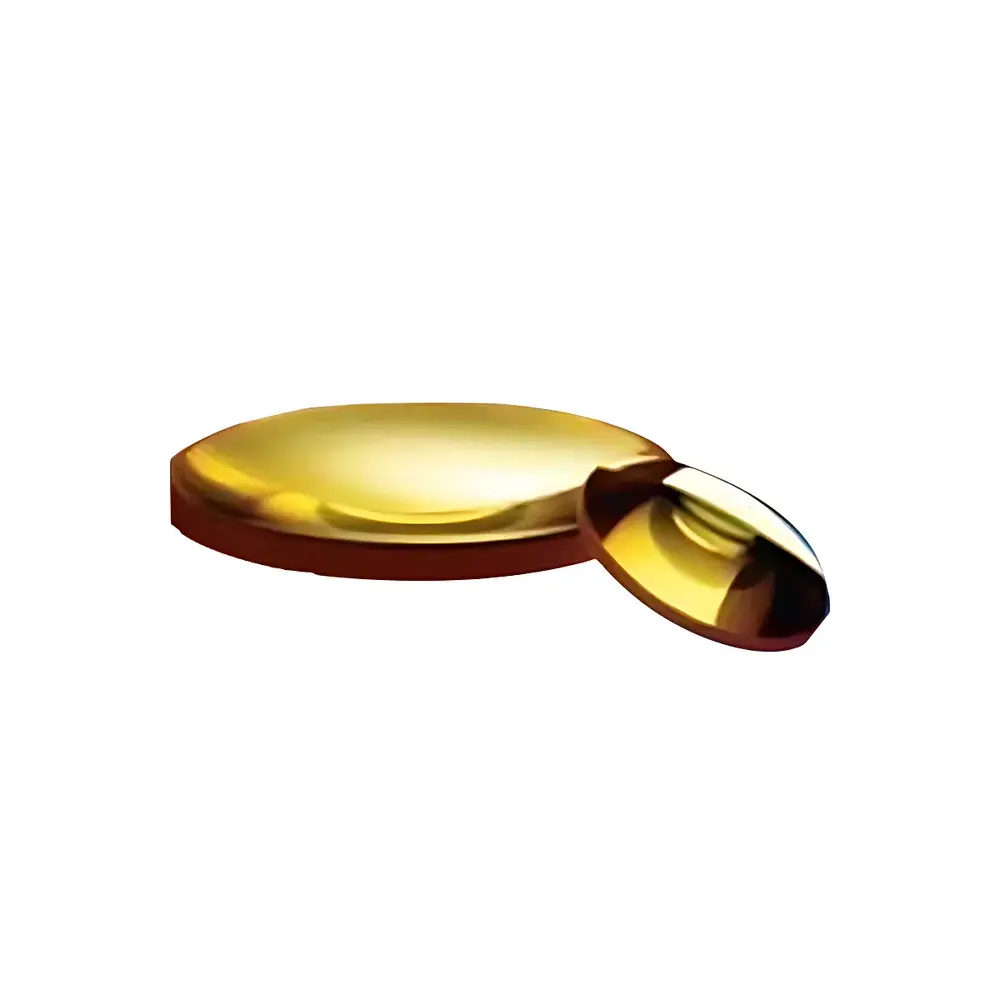
ZnSe Aspheric Lens GL7AL Series – Uncoated & Broadband IR Anti-Reflective Coated (3–5 µm)
| Origin | Beijing, China |
|---|---|
| Manufacturer Type | Authorized Distributor |
| Origin Category | Domestic |
| Model | GL7AL |
| Price Range | USD 420–1,400 (FOB) |
| Component Type | Optical Element |
| Diameter Tolerance | +0.0 / −0.1 mm |
| Center Thickness Tolerance | ±0.1 mm |
| EFL Tolerance | ±1% |
| Centration Error | < 3 arcmin |
| Surface Quality | 3–4 Scratch-Dig |
| Edge Bevel | 0.2 mm × 45° |
| Coating Options | Uncoated or Broadband AR (Rₐᵥg < 1.5% @ 3–5 µm) |
Overview
The GL7AL series comprises precision-molded aspheric lenses fabricated from chemical vapor deposition (CVD) grade zinc selenide (ZnSe), engineered specifically for high-performance infrared (IR) optical systems operating in the 3–5 µm mid-wave infrared (MWIR) atmospheric transmission window. Unlike conventional spherical ZnSe lenses, the aspheric geometry of the GL7AL eliminates spherical aberration, enabling diffraction-limited focusing and improved beam collimation without requiring multi-element correction. This design significantly enhances throughput and spatial resolution in compact IR imaging, laser delivery, thermal sensing, and spectroscopic applications where space, weight, and optical efficiency are constrained. ZnSe’s low absorption coefficient (< 0.0005 cm⁻¹ at 4.0 µm), high refractive index (~2.4 at 4 µm), and excellent thermal stability make it a preferred substrate for CO, CO₂, and quantum cascade laser (QCL) systems. All GL7AL lenses are manufactured under cleanroom-controlled conditions and undergo interferometric verification to ensure surface form accuracy better than λ/4 PV at 633 nm.
Key Features
- High-purity CVD-grown ZnSe substrate with <10 ppm impurity content and uniform crystallinity across the aperture
- Monolithic aspheric surface generated via single-point diamond turning and verified by non-contact profilometry
- Two standard coating configurations: uncoated (for inert gas environments or custom coating substrates) and broadband anti-reflective (BBAR) coating optimized for 3–5 µm (Rₐᵥg < 1.5%, max R < 2.5% across band)
- Tight mechanical tolerances: diameter tolerance +0.0/−0.1 mm; center thickness ±0.1 mm; effective focal length (EFL) ±1%; centration error < 3 arcminutes
- Surface quality rated to MIL-PRF-13830B Scratch-Dig 3–4, verified via automated dark-field inspection
- Consistent edge preparation: 0.2 mm × 45° protective bevel applied to both surfaces to mitigate chipping during handling and mounting
Sample Compatibility & Compliance
The GL7AL series is compatible with standard kinematic and flexure-based lens mounts (e.g., SM1-threaded, Ø25.4 mm cage systems). Its thermal expansion coefficient (7.6 × 10⁻⁶ K⁻¹) and low thermo-optic coefficient (dn/dT ≈ −5.9 × 10⁻⁶ K⁻¹ at 4 µm) ensure stable performance across operational temperature ranges from −40 °C to +80 °C. Lenses conform to ISO 10110-1 (optical element drawing standards) and ISO 10110-7 (surface imperfection specifications). The BBAR-coated variants meet MIL-C-48497A requirements for environmental durability (adhesion, humidity, abrasion). While not certified to ISO 13485 or FDA QSR, documentation packages—including material traceability (batch-certified CVD ZnSe ingot), coating spectral data (measured via FTIR spectrophotometry), and interferometric test reports—are provided upon request for integration into regulated instrumentation (e.g., medical IR endoscopes or industrial process analyzers).
Software & Data Management
No embedded firmware or proprietary software is associated with the GL7AL lens itself; however, comprehensive optical design support is available. Zemax OpticStudio and CODE V prescription files (including surface sag tables and coating dispersion models) are supplied for each model variant. Spectral reflectance curves (3–5 µm, 1 cm⁻¹ resolution) and measured wavefront error maps (via Zygo GPI interferometer) are delivered in CSV and .zbf formats. For traceable calibration workflows, each lens is serialized and linked to its metrology dataset in a secure cloud-accessible archive—compatible with enterprise document control systems supporting ISO/IEC 17025 audit trails.
Applications
- MWIR laser focusing and collimation in CO₂ (10.6 µm) and QCL (3.5–4.8 µm) systems
- Thermal imaging optics for uncooled microbolometer arrays (e.g., FLIR Tau2, Seek Thermal)
- FTIR spectrometer fore-optics and detector coupling elements
- Gas sensing platforms utilizing tunable diode laser absorption spectroscopy (TDLAS) in the 3–5 µm fingerprint region
- Miniaturized IR endoscopes and portable standoff detection systems
- Custom hybrid refractive-diffractive optics where ZnSe serves as the refractive base element
FAQ
What is the maximum continuous power density this lens can withstand without thermal lensing or damage?
For uncoated ZnSe, the damage threshold is ≥ 500 MW/cm² for 10 ns pulses at 10.6 µm (CO₂), and ~1.5 kW/cm² for CW operation at 4.0 µm with adequate heat sinking. BBAR-coated versions exhibit comparable thresholds due to low absorption (<0.15% per surface).
Can these lenses be used in vacuum or purged nitrogen environments?
Yes. CVD ZnSe exhibits negligible outgassing (per ASTM E595: TML < 0.05%, CVCM < 0.01%) and is routinely deployed in vacuum-compatible IR spectrometers and space-qualified sensors.
Is custom aspheric design supported beyond the standard GL7AL catalog?
Yes. Custom prescriptions—including off-axis aspheres, hybrid profiles, and multi-surface monoliths—are available under NDA with full metrology validation and ISO 10110-compliant certification.
Do you provide mounting adapters or kinematic cells for these lenses?
Standard SM1-threaded lens tubes, retaining rings, and kinematic mounts compatible with Thorlabs and Edmund Optics platforms are available as optional accessories; OEM integration kits (e.g., anodized aluminum housings with alignment fiducials) can be quoted separately.




