
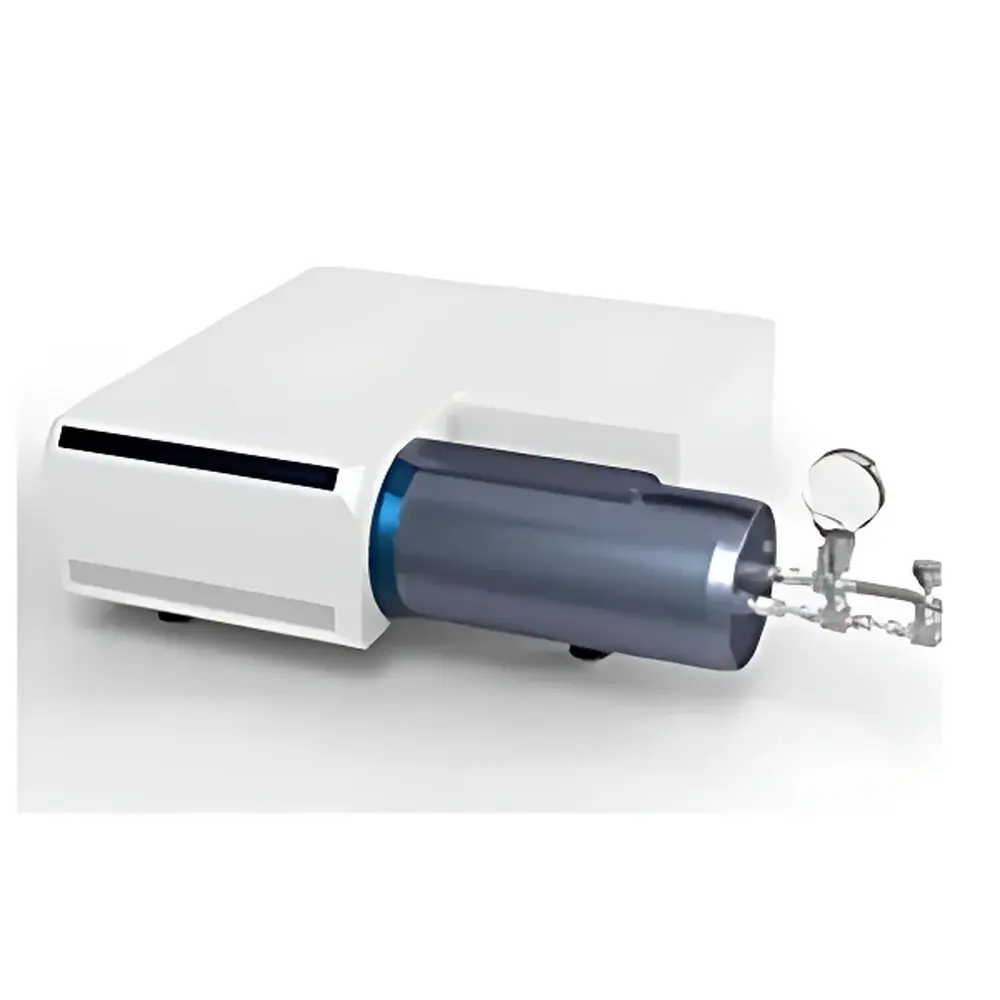
ZOLIX Gas Phase Raman Spectrometer
| Brand | ZOLIX |
|---|---|
| Origin | Beijing, China |
| Manufacturer Type | Authorized Distributor |
| Product Category | Domestic |
| Model | Gas Phase Raman Spectrometer |
| Pricing | Available Upon Request |
Overview
The ZOLIX Gas Phase Raman Spectrometer is a benchtop, laser-based analytical instrument engineered for quantitative, real-time, and non-invasive molecular identification and concentration measurement of gaseous species. It operates on the fundamental principle of spontaneous Raman scattering: when monochromatic 532 nm laser light interacts with gas molecules, inelastic scattering generates Stokes and anti-Stokes spectral shifts unique to each molecular vibrational mode—constituting a highly specific “molecular fingerprint.” Unlike Fourier-transform infrared (FTIR) spectroscopy—which struggles with homonuclear diatomic gases (e.g., N₂, O₂, H₂) due to lack of dipole moment change—or gas chromatography (GC), which requires carrier gas, thermal desorption, and minutes-long separation cycles, this system delivers second-scale response without consumables, moving parts, or sample preparation. Its optical architecture eliminates water vapor interference—a critical limitation in tunable diode laser absorption spectroscopy (TDLAS) and many IR platforms—making it uniquely suited for humid industrial environments such as refinery off-gas streams, battery outgassing analysis, and metallurgical process monitoring.
Key Features
- High-stability 532 nm diode-pumped solid-state (DPSS) laser source with adjustable output (0–1.5 W) and power stability < ±3% RMS over 8 hours
- VPH (Volume Phase Holographic) transmission imaging spectrometer optimized for high throughput (>65% peak efficiency) and broad spectral coverage (100–4000 cm⁻¹)
- Deep-cooled, back-illuminated CCD detector with thermoelectric cooling to –60°C, enabling low-noise acquisition at integration times from 10 ms to 60 s
- Modular gas cell design: configurable options include high-pressure multi-pass cavity (up to 10 atm), integrating sphere (for multi-phase compatibility), and hollow-core photonic crystal fiber (HC-PCF) gas cell for ultra-fast in-situ measurements
- Real-time spectral acquisition and processing engine supporting baseline correction, cosmic ray removal, and multivariate curve resolution (MCR)
Sample Compatibility & Compliance
The system supports direct analysis of pure gases, binary and multi-component gas mixtures, and transient emissions without dilution or pre-concentration. Validated detection limits (1σ, 10 s integration) range from sub-ppm for CO₂ and CH₄ at 1 atm to low-ppm levels under elevated pressure (e.g., 10 ppm CO at 10 atm). The optical path is sealed and inert-compatible, suitable for corrosive or reactive species including NH₃, H₂S, and Cl₂ when paired with appropriate cell materials (e.g., fused silica, Hastelloy-lined chambers). Instrument design aligns with ISO/IEC 17025 general requirements for competence of testing and calibration laboratories; spectral data files include embedded metadata compliant with ASTM E131-22 (Standard Terminology Relating to Molecular Spectroscopy) and support audit-ready reporting per GLP and FDA 21 CFR Part 11 when deployed with optional secure software modules.
Software & Data Management
ZOLIX RamanView™ v4.x provides a validated, Windows-based platform for instrument control, spectral acquisition, library matching (NIST Chemistry WebBook–aligned reference database), and quantitative modeling via partial least squares (PLS) regression. All raw spectra are saved in HDF5 format with time stamps, laser power logs, temperature/humidity sensor readings (optional external probe), and user-defined experimental annotations. Software supports automated batch processing, report generation (PDF/Excel), and export to LIMS via OPC UA or CSV. Audit trail functionality records all parameter changes, calibration events, and user actions with immutable timestamps—essential for regulated QC/QA workflows in petrochemical, pharmaceutical, and energy storage applications.
Applications
- Transformer oil-gas dissolved gas analysis (DGA) for early detection of insulation degradation (C₂H₂, CH₄, C₂H₄)
- Real-time hydrocarbon profiling during petroleum logging (C₁–C₆ alkanes, H₂S, CO₂)
- In-situ outgassing monitoring in lithium-ion battery cycling and thermal runaway studies
- Continuous stack emission monitoring (CEMS) for CO, NO, SO₂, and unburnt hydrocarbons in steelmaking blast furnace off-gas
- Process gas composition verification in hydrogen production (H₂ purity >99.999%), ammonia synthesis, and syngas conditioning
FAQ
Does the system require calibration gases for quantitative analysis?
Yes—initial calibration uses certified standard gas mixtures traceable to NIST SRMs; subsequent drift correction employs internal reference peaks (e.g., rotational Raman of N₂ or O₂) to maintain long-term accuracy without frequent recalibration.
Can it distinguish between structural isomers such as n-butane and iso-butane?
Yes—Raman spectral differences in C–C stretching and CH₃ deformation modes enable robust isomer discrimination, validated in independent studies using HC-PCF cells (Brooks et al., J. Raman Spectrosc. 2021, 52:1772).
Is vacuum operation supported?
The standard gas cells operate at ambient to 10 atm; vacuum-compatible versions (down to 10⁻³ mbar) are available upon request with modified sealing and flange interfaces.
What maintenance is required beyond routine laser alignment checks?
None—no consumables, no moving parts, no optical re-alignment needed under normal operation. Detector dark current and laser power are auto-monitored and logged daily.




