
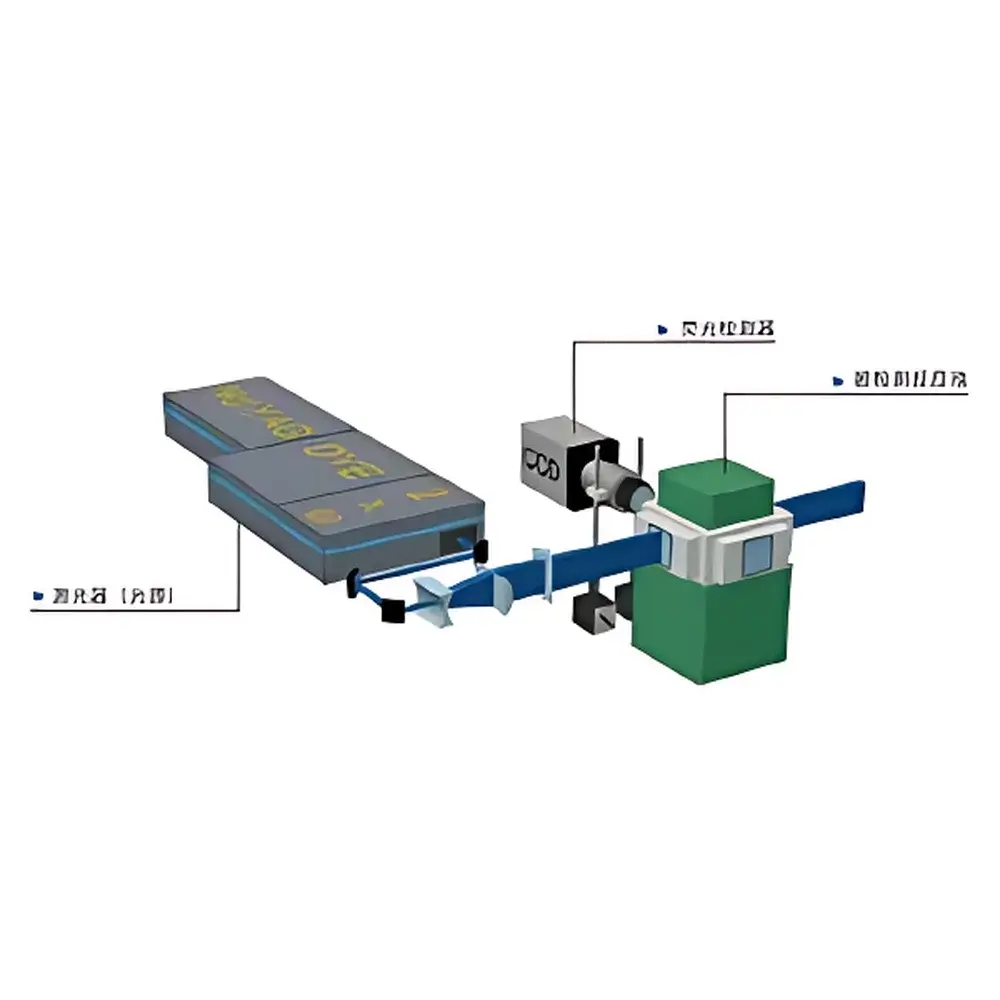
ZOLIX LIF&PLIF Planar Laser-Induced Fluorescence Diagnostic System
| Brand | ZOLIX |
|---|---|
| Model | LIF&PLIF |
| Origin | Beijing, China |
| Type | Modular, turnkey PLIF/LIF combustion diagnostic platform |
| Laser Tuning Range | 220–780 nm (extendable to 200–4500 nm) |
| Spectral Linewidth | ≤0.06 cm⁻¹ |
| Pulse Energy | 110 mJ @ 560 nm |
| Repetition Rate | 10 Hz |
| Laser Sheet Thickness | 0.1–0.3 mm |
| Temporal Synchronization Precision | ±5 ps |
| ICCD Optical Gate Width | <2 ns (true optical) |
| Delay Range | 0–2000 s |
| Delay Channels | 4 (expandable to 8) |
| Detector Options | iStar Gen II/III ICCD or iStar sCMOS (2560×2160, USB3.0, 50 fps full-frame) |
| Software | Integrated acquisition, time-resolved image processing, quantitative species concentration & temperature field reconstruction, multi-species LIF analysis (OH, CO, CH, NO, fuel tracers), PIV-compatible timing architecture |
Overview
The ZOLIX LIF&PLIF Planar Laser-Induced Fluorescence Diagnostic System is a fully integrated, research-grade optical diagnostic platform engineered for quantitative, non-intrusive, two-dimensional measurement of reactive species, temperature, and mixture fraction in transient combustion environments. Based on the physical principle of resonant laser excitation and spontaneous fluorescence emission, the system operates by tuning a narrow-linewidth pulsed dye laser to match the electronic transition wavelength of a target molecular species (e.g., OH, CO, CH, NO, or seeded fuel tracers). Upon absorption, population is promoted to an excited electronic state; subsequent radiative decay emits photons detectable as spatially resolved fluorescence. In Planar LIF (PLIF) configuration, the laser beam is transformed into a thin, collimated light sheet (0.1–0.3 mm thickness) using cylindrical and spherical optics, enabling volumetric interrogation of a planar cross-section within flames, combustors, or propulsion test rigs. This yields instantaneous, pixel-resolved maps of relative or absolute species concentration, temperature (via two-line or Boltzmann-distribution LIF), and scalar fields—critical for validating high-fidelity CFD simulations and optimizing low-emission combustion strategies.
Key Features
- Modular, turnkey architecture integrating tunable dye laser, precision laser sheet optics, sub-nanosecond-gated intensified imaging detectors, and hardware-synchronized timing control.
- Continuous laser wavelength tuning from 220 nm to 780 nm (with optional extension to UV/VIS/NIR up to 4500 nm), supporting diagnostics of key radicals (OH, CH, NO), stable intermediates (CO), and hydrocarbon tracers (acetone, toluene).
- High spectral purity (<0.06 cm⁻¹ linewidth) ensures selective excitation and minimizes interferences from overlapping transitions.
- Sub-5 ps temporal synchronization accuracy across four independent delay channels enables precise gating of ICCD or sCMOS detectors relative to laser pulse, critical for capturing fast flame dynamics and reaction zones.
- Two detector options: iStar Gen II/III ICCD with true optical gate width <2 ns and thermoelectric cooling to –40°C; or iStar sCMOS offering 550 MP resolution (2560×2160), 50 fps full-frame readout, and PIV-compatible dual-frame mode with 200 ns inter-frame interval.
- Dedicated software suite supporting real-time acquisition, spectral calibration, background subtraction, Abel inversion (for axisymmetric flames), temperature mapping via two-line LIF, and multi-species quantification using calibrated reference signals.
Sample Compatibility & Compliance
The system is designed for gas-phase, high-speed reactive flows under atmospheric or elevated-pressure conditions typical of laboratory-scale burners, shock tubes, scramjet mock-ups, and gas turbine combustion chambers. It supports both single-species and simultaneous multi-species detection through sequential or multi-wavelength excitation schemes. All optical components comply with ISO 10110 surface quality standards; laser safety design conforms to IEC 60825-1 Class 4 requirements with interlocked enclosures and beam path containment. Data acquisition workflows support audit-trail generation and user-access logging, aligning with GLP-compliant experimental documentation practices. While not certified per FDA 21 CFR Part 11, the software architecture permits integration with validated laboratory information management systems (LIMS) for traceable data handling in regulated R&D environments.
Software & Data Management
The proprietary acquisition and analysis platform provides end-to-end control—from laser parameter definition and delay generator programming to real-time image preview, post-processing, and visualization. Core modules include: (1) Time-resolved image acquisition with programmable gate width, delay, gain, and binning; (2) Spectral calibration using Hg/Ne lamp references and wavelength mapping correction; (3) Quantitative LIF analysis incorporating collisional quenching corrections, camera quantum efficiency normalization, and spatial uniformity correction; (4) Temperature field reconstruction via ratio imaging (e.g., OH A²Σ⁺–X²Π (0,0)/(1,1)) or Boltzmann plot methods; (5) Mixture fraction calculation using dual-tracer or fuel/oxidizer LIF pairs; (6) Export of calibrated 16-bit TIFF stacks compatible with MATLAB, Python (NumPy, OpenCV), and commercial CFD post-processors (Tecplot, FieldView). All processing steps are scriptable and reproducible; metadata (laser energy, delay settings, ambient T/P) is embedded in image headers per TIFF/EXIF standards.
Applications
This system serves as a primary diagnostic tool in fundamental and applied combustion research, including: turbulent flame structure characterization in premixed and diffusion flames; ignition delay and kernel development studies in homogeneous charge compression ignition (HCCI) and spark-ignition engines; pollutant formation mechanisms (soot precursors, NOₓ pathways); validation of chemical kinetic models under realistic pressure and temperature conditions; mixing and entrainment analysis in supersonic combustion; and development of active combustion control strategies. Its modularity also supports adaptation to non-combustion domains requiring time-resolved planar fluorescence, such as plasma chemistry, catalytic surface reactions, and microfluidic mixing dynamics.
FAQ
What species can be measured with this PLIF system?
OH, CH, CO, NO, CN, NH₂, and common fuel tracers (e.g., acetone, diethyl ether, toluene) are routinely imaged. Selection depends on available laser tuning range and spectroscopic cross-sections.
Is absolute concentration quantification possible?
Yes—via calibration against known reference conditions (e.g., laminar flat flame, shock tube standard), combined with collisional quenching modeling and instrument response correction.
Can the system be synchronized with other diagnostics like PIV or Rayleigh scattering?
Yes—the built-in 4-channel (expandable to 8) digital delay generator provides TTL-compatible triggers with ≤5 ps jitter, enabling robust multi-modal synchronization.
What level of technical support is provided for method development?
ZOLIX offers application engineering support including experimental design consultation, spectral line selection guidance, optical alignment assistance, and custom script development for specialized analysis pipelines.
Are third-party software integrations supported?
All raw image data is exported in standard TIFF format with embedded metadata; APIs and MATLAB/Python SDKs are available upon request for automated workflow integration.





