
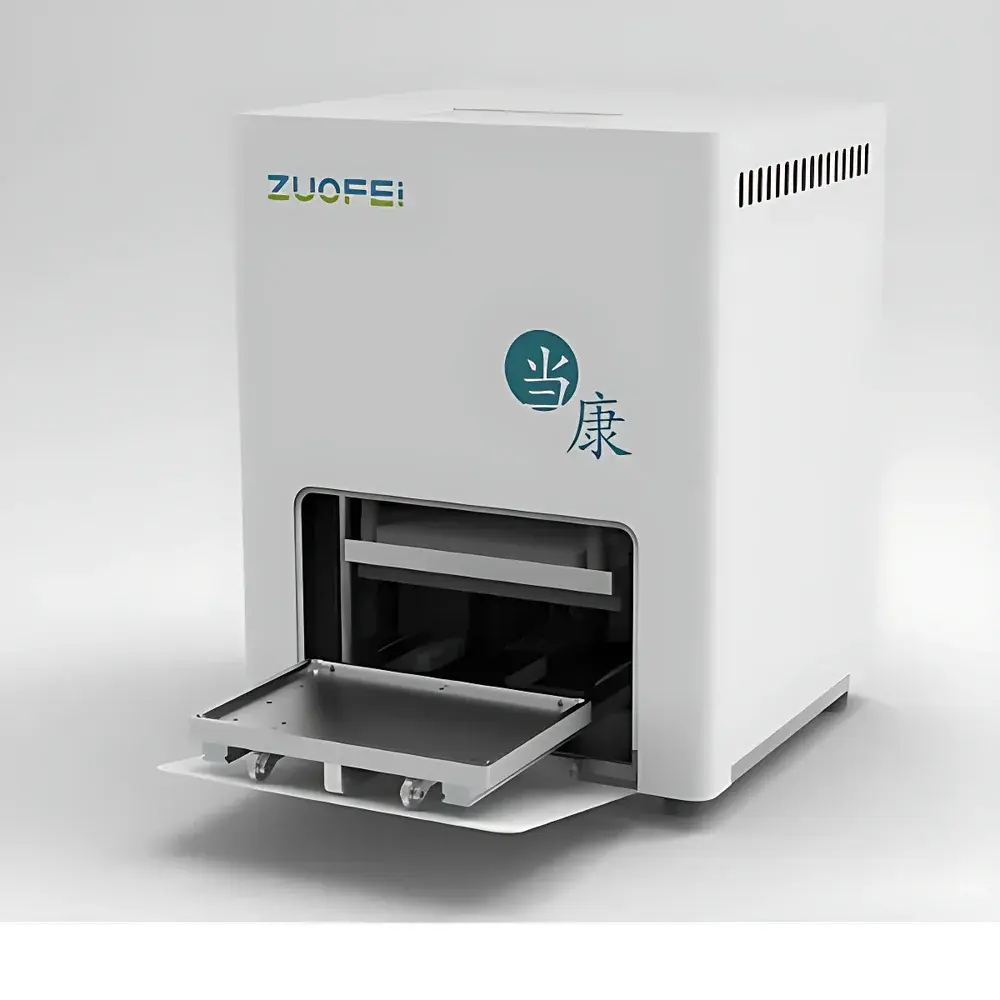
ZUOFEi Dangkang Automated Microplate Heat Sealer
| Brand | ZUOFEi |
|---|---|
| Origin | Shanghai, China |
| Manufacturer Type | Direct Manufacturer |
| Country of Origin | China |
| Model | Dangkang |
| Automation Level | Fully Automatic |
| Sealing Temperature Range | 30–200 °C |
| Temperature Accuracy | ±0.5 °C |
| Sealing Time | 8 s (actual thermal contact time: ~2.5 s) |
| Plate Height Compatibility | 7–64 mm |
| Max Input Power | 600 W |
| Dimensions (W×D×H) | 230 × 220 × 290 mm |
| Net Weight | 10 kg |
| Compatible Plate Materials | Polypropylene, Polystyrene, Cyclo-olefin Copolymer (COC), and other standard microplate substrates |
| Compatible Plate Formats | 96-well, 384-well, 1536-well, deep-well, PCR, and skirted/unskirted plates |
Overview
The ZUOFEi Dangkang Automated Microplate Heat Sealer is an engineered solution for reproducible, contamination-free thermal sealing of microplates in high-throughput life science workflows. Designed around precision resistive heating and programmable pneumatic actuation, the system applies uniform thermal energy across the entire sealing surface—ensuring consistent bond integrity without warping or delamination. Unlike manual or semi-automated alternatives, the Dangkang sealer integrates closed-loop temperature control with real-time feedback, maintaining setpoint stability within ±0.5 °C across its full 30–200 °C operating range. Its compact footprint (230 × 220 × 290 mm) and low thermal mass enable rapid warm-up (<10 min to operational temperature), minimizing idle time between batches. The device complies with core laboratory infrastructure requirements—including CE-marked electrical safety (EN 61010-1), RoHS-conformant materials, and IEC 60601-1–aligned mechanical design—making it suitable for ISO 13485–registered facilities and GLP-compliant environments.
Key Features
- Fully automated sealing cycle: single-button initiation with pre-programmed profiles for common plate types and film materials (e.g., aluminum, polyester, polyolefin)
- Adjustable sealing height (7–64 mm) accommodates standard ANSI/SLAS-format microplates—from shallow assay plates to deep-well storage plates—without manual recalibration
- Dual-mode operation: “Quick Release” mechanical clamping allows immediate tool-free access to the sealing head for film roll replacement or cleaning; “Quick Elbow” alignment ensures repeatable vertical positioning
- Intelligent thermal management: PID-controlled heating element with integrated thermistor array delivers spatially uniform heat distribution and prevents localized overheating
- Robust construction: stainless-steel sealing platen, reinforced polymer chassis, and IP20-rated enclosure ensure long-term reliability under continuous 8–12 h/day operation
- Energy-efficient design: 600 W maximum draw with dynamic power modulation reduces standby consumption by >40% compared to legacy resistance-heated sealers
Sample Compatibility & Compliance
The Dangkang sealer supports all commercially available microplate formats compliant with ANSI/SLAS standards, including 96-, 384-, and 1536-well plates, PCR plates, and custom-height deep-well plates. It accepts films manufactured from aluminum, polyester (PET), polyolefin (PO), and fluoropolymer-coated laminates—each requiring specific temperature and dwell parameters that are stored as user-configurable presets. The system meets material compatibility requirements per ASTM D882 (tensile properties of thin plastic sheeting) and ISO 11607-1 (packaging for terminally sterilized medical devices). All firmware and operational logs adhere to ALCOA+ principles (Attributable, Legible, Contemporaneous, Original, Accurate, Complete, Consistent, Enduring, Available), supporting audit readiness for FDA 21 CFR Part 11 and EU Annex 11 compliance when deployed with validated LIMS integration.
Software & Data Management
While the Dangkang operates via a dedicated embedded interface (no PC dependency), optional USB-C connectivity enables export of sealing event logs—including timestamp, plate ID (manually entered), temperature setpoint, actual peak temperature, dwell duration, and operator ID—to CSV or XML for traceability. Firmware version 2.3+ supports configurable audit trails with immutable timestamps and user-level access controls (admin/operator modes). Data retention spans ≥10,000 cycles locally, with automatic overwrite protection for flagged critical events (e.g., temperature deviation >±1.0 °C). Integration with third-party lab informatics systems (e.g., LabVantage, STARLIMS) is achievable via RESTful API endpoints documented in the manufacturer’s Technical Integration Guide (TIG v3.1).
Applications
- High-throughput screening (HTS) labs requiring rapid, sterile sealing prior to automated liquid handling or incubation
- Biobanking and clinical sample repositories where long-term plate integrity and vapor barrier performance are essential
- mRNA vaccine development workflows involving cold-chain-sensitive reagents sealed under inert atmosphere conditions
- qPCR and digital PCR preparation where evaporation prevention and cross-contamination control are mission-critical
- Quality control laboratories performing routine seal integrity validation per USP and ISO 8573-7 (non-viable particulate testing)
- Academic core facilities serving multi-user environments with diverse plate geometries and film specifications
FAQ
What microplate heights does the Dangkang support?
It accommodates plates ranging from 7 mm (low-profile assay plates) to 64 mm (deep-well storage plates) without mechanical adjustment.
Is the sealing time adjustable?
Yes—the nominal 8-second cycle includes preheat, dwell, and cool-down phases; users may modify dwell duration (1.5–12 s) and ramp rates via advanced mode.
Does the system support GMP documentation requirements?
When operated with enabled audit trail and electronic signature features, it satisfies data integrity expectations for GMP Annex 11 and FDA 21 CFR Part 11 compliance.
Can it seal PCR plates with optical films?
Yes—optimized presets for transparent polyester and polyolefin films ensure optical clarity preservation and thermal bond strength ≥1.2 N/mm per ASTM F88.
What maintenance is required?
Routine cleaning of the sealing platen with isopropyl alcohol biweekly; annual calibration verification using NIST-traceable RTD probe is recommended.




