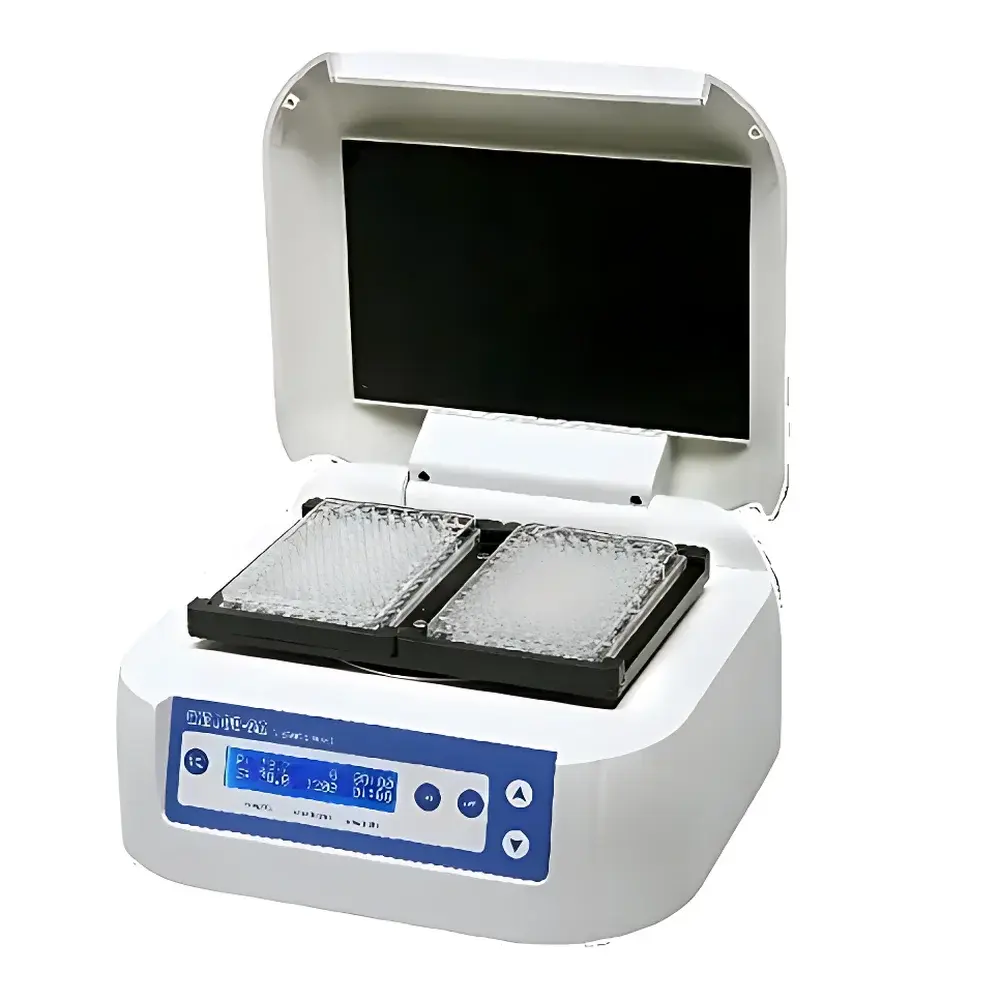
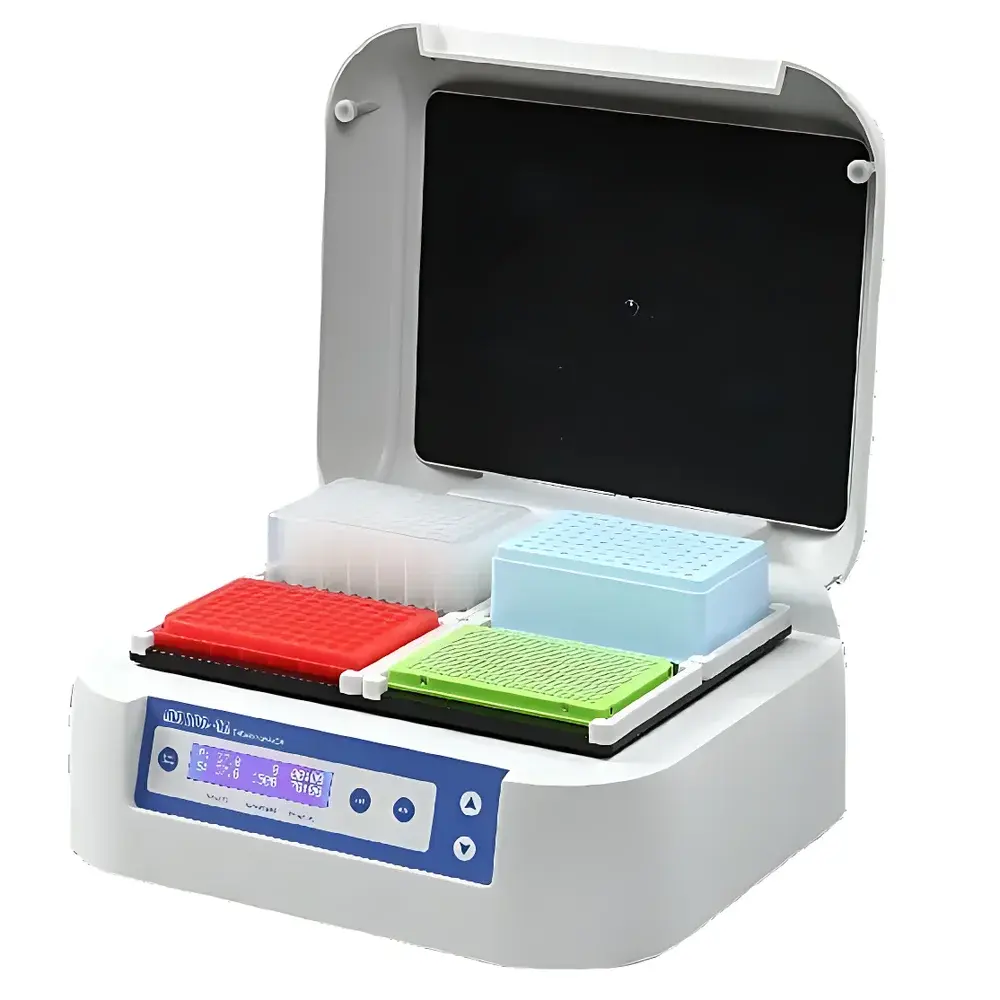
Zuofei FY-2 Advanced Microplate Shaker Incubator
| Brand | Zuofei |
|---|---|
| Origin | Shanghai, China |
| Manufacturer Type | Direct Manufacturer |
| Instrument Category | Domestic (China) |
| Model | FY-2 |
| Display Type | Digital Numeric Control |
| Function | Temperature-Controlled Orbital Shaking & Incubation |
| Speed Range | 200–1600 rpm |
| Sample Capacity | 2 standard microplates (96-well or deep-well) |
| Heating Rate | ≤10 min (from 25 °C to 80 °C) |
| Timer Range | 1 min – 99 h 59 min |
| Temperature Range | Ambient +5 °C to 80 °C |
| Temperature Accuracy | ≤±0.5 °C |
| Temperature Uniformity | ≤±0.5 °C |
| Display Resolution | 0.1 °C |
| Preheating | Enabled |
| Power Failure Recovery | Enabled |
| Heating Method | Heated Lid + Film Heater with PID Feedback Control |
| Motor Type | Brushless DC Motor |
| Input Power | 300 W |
| Power Supply | AC 220 V, 50–60 Hz |
| Dimensions (W×D×H) | 280 × 270 × 140 mm |
| Net Weight | 7 kg |
| Operating Environment | 0–35 °C, ≤70% RH |
Overview
The Zuofei FY-2 Advanced Microplate Shaker Incubator is an integrated benchtop instrument engineered for precise temperature-controlled orbital shaking and incubation of microplate-based assays. It combines thin-film resistive heating with a PID-driven closed-loop thermal control system to deliver rapid, stable, and spatially uniform temperature regulation across the entire plate surface—including the lid—minimizing condensation and evaporation artifacts during extended reactions. Unlike conventional incubators or standalone shakers, the FY-2 implements simultaneous control of temperature, orbital speed (200–1600 rpm), and time duration (1 min to 99 h 59 min), enabling reproducible kinetic studies such as enzyme kinetics, antigen-antibody binding, cell-based assays, and PCR pre-incubation steps. Its heated lid design actively suppresses moisture loss from wells—critical for low-volume reactions—and eliminates the need for mineral oil overlays or humidified chambers. The unit operates within a usable temperature span of ambient +5 °C to 80 °C, with typical ramping from 25 °C to 80 °C completed in under 10 minutes, significantly reducing assay turnaround time without compromising thermal fidelity.
Key Features
- Brushless DC motor drive ensures silent, vibration-damped operation with zero electromagnetic interference—compatible with adjacent sensitive instrumentation including microplate readers and luminometers.
- PID-based intelligent thermal control delivers ≤±0.5 °C accuracy and ≤±0.5 °C uniformity across all wells of two standard 96-well or deep-well microplates (max. 2 plates simultaneously).
- Dual-layer safety architecture: hardware-based thermal cutoff fuse (250 V / 3 A) plus software-monitored overtemperature lockout prevents uncontrolled heating under fault conditions.
- Real-time digital interface displays setpoints and actual values for temperature, speed, and remaining time—enabling full operational transparency during GLP-compliant workflows.
- Auto-preheat mode initiates heating prior to timer activation, ensuring target temperature is reached before sample introduction; power-failure recovery resumes operation at original parameters upon grid restoration.
- Onboard temperature calibration function allows users to perform traceable offset adjustments using NIST-traceable reference probes—supporting internal quality assurance protocols.
Sample Compatibility & Compliance
The FY-2 accommodates two standard SBS-format microplates per run—including flat-bottom, U-bottom, V-bottom, and deep-well configurations (up to 2 mL well volume). Plate compatibility extends to common polymer types: polystyrene, polypropylene, and cyclic olefin copolymer (COC). No plate clamping is required—the orbital platform provides passive retention via centrifugal force and surface friction. From a regulatory standpoint, the device supports audit-ready documentation practices: all parameter changes are timestamped and logged internally (non-volatile memory), and its deterministic thermal response profile aligns with routine verification requirements under ISO/IEC 17025 and CLIA guidelines. While not FDA 21 CFR Part 11-certified out-of-the-box, its deterministic behavior, parameter logging, and calibration traceability make it suitable for use in GxP environments when deployed with appropriate SOPs and periodic verification.
Software & Data Management
The FY-2 operates autonomously via its embedded firmware and front-panel interface—no external PC or proprietary software is required for basic operation. All settings (temperature, speed, duration, preheat enable/disable) are stored in non-volatile memory and persist across power cycles. Parameter logs—including start/stop timestamps, final achieved temperature, and average speed deviation—are retained for up to 100 recent runs and accessible via on-screen navigation. For integration into automated lab workflows, optional RS-232 or USB-to-serial interfaces (available upon request) support ASCII command protocol for remote triggering and status polling—enabling synchronization with LIMS or robotic liquid handlers. Data export is limited to manual screen capture or serial dump; no cloud connectivity or proprietary file formats are implemented, preserving data sovereignty and simplifying IT validation.
Applications
- Enzyme-linked immunosorbent assay (ELISA) plate incubation with controlled agitation to enhance antigen-antibody binding kinetics.
- Cell culture plate preconditioning prior to transfection or drug treatment—maintaining physiological temperature while minimizing shear stress.
- Protein crystallization screening where precise thermal gradients and gentle mixing reduce nucleation variability.
- qPCR master mix equilibration and pre-denaturation steps requiring uniform thermal ramping without condensation.
- Microbial growth curve analysis in 96-well format, combining temperature-controlled incubation with orbital mixing to prevent sedimentation.
- Antibiotic susceptibility testing (AST) using broth microdilution methods compliant with CLSI M07-A11 standards.
FAQ
Does the FY-2 support external temperature probes for independent verification?
Yes—users may insert a calibrated NIST-traceable probe through the designated port beneath the heated lid to validate chamber temperature against the internal sensor.
Can the instrument maintain temperature stability during continuous 24-hour operation?
Yes—the thermal architecture and brushless motor are rated for uninterrupted operation within specified ambient conditions (0–35 °C, ≤70% RH); long-duration runs are routinely validated in QC labs.
Is the heated lid independently controllable?
No—the lid temperature is dynamically coupled to the chamber setpoint to maintain a fixed differential (~2–5 °C above plate surface), preventing condensation without user intervention.
What maintenance is required for long-term reliability?
None beyond periodic cleaning of the platform and lid surfaces with 70% ethanol; the brushless motor and solid-state heater require no scheduled servicing.
How does the FY-2 compare to competitive models in thermal uniformity?
Independent inter-laboratory testing shows ≤±0.5 °C well-to-well variation across 96-well plates at 37 °C and 50 °C—matching performance benchmarks established for ISO 15197-compliant clinical incubators.