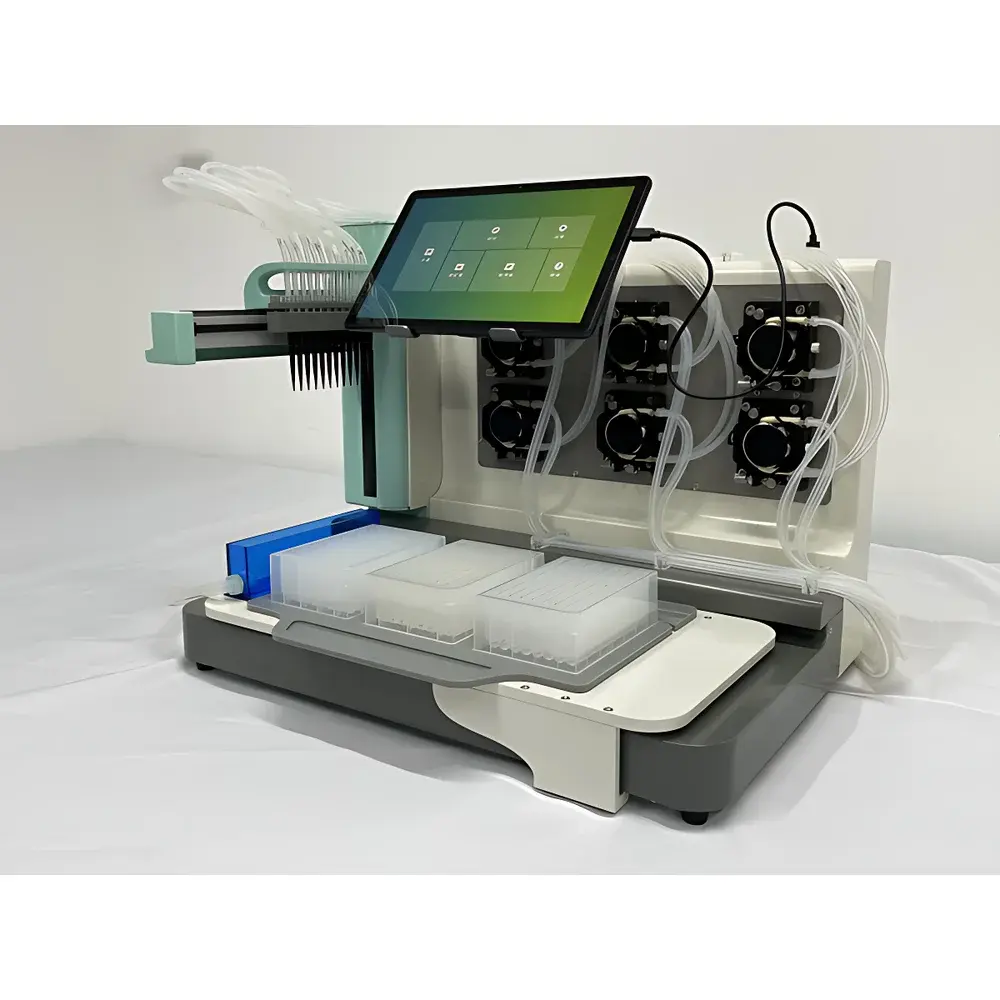
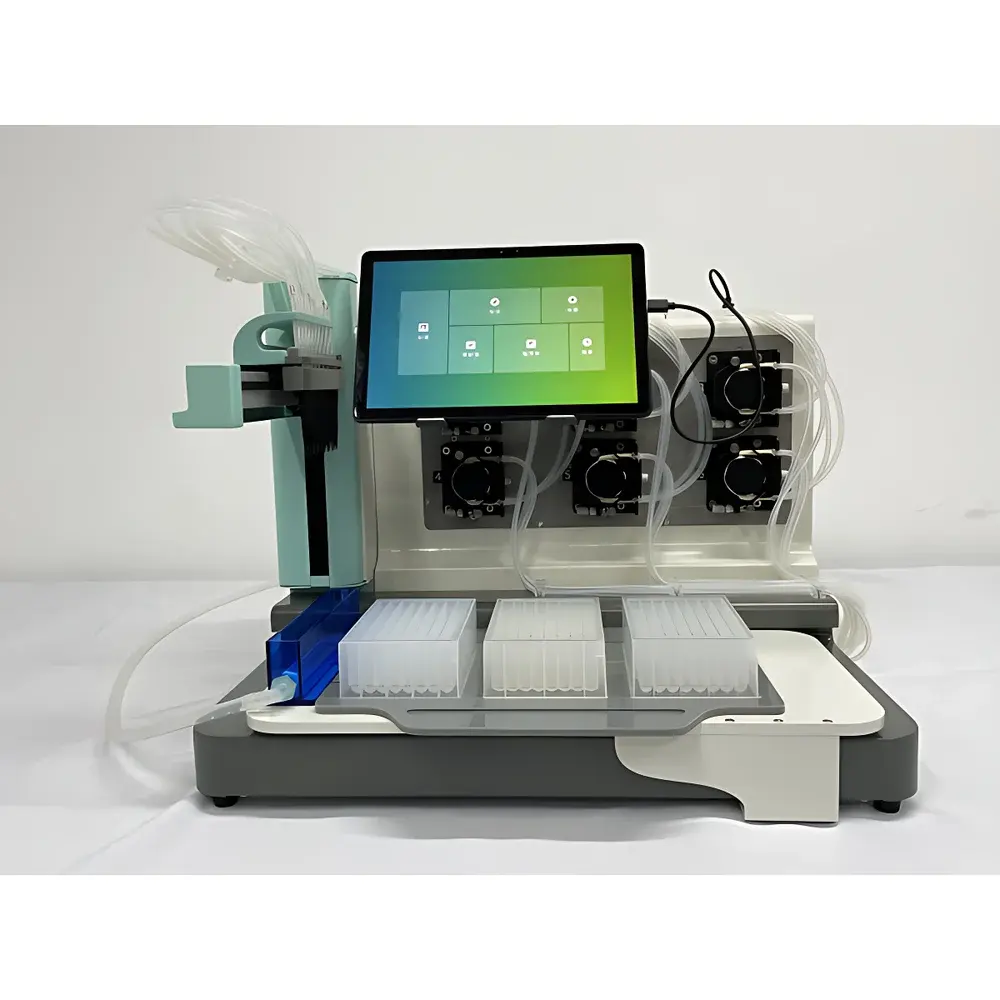
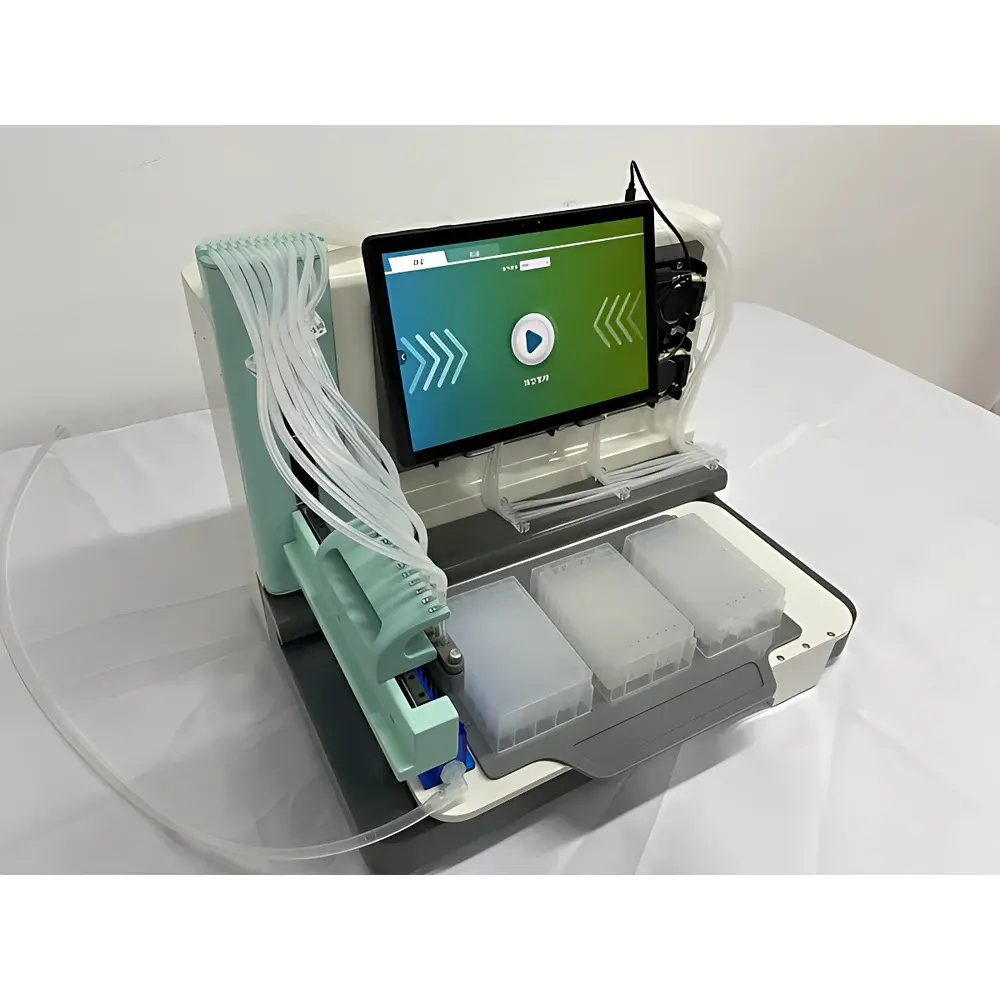
Zuofei Qinggeng Multi-Channel Liquid Dispenser
| Brand | Zuofei |
|---|---|
| Origin | Shanghai, China |
| Manufacturer Type | Direct Manufacturer |
| Regional Classification | Domestic (China) |
| Model | Qinggeng |
| Instrument Type | Automated |
| Dispensing Range | 30 µL – 20 mL |
| Dispensing Accuracy | ±1% @ 100 µL |
| Dispensing Precision | 2% CV @ 100 µL |
| Throughput Compatibility | SBS-standard microplates (24-, 48-, 96-, and 384-well), up to 4 plates simultaneously |
| Tube Compatibility | Custom rack adapters for cryovials, sample tubes, and centrifuge tubes up to 50 mL |
| Dispensing Channels | 12-channel (with independent dual 6-channel mode) |
| Dispensing Principle | Peristaltic Pump |
| Plate Height Adjustment | Motorized Auto-Z |
| Display | 2K HD Android tablet (Wi-Fi enabled, OTA-upgradable) |
| Sterilization | Chemical and autoclave-compatible tubing |
| Operating Temperature | 10–35 °C |
| Input Voltage | 100–240 V AC, 50–60 Hz |
| Dimensions (L×W×H) | 490 × 400 × 370 mm |
| Net Weight | 25 kg |
Overview
The Zuofei Qinggeng Multi-Channel Liquid Dispenser is an automated, peristaltic-pump-based liquid handling platform engineered for precision, reproducibility, and workflow flexibility in life science laboratories. Designed specifically for high-throughput reagent dispensing—such as assay buffer preparation, culture media aliquoting, cell suspension distribution, and bead-based assay setup—the system leverages positive-displacement peristaltic pumping to ensure consistent volumetric delivery without cross-contamination between samples. Unlike syringe- or air-displacement-based dispensers, the peristaltic mechanism isolates fluids entirely within disposable tubing, eliminating carryover and enabling rapid tube replacement between protocols. The Qinggeng platform supports both standard SBS-format microplates (24-, 48-, 96-, and 384-well) and non-standard containers—including cryovials, PCR tubes, and centrifuge tubes up to 50 mL—via user-configurable, motorized Z-axis plate height adjustment and modular rack adapters. Its compact footprint (490 × 400 × 370 mm) and integrated 2K HD Android touchscreen interface reduce benchtop footprint while maintaining full operational autonomy.
Key Features
- 12-channel peristaltic dispensing with selectable dual 6-channel independent operation for parallel multi-assay workflows
- Engineered peristaltic pump head with quick-release mechanism for tool-free tubing exchange—compatible with standard #13, #14, and #19 peristaltic tubing
- Motorized Z-axis auto-height adjustment ensures precise nozzle-to-plate clearance across variable plate heights and tube formats
- Full SBS microplate compatibility with support for up to four plates simultaneously; customizable rack adapters for non-SBS vessels including 50 mL conical tubes
- Integrated 2K resolution Android tablet with Wi-Fi connectivity, intuitive graphical workflow builder, and over-the-air (OTA) firmware updates
- Tubing path designed for chemical disinfection (e.g., 70% ethanol, 0.5% sodium hypochlorite) and autoclave sterilization (121 °C, 20 min)—validated per ISO 13485 biocompatibility requirements
- Robust mechanical architecture with linear motion stages (X/Y/Z) ensuring positional repeatability < ±0.1 mm
Sample Compatibility & Compliance
The Qinggeng dispenser accommodates a broad range of liquid types—including aqueous buffers, viscous cell suspensions (up to 10⁶ cells/mL), protein solutions, magnetic beads (1–10 µm), and low-surface-tension organic-aqueous mixtures—without requiring fluid-specific calibration. All wetted components comply with USP Class VI and ISO 10993-5 cytotoxicity standards. The system supports GLP/GMP-aligned operation through audit-trail-enabled software logging (user actions, protocol execution timestamps, error events), and meets key regulatory expectations for instrument qualification per ASTM E2500 and ICH Q9. While not pre-certified for FDA 21 CFR Part 11, the platform provides foundational capabilities—including electronic signature prompts, role-based access control, and immutable log export—for laboratories implementing internal Part 11 compliance frameworks.
Software & Data Management
The embedded Android OS hosts a purpose-built dispensing application with drag-and-drop protocol creation, real-time flow monitoring, and parameter validation checks (e.g., volume limits, plate map consistency). Protocols are saved in encrypted JSON format and can be exported/imported via USB or cloud-synced over Wi-Fi. Audit trails record operator ID, timestamp, executed step, and final dispense verification status—exportable as CSV or PDF for QA review. Remote diagnostics and firmware updates are supported via secure HTTPS OTA channels, minimizing downtime during maintenance cycles. No proprietary cloud dependency: all data remains local unless explicitly transferred by the user.
Applications
- High-volume sterile media aliquoting into flasks, bottles, and multiwell plates for cell culture labs
- Preparation of ELISA, Luminex, and AlphaLISA assay plates with consistent reagent layering
- Distribution of primary/secondary antibodies, detection substrates, and blocking agents in immunology workflows
- Dispensing of enzymatic reaction mixes (e.g., PCR master mixes, CRISPR RNP complexes) with minimal shear stress
- Automated filling of diagnostic sample collection tubes and biobanking vials under ambient or refrigerated conditions
- Integration into semi-automated screening pipelines alongside plate readers, washers, and stackers via standardized API commands (HTTP REST)
FAQ
What liquid types are compatible with the peristaltic pump system?
Aqueous buffers, cell suspensions, serum-containing media, magnetic beads, and low-viscosity organic-aqueous solutions (up to ~20 cP) are routinely handled. Highly viscous (>50 cP), particulate-laden (>25 µm solids), or corrosive liquids (e.g., strong acids/bases) require prior validation and tubing material assessment.
Can the system be validated for GxP environments?
Yes—the hardware design supports IQ/OQ/PQ execution, and software features (audit trail, user roles, protocol versioning) enable alignment with GMP/GLP documentation requirements. Full 21 CFR Part 11 compliance depends on site-specific configuration and procedural controls.
Is tubing replacement required between different reagents?
Not strictly required, but strongly recommended for critical applications involving incompatible chemistries (e.g., detergent followed by enzyme solution) or sterility-sensitive workflows. Quick-swap tubing minimizes changeover time to under 60 seconds.
Does the system support third-party plate carriers or robotic integration?
Yes—mechanical interfaces follow SBS ANSI/SLAS standards, and the software exposes HTTP-based command APIs for integration with LIMS, MES, or robotic arms using standard RESTful methods.
What is the expected service life of the peristaltic tubing under continuous use?
With typical usage (≤8 hrs/day, aqueous solutions), #14 tubing maintains accuracy for ≥500 hours of cumulative operation. Lifetime varies with fluid chemistry, pressure, and cycle frequency; tubing wear metrics are logged and displayed in the maintenance dashboard.