
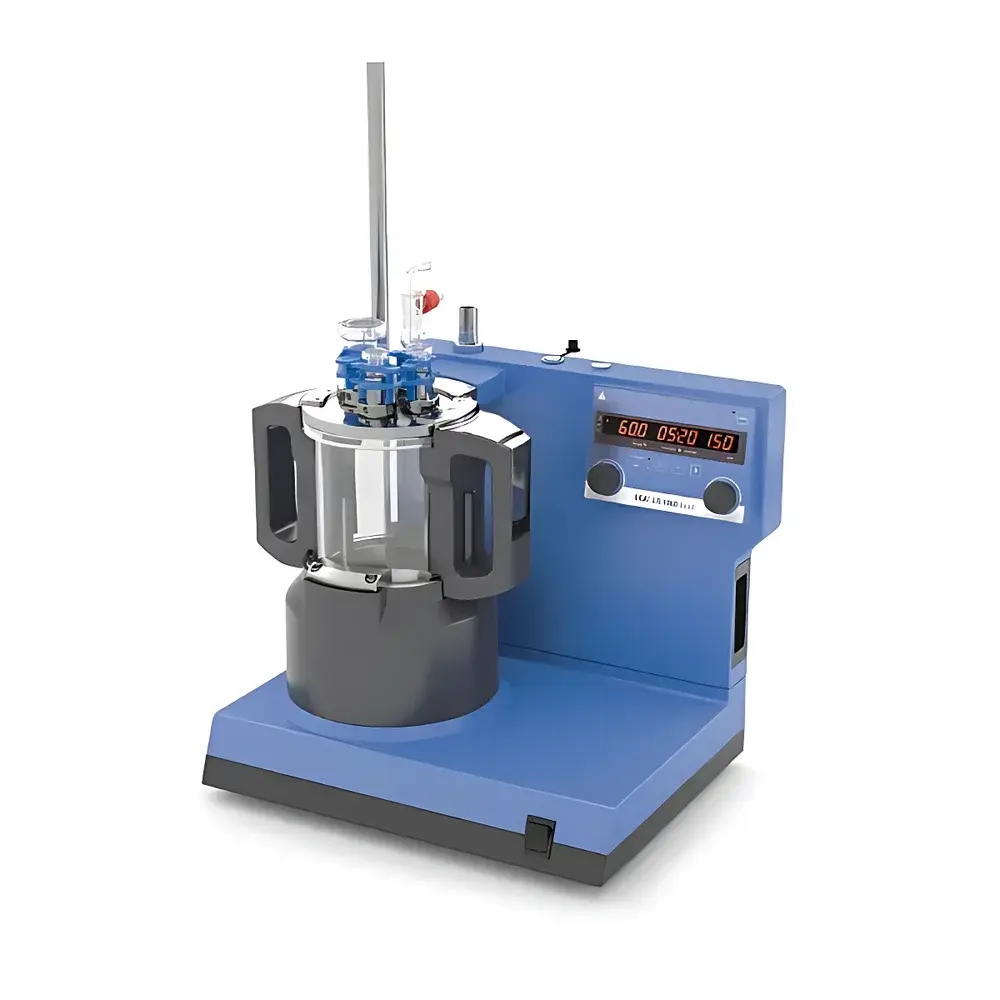
IKA LR 1000 basic System Laboratory Reactor
| Brand | IKA |
|---|---|
| Origin | Germany |
| Model | LR 1000 basic System |
| Max. Working Volume | 1000 mL |
| Min. Sample Volume (without disperser) | 500 mL |
| Max. Operating Temperature | 120 °C |
| Vacuum Capability | 25 mbar |
| Max. Viscosity | 100,000 mPa·s |
| Speed Range | 10–150 rpm |
| Stirrer Shaft Diameter (incl. integrated clamp) | 16 mm |
| Wetted Materials | AISI 316L stainless steel (1.4571), Borosilicate Glass 3.3, PTFE, PEEK, FKM |
| Reaction Vessel Opening | 1× NS 29/32, 3× NS 14/23 |
| Continuous Duty Cycle | 100 % |
| Temperature Measurement Accuracy | ±0.1 K |
| Rated Torque | 3 Nm |
| Heating Power Output | 1000 W |
| Cooling Medium Max. Pressure | 1 bar |
| Min. Adjustable Speed | 10 rpm |
| Max. Heating Temperature | 180 °C |
| Adjustable Safety Cut-off Range | 47–225 °C (±10–±20 K deviation) |
| Cooling Medium Min. Inlet Temperature | 3 °C |
| Temp. Control Accuracy (heating) | ±1 K |
| Sensor-Based Temp. Control Accuracy | ±0.2 K |
| Speed Deviation | ±5 rpm |
| Speed Display | LED, 7-segment |
| External Temp. Sensor Interface | PT100 |
| Timer | Yes, LED display |
| Speed Control Resolution | 1 rpm/step |
| Cooling Method | External circulation |
| Temp. Display (cooling circuit) | Yes |
| Safety Temp. Display | LED |
| External Sensor Usage Indicator | Yes |
| Thermal Fuse | Yes |
| Dimensions (W×D×H) | 443 × 360 × 295 mm |
| Weight | 21.897 kg |
| Ambient Operating Temp. | 5–40 °C |
| Max. Relative Humidity | 80 % |
| Protection Class (DIN EN 60529) | IP21 |
| RS232 Interface | Yes |
| USB Interface | Yes |
| Voltage | 230 V |
| Frequency | 50/60 Hz |
| Input Power Rating | 1200 W |
| Optional Voltage Variant | 115 V (R1000 basic variant) |
Overview
The IKA LR 1000 basic System is a modular, benchtop laboratory reactor engineered for precise thermal and mechanical control during chemical synthesis, dispersion, homogenization, and emulsification processes. It operates on the principle of jacketed or bottom-heated temperature regulation combined with torque-controlled mechanical agitation—enabling reproducible reaction conditions under controlled vacuum, elevated temperature, and high-viscosity regimes. Designed for scalability from lab-scale process development to pilot-stage optimization, the system integrates a robust heating module (up to 180 °C), vacuum compatibility down to 25 mbar, and continuous-duty operation—making it suitable for extended kinetic studies and batch consistency validation in regulated environments.
Key Features
- Modular architecture supporting seamless integration of optional components including ULTRA-TURRAX® T 25 dispersers, anchor stirrers with PTFE刮片 (scraping blades), and external cooling circulators via rear-mounted fluid ports.
- Seven-segment LED displays for real-time monitoring of speed (10–150 rpm, adjustable in 1-rpm increments) and temperature (±0.2 K accuracy with PT100 sensor feedback).
- Dual-layer safety system: programmable thermal cut-off (47–225 °C, ±10–20 K hysteresis) coupled with automatic shutdown upon vessel or lid removal—ensuring compliance with DIN EN 60529 IP21 personnel protection standards.
- Chemically resistant wetted materials: AISI 316L stainless steel (1.4571), borosilicate glass 3.3, PTFE, PEEK, and FKM seals—validated for compatibility with aggressive solvents, APIs, and cosmetic actives per ISO 10993-5 cytotoxicity screening guidelines.
- Digital connectivity via RS232 and USB interfaces enables instrument parameter logging, remote setpoint adjustment, and audit-trail generation—supporting alignment with FDA 21 CFR Part 11 requirements when paired with compliant LIMS or ELN software.
Sample Compatibility & Compliance
The LR 1000 basic System accommodates reaction volumes from 500 mL (minimum without disperser) to 1000 mL (maximum working capacity), with standardized NS 29/32 and NS 14/23 ground-glass joints enabling rapid adaptation of condensers, gas inlets, pH probes, or sampling ports. Its ability to maintain stable temperatures up to 120 °C under vacuum supports solvent reflux, moisture-sensitive Grignard reactions, and low-pressure distillations. The system meets CE marking requirements and conforms to DIN EN 61000-6-2 (immunity) and DIN EN 61000-6-4 (emission) electromagnetic compatibility standards. For GMP-aligned workflows, traceable calibration of the included PT100.30 sensor and LR1000.61 mounting assembly facilitates IQ/OQ documentation per ASTM E2500 and ISO/IEC 17025 frameworks.
Software & Data Management
While the LR 1000 basic System operates as a standalone unit with intuitive front-panel controls, its RS232 and USB ports allow bidirectional communication with third-party data acquisition platforms (e.g., LabVIEW, MATLAB, or custom Python scripts). Logged parameters—including speed, temperature, timer status, and safety event flags—are timestamped and exportable in CSV format. When deployed in GLP/GMP settings, users may configure external software to enforce electronic signatures, user access levels, and automated backup—fulfilling ALCOA+ data integrity principles. No proprietary firmware or cloud dependency is required; all configuration remains local and auditable.
Applications
- Pharmaceutical process development: API crystallization under controlled supersaturation, suspension polymerization, and viscosity-driven coating formulation.
- Cosmetic emulsion engineering: O/W and W/O systems requiring simultaneous shear control and thermal ramping (e.g., silicone-based serums, anhydrous sticks).
- Materials science: Nanoparticle dispersion in high-viscosity polymer melts (up to 100,000 mPa·s), solvent-borne resin synthesis, and catalyst slurry homogenization.
- Academic research: Kinetic modeling of exothermic reactions with integrated cooling loop modulation and real-time temperature profiling.
- Quality control labs: Batch-to-batch reproducibility testing per USP Viscosity and EP 2.2.35 Rheological Properties protocols.
FAQ
Can the LR 1000 basic System be used for reactions requiring inert atmosphere control?
Yes—via the standard NS 29/32 port, users may connect gas inlet adapters and pressure-relief valves to establish nitrogen or argon purging sequences. Vacuum capability (25 mbar) further supports degassing prior to inert gas backfill.
Is the heating plate compatible with glass reactors only, or can metal vessels be used?
The system is optimized for borosilicate glass 3.3 vessels with flat-bottom geometry. Use with metallic reactors is not recommended due to thermal coupling inefficiency and potential interference with magnetic drive coupling (if equipped with optional overhead stirrer motor).
What is the validation support available for regulated industries?
IKA provides factory calibration certificates for the PT100 sensor and torque verification reports. Users are responsible for periodic recalibration per internal SOPs; documentation templates for IQ/OQ are available upon request from authorized distributors.
Does the system support programmable temperature ramps?
No—the LR 1000 basic System features manual setpoint control only. For multi-step thermal profiles, integration with an external programmable circulator (e.g., Huber Chiller) via the analog input/output interface is required.
How is maintenance performed on the stirring mechanism?
The sealed stirrer drive unit requires no routine lubrication. Annual inspection of shaft runout (≤0.1 mm), seal integrity, and clamp torque (per DIN 13125) is advised. Replacement parts—including PTFE-coated anchor impellers and FKM gaskets—are catalogued under IKA spare part numbers LR1000.SPA-XXX.



