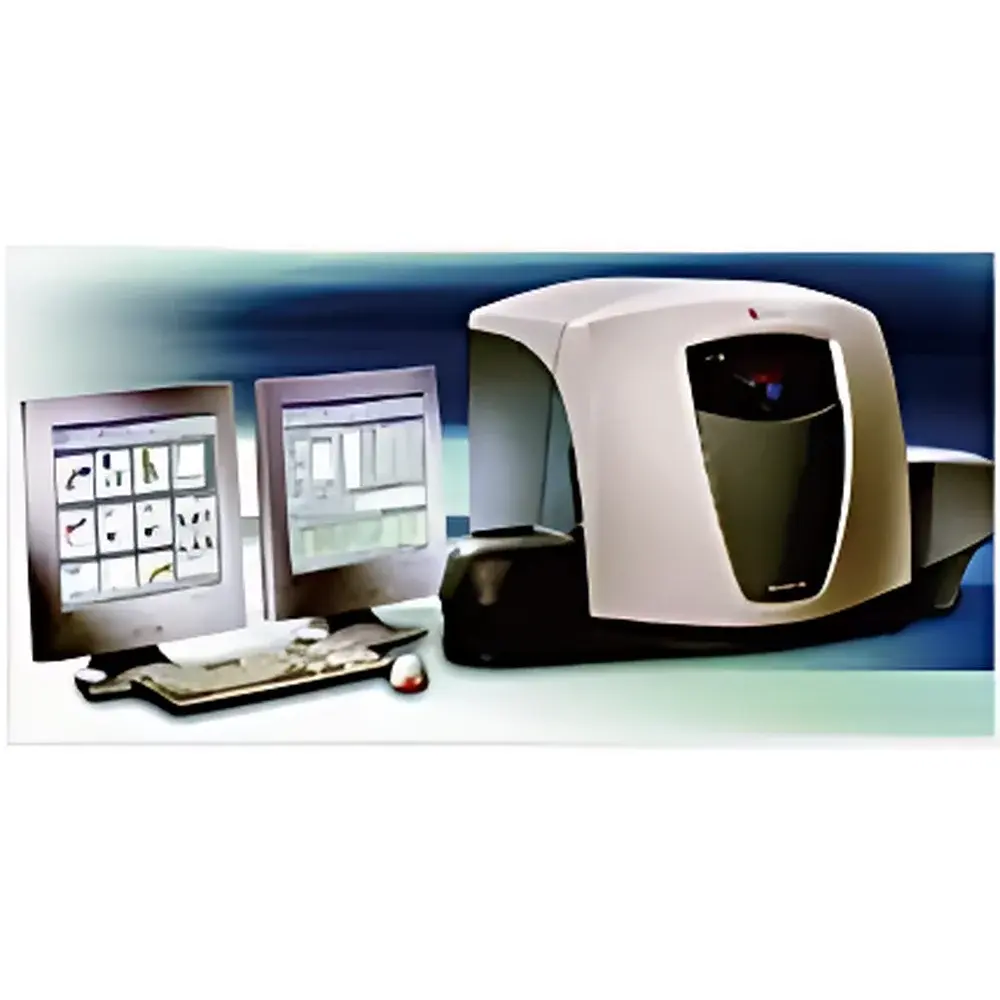
Beckman Coulter Cytomics FC500 Five-Color Flow Cytometer
| Brand | Beckman Coulter |
|---|---|
| Origin | USA |
| Model | Cytomics FC500 |
| Product Type | Flow Cytometry Analyzer |
| Laser Configuration | Single or dual collinear lasers |
| Fluorescence Channels | 5-color detection |
| Sample Formats | 12×75 mm tubes, 24-/48-/96-well microplates, Eppendorf tubes |
| Software | CXP Data Acquisition and Analysis Software |
| Compliance | Designed for GLP-compliant research environments |
Overview
The Beckman Coulter Cytomics FC500 is a benchtop five-color flow cytometer engineered for precision, reproducibility, and operational efficiency in academic and pharmaceutical research laboratories. Utilizing orthogonal light scattering (forward scatter, FSC; side scatter, SSC) combined with fluorescence detection via photomultiplier tube (PMT)-based optics, the FC500 enables quantitative multi-parameter analysis of single cells or particles in suspension at rates up to 10,000 events per second. Its dual-laser architecture features collinear beam alignment—eliminating spatial separation artifacts and time-delay compensation requirements common in non-collinear systems—thereby improving signal fidelity and simplifying experimental setup for complex immunophenotyping and functional assays.
Key Features
- Collinear dual-laser optical design (typically 488 nm blue laser + optional 638 nm red laser), enabling simultaneous excitation of spectrally distinct fluorochromes without beam walk or timing drift
- Five independent fluorescence detection channels with configurable bandpass filters and dichroic mirrors, supporting common conjugates including FITC, PE, PerCP-Cy5.5, APC, and Alexa Fluor 700
- Integrated automated fluidics system with programmable sample introduction modes: manual capillary (CL), manual tube (MCL), automated tube (MCL-Auto), plate loader (PL), and EP-tube handling—compatible with 24-, 48-, and 96-well plates as well as standard 12×75 mm polystyrene tubes
- CXP software platform providing guided instrument setup, real-time data acquisition, on-the-fly compensation matrix calculation, and standardized template-based analysis workflows
- Self-calibrating optical alignment and daily QC tracking via built-in calibration beads (e.g., Flow-Check Pro), ensuring long-term measurement stability across user shifts and instrument maintenance cycles
- Compact footprint (< 0.5 m²) with integrated touchscreen interface and Ethernet connectivity for networked lab deployment and remote monitoring
Sample Compatibility & Compliance
The Cytomics FC500 accommodates a broad range of biological specimens—including peripheral blood mononuclear cells (PBMCs), bone marrow aspirates, cultured cell lines, and microorganism suspensions—without requiring specialized sample preparation beyond standard fixation/permeabilization protocols. It supports both fixed and live-cell analysis, with optional temperature-controlled sample chamber integration for kinetic assays such as calcium flux or mitochondrial membrane potential measurements. The system is designed to meet core requirements for Good Laboratory Practice (GLP) environments, including audit-trail-enabled software logging, user-access controls, and electronic signature support within CXP v3.x and later. While not FDA 510(k)-cleared for clinical diagnostics, its performance characteristics align with ISO 13845:2017 guidelines for analytical instrumentation used in regulated preclinical research.
Software & Data Management
CXP (Cytometry eXpert Platform) serves as the native acquisition and analysis environment, offering intuitive drag-and-drop gating, batch processing of plate-based experiments, and export-ready reporting in FCS 3.0/3.1 format. Advanced features include automated compensation using single-stained control samples, spillover spreading coefficient (SSC) visualization, and hierarchical population annotation consistent with MIFlowCyt reporting standards. Raw data files are stored in vendor-neutral formats compatible with third-party tools including FlowJo, FCS Express, and R/Bioconductor packages (e.g., flowCore, cytolib). All software updates, firmware patches, and calibration utilities are distributed via Beckman Coulter’s secure customer portal, with version history and change logs maintained for internal validation documentation.
Applications
- Immunophenotyping of hematopoietic lineages using 5-color antibody panels for leukemia and lymphoma classification (e.g., CD45/CD14/CD16/CD34/HLA-DR)
- Intracellular cytokine staining (ICS) and phospho-protein detection following stimulation and brefeldin A treatment
- Calcium flux kinetics monitored via Indo-1 or Fluo-4 AM dyes in primary T cells or mast cells
- GFP/RFP reporter expression quantification in transfected or transduced cell populations
- Platelet activation status assessment through GPIIb/IIIa conformational epitope binding (e.g., PAC-1) combined with CD62P and CD41 labeling
- Apoptosis profiling using Annexin V-FITC/PI dual staining with precise quadrant-based discrimination
FAQ
Is the Cytomics FC500 compliant with 21 CFR Part 11?
The CXP software supports optional 21 CFR Part 11–compliant configurations—including electronic signatures, audit trails, and role-based access control—when deployed with validated IT infrastructure and documented SOPs.
Can it perform absolute counting without reference beads?
Absolute quantification requires volumetric sampling calibration; the FC500 supports this via optional AccuCount fluorescent microsphere kits and integrated volume tracking in CXP.
What maintenance intervals are recommended?
Daily startup QC with Flow-Check Pro beads, monthly optical alignment verification, and annual PM service by Beckman Coulter Field Service Engineers are advised per manufacturer guidelines.
Is there support for high-throughput screening workflows?
Yes—the PL (plate loader) option enables unattended acquisition from 96-well plates with customizable plate maps, cycle times, and event thresholds per well.
Does the system integrate with LIMS or ELN platforms?
CXP exports metadata-rich FCS files and CSV reports compatible with major laboratory informatics systems via shared network drives or REST API adapters (third-party developed).