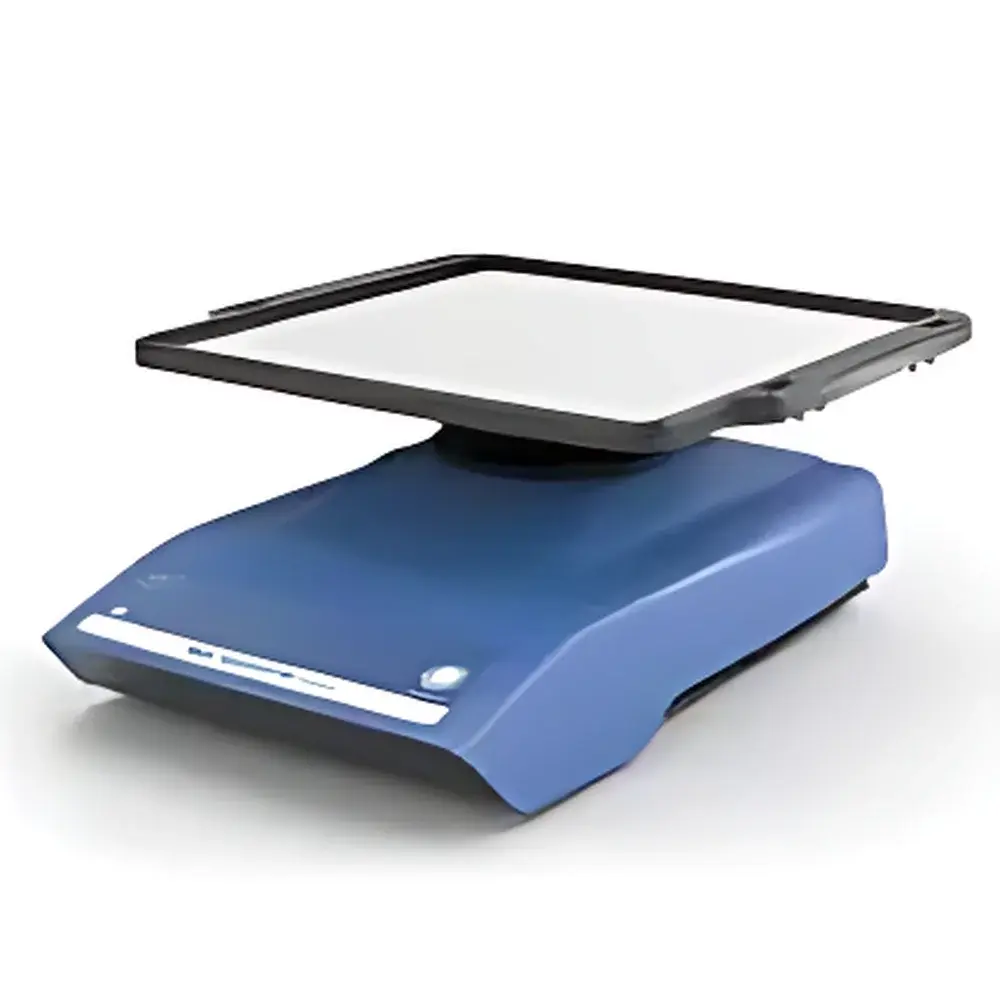
IKA ROCKER 3D basic Rocking Mixer
| Brand | IKA |
|---|---|
| Origin | Germany |
| Model | ROCKER 3D basic |
| Oscillation Angle | 8° |
| Oscillation Amplitude | 30 mm |
| Temperature Range | 4–50 °C |
| Platform Quantity | 1 |
| Maximum Load (incl. fixture) | 2 kg |
| Continuous Operation | 100% duty cycle |
| Fixed Speed | 30 rpm |
| Dimensions (W × D × H) | 280 × 165 × 330 mm |
| Weight | 2.2 kg |
| Protection Rating | IP21 |
| Input Voltage | 100–240 V AC, 50/60 Hz |
| Power Consumption | 24 W |
| Operating Ambient Temperature | 4–50 °C |
| Relative Humidity Limit | 80 % |
| Stackable Platforms | Yes (30 mm height increment) |
| Slip-Resistant Rubber Mat | Included |
| Touch Control Interface | Yes |
| USB/RS232/Analog Output | None |
| Timer Function | None |
| Speed Display | None |
| Pulse Mode | No |
| Benchtop Brake | No |
Overview
The IKA ROCKER 3D basic is a precision-engineered rocking mixer designed for gentle, reproducible sample homogenization in life science laboratories. Unlike orbital or reciprocating shakers, it employs a controlled 3D rocking motion—defined by a fixed 8° tilt angle and 30 mm oscillation amplitude—to induce laminar fluid displacement across vessels. This motion minimizes shear stress on sensitive biological samples while ensuring uniform suspension of cells, nucleic acids, or reagents. The device operates at a constant 30 rpm, eliminating speed variability caused by load changes or line voltage fluctuations—a critical advantage for long-term incubation-compatible protocols. Its compact footprint (280 × 165 × 330 mm) and low power draw (24 W) make it suitable for placement inside refrigerated or heated incubators (4–50 °C), supporting applications ranging from cell monolayer maintenance to post-lysis DNA binding steps.
Key Features
- Fixed 8° rocking angle ensures high inter- and intra-experiment reproducibility—essential for GLP-compliant workflows and method validation.
- Gentle 30 mm amplitude motion prevents foam formation and cell membrane damage during extended mixing of mammalian cultures or fragile organelles.
- Robust DC motor architecture with integrated thermal protection enables uninterrupted 100% duty-cycle operation—validated for continuous use over 72+ hours.
- IP21-rated enclosure provides dust ingress protection and safeguards against vertically dripping condensate, supporting safe integration into humidified CO2 incubators.
- Touch-sensitive control panel with tactile feedback offers intuitive one-button activation—no firmware updates or software drivers required.
- Stackable platform design allows vertical configuration of multiple units (30 mm spacing between decks), optimizing bench or incubator space without compromising airflow.
- Included anti-slip rubber mat ensures stable positioning on stainless-steel or polymer lab surfaces—even under centrifugal forces generated during rapid acceleration phases.
Sample Compatibility & Compliance
The ROCKER 3D basic accommodates standard laboratory vessels—including Erlenmeyer flasks (up to 500 mL), T-flasks (75 cm²), Petri dishes (90–150 mm), and conical tubes (15–50 mL)—when paired with optional IKA-certified fixtures (e.g., universal clamp sets, multi-well plate holders). All contact materials comply with USP Class VI biocompatibility standards. While the unit itself does not carry CE marking for in vitro diagnostic use, its mechanical stability and temperature tolerance align with ISO 13485 environmental control requirements for ancillary equipment in medical device manufacturing cleanrooms. It meets DIN EN 60529 (IP21) for electrical safety in non-hazardous laboratory environments and conforms to IEC 61000-6-3 (EMC emissions) and IEC 61000-6-2 (immunity) standards.
Software & Data Management
This is a stand-alone electromechanical instrument with no embedded microprocessor, network interface, or digital data logging capability. As such, it requires no software installation, firmware updates, or cybersecurity validation. Its operational simplicity eliminates risks associated with software obsolescence, OS compatibility, or FDA 21 CFR Part 11 audit trail requirements—making it ideal for regulated QC labs where documentation relies solely on manual logbooks or LIMS-integrated environmental monitoring systems. All operating parameters (speed, angle, amplitude) are factory-calibrated and mechanically locked; no user-adjustable settings exist, thereby reducing qualification burden during IQ/OQ/PQ validation cycles.
Applications
- Cell culture maintenance: Uniform redistribution of adherent cells during medium exchange or staining protocols without detachment-induced apoptosis.
- Molecular biology workflows: Consistent mixing during column-based DNA/RNA purification, hybridization steps, and antibody incubations on membranes.
- Histology & cytology: Gentle agitation during tissue section deparaffinization, antigen retrieval, and chromogenic substrate development.
- Microbiology: Homogenization of low-viscosity broth cultures prior to plating or OD600 measurement—avoiding vortex-induced aerosol generation.
- Biopharmaceutical QC: Sample equilibration in stability studies conducted at controlled temperatures (4 °C, 25 °C, 37 °C, 40 °C).
FAQ
Can the ROCKER 3D basic be used inside a CO2 incubator?
Yes—the unit is rated for continuous operation at ambient temperatures from 4 to 50 °C and relative humidity up to 80 %, making it compatible with standard humidified CO2 incubators.
Is speed adjustment possible?
No—this model operates exclusively at a fixed 30 rpm. Speed variability is intentionally eliminated to ensure protocol consistency across users and instruments.
What is the maximum vessel weight capacity?
The platform supports up to 2 kg total mass, including the vessel, sample volume, and fixture. Overloading may compromise motion fidelity and long-term motor performance.
Does it support timer-based shutdown?
No—there is no built-in timer function. For timed protocols, external programmable timers or LIMS-controlled relay switches must be used.
Are third-party clamps compatible?
Only IKA-certified accessories are validated for mechanical integrity and vibration damping. Non-OEM fixtures may introduce resonance or uneven load distribution, affecting mixing uniformity.