
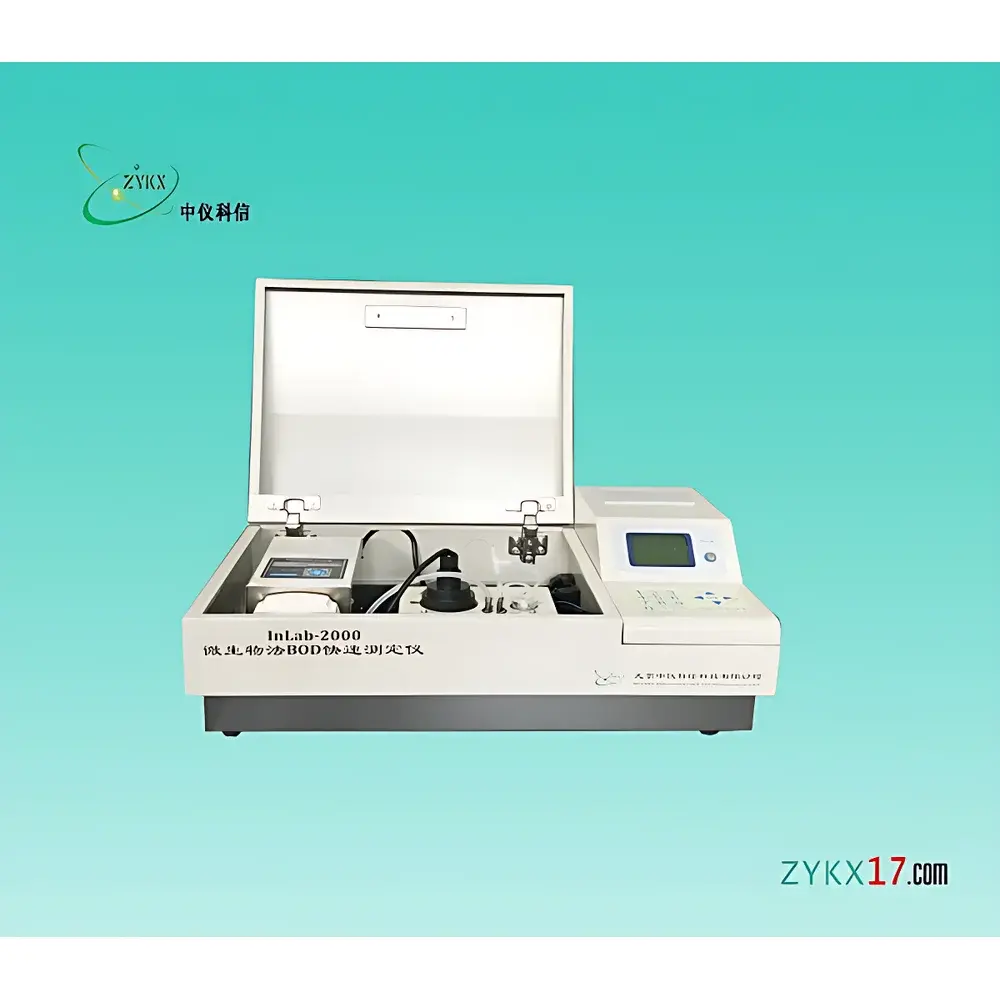
InLab-2000 Microbial Electrode-Based BOD Analyzer
| Origin | Beijing, China |
|---|---|
| Manufacturer Type | Authorized Distributor |
| Origin Category | Domestic (PRC) |
| Model | InLab-2000 |
| Price Range | USD 7,000–14,000 |
| Instrument Type | Laboratory BOD Analyzer |
| Measurement Principle | Microbial Electrode Method |
| Measurement Range | 2–50 mg/L (extendable to 2–5000 mg/L via dilution) |
| Detection Limit | 2 mg/L |
| Accuracy | ≤1% |
| Single-Sample Analysis Time | 8 minutes |
| Repeatability | ≤5% |
| Sample Volume per Test | 50 mL |
| Buffer Consumption | 5 mL/min |
| Operating Temperature | 5–40 °C |
| Relative Humidity | ≤90% |
| Power Supply | AC 220 V, 50 Hz |
| Dimensions (W×D×H) | 550 × 350 × 210 mm |
| Weight | 15 kg |
Overview
The InLab-2000 Microbial Electrode-Based BOD Analyzer is an EPA-aligned, regulatory-compliant instrument engineered for rapid, reliable quantification of biochemical oxygen demand (BOD) in aqueous environmental samples. Unlike conventional 5-day BOD5 methods defined in ISO 5815-1:2019 and ASTM D5210, the InLab-2000 employs a microbial electrode transduction principle—leveraging the metabolic activity of immobilized aerobic microorganisms to generate a measurable electrochemical signal proportional to organic biodegradability. This method is formally recognized under China’s HJ/T 86–2002 standard (“Determination of Biochemical Oxygen Demand in Water by Microbial Sensor Method”) and included as Method A in the fourth edition of *Methods for Monitoring and Analyzing Water and Wastewater*. The analyzer operates on a continuous-flow configuration: sample solution passes through a dedicated flow cell where a dry-stabilized microbial membrane—containing non-pathogenic, Gram-negative heterotrophic strains—is interfaced with a Clark-type polarographic dissolved oxygen (DO) sensor. As biodegradable organics diffuse into the biofilm, microbial respiration consumes dissolved oxygen at a rate linearly correlated with substrate concentration. The resulting decrease in DO partial pressure across the membrane is converted into a current signal, digitally processed, and reported as BOD (mg/L) within 8 minutes.
Key Features
- Regulatory-grade methodology validated per HJ/T 86–2002 and compatible with ISO/IEC 17025-accredited laboratory workflows
- True rapid analysis: single-sample measurement completed in ≤8 minutes—reducing turnaround time by >98% versus BOD5
- Dry-format microbial membranes: shelf life ≥12 months unhydrated; operational lifespan ≥45 days post-hydration and activation
- Integrated LCD interface with real-time status indicators, numeric BOD readout, and system diagnostics
- No sample pre-filtration or chemical pretreatment required—robust performance in turbid, colored, or low-salinity matrices
- Minimal consumables: only microbial membrane and peristaltic tubing require periodic replacement—no reagents, catalysts, or nutrient media
- Self-contained flow control: constant-rate peristaltic pumping ensures reproducible hydraulic residence time in the biosensor chamber
- Onboard thermal regulation maintains stable electrode response across ambient temperatures from 5 to 40 °C
- Optional thermal printer module supports GLP-compliant hardcopy output with timestamp, sample ID, and operator tag
- Low power consumption (100 W) and compact footprint (550 × 350 × 210 mm) suitable for benchtop deployment in QC labs and field mobile units
Sample Compatibility & Compliance
The InLab-2000 is validated for direct analysis of raw and diluted water matrices including surface water, domestic wastewater, and industrial effluents with nominal BOD concentrations between 2 and 50 mg/L. Dilution protocols extend effective range to 2–5000 mg/L while preserving linearity and recovery. Interference testing confirms resilience against common co-analytes: chloride ions ≤1000 mg/L, nitrate ≤50 mg/L, and suspended solids ≤100 mg/L do not significantly affect sensor response (bias <±3%). All biological components are classified as Risk Group 1 (RG1) per WHO and GB 19489–2008—non-pathogenic, non-toxigenic, and non-invasive to humans or ecosystems. The instrument design conforms to IEC 61010-1:2010 safety standards for electrical equipment in laboratory use. Data integrity features—including audit-trail-capable firmware logging and user-access-level controls—support alignment with GLP and GMP documentation requirements.
Software & Data Management
The InLab-2000 embeds a dedicated microcontroller-based operating system with no external PC dependency. All measurements are stored internally (up to 1000 records) with metadata: date/time stamp, sample ID, operator code, calibration status, and raw sensor current values. Export is supported via RS-232 serial interface to LIMS or Excel-compatible CSV files. Firmware supports manual calibration verification using standardized glucose-glutamic acid (GGA) reference solutions (e.g., 198 mg/L BOD). While native software does not implement FDA 21 CFR Part 11 electronic signature functionality, exported datasets retain full traceability and may be ingested into validated third-party data management platforms compliant with Part 11 and Annex 11 requirements.
Applications
- Routine BOD screening in municipal wastewater treatment plant (WWTP) influent/effluent monitoring programs
- Compliance verification against discharge limits per local environmental regulations (e.g., China’s GB 8978–1996, EU Urban Wastewater Treatment Directive)
- Process optimization studies requiring high-frequency BOD feedback during activated sludge or MBR operation
- Environmental impact assessments (EIA) and baseline water quality surveys for industrial site permitting
- Educational laboratories conducting comparative kinetics experiments on biodegradation pathways
- Emergency response teams assessing acute organic contamination following spills or runoff events
FAQ
What regulatory standards does the InLab-2000 comply with?
It is type-approved per HJ/T 86–2002 and referenced in China’s official *Methods for Monitoring and Analyzing Water and Wastewater* (4th ed.). While not EPA-certified, its microbial electrode principle aligns conceptually with ASTM D888 (DO saturation) and ISO 5815-1 (BOD5), enabling method-equivalency validation.
Can the instrument measure samples with high turbidity or suspended solids?
Yes—no filtration is required. Validation data confirm acceptable accuracy (<±5% bias) for samples with TSS up to 100 mg/L. For higher loads, optional inline sedimentation or coarse filtration may be applied without compromising method integrity.
How often must the microbial membrane be replaced?
Under typical usage (≤20 tests/day), the dry-stabilized membrane remains functional for ≥45 days post-activation. Membrane replacement is a 90-second procedure requiring no tools or recalibration.
Is buffer solution required during operation?
Yes—a phosphate-based pH-stabilized buffer (supplied separately) is continuously delivered at 5 mL/min to maintain optimal biofilm pH and ionic strength. Standard buffer kits support ≥200 analyses per 500-mL bottle.
Does the analyzer support multi-point calibration?
No—it uses a single-point GGA reference check (198 mg/L) for daily verification. Linearity across 2–50 mg/L is factory-verified and documented in the Certificate of Conformance supplied with each unit.
Related Products







