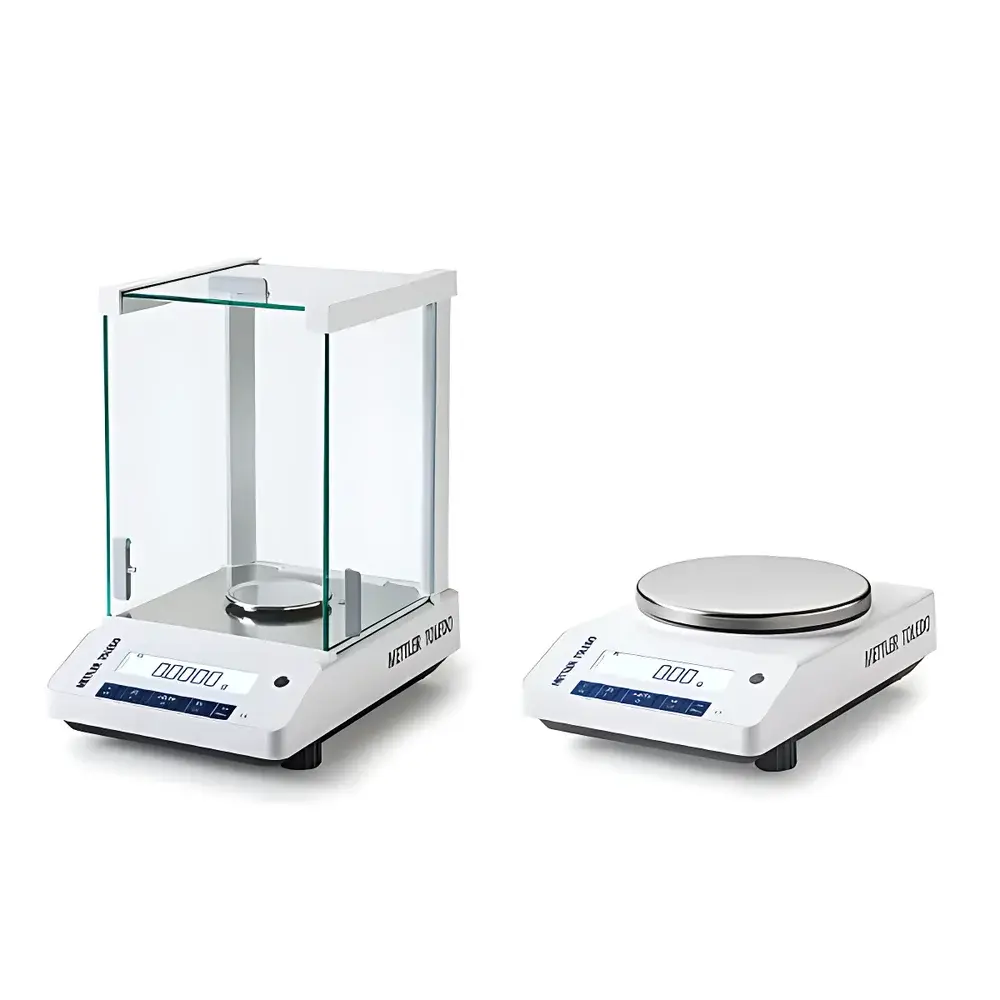
METTLER TOLEDO LA Series Analytical and Precision Balances
| Brand | METTLER TOLEDO |
|---|---|
| Origin | Switzerland |
| Model | LA Series |
| Maximum Capacity | 82 g to 4200 g |
| Readability | 0.1 mg to 10 mg |
| Repeatability (5% load) | 0.1 mg / 1 mg / 10 mg (typical: 0.08 mg / 0.7 mg / 7 mg) |
| Linearity Error | 0.2 mg / 2 mg / 20 mg (typical: 0.08 mg / 0.6 mg / 6 mg) |
| Minimum Weight (USP, ±0.10%) | 160 mg / 1.4 g / 14 g |
| Minimum Weight (±1%) | 16 mg / 0.14 g / 1.4 g |
| Stabilization Time | 3 s |
| Dimensions (W × D × H) | 210 × 308 × 345 mm (LA84E–LA4002E) |
| Pan Diameter | 80 mm / 100 mm / 180 mm |
| Weighing Principle | Electromagnetic Force Compensation (EMFC) |
| Interface | RS232, optional Bluetooth |
| Software | MT-SICS, EasyDirect™ |
Overview
The METTLER TOLEDO LA Series comprises a family of high-performance analytical and precision balances engineered for reliability, regulatory compliance, and operational efficiency in regulated laboratory environments. Built on electromagnetic force compensation (EMFC) technology, each model delivers exceptional stability and long-term accuracy without mechanical wear—ensuring consistent performance across daily use, routine calibration, and extended service intervals. The LA Series is designed to meet the stringent requirements of quality control (QC), research & development (R&D), and pharmaceutical manufacturing, where traceable mass measurement, documented repeatability, and adherence to pharmacopeial standards—including USP , , and ISO/IEC 17025—are mandatory. With capacities ranging from 82 g to 4200 g and readability options spanning 0.1 mg to 10 mg, the series supports diverse workflows—from micro-weighing of active pharmaceutical ingredients (APIs) to bulk formulation and intermediate process checks.
Key Features
- Electromagnetic Force Compensation (EMFC) sensor architecture ensures zero drift, high linearity, and immunity to environmental fluctuations such as temperature gradients or air currents.
- Integrated internal calibration with motorized internal weights enables automated, user-initiated or time-scheduled calibration—fully traceable and compliant with GLP/GMP documentation requirements.
- Bright, high-contrast backlit LCD display with intuitive icon-based navigation simplifies operation for multi-user labs; all critical parameters—including stability status, calibration mode, and error codes—are presented unambiguously.
- Robust mechanical design features a die-cast metal base and impact-resistant ABS housing, providing structural rigidity and vibration damping essential for stable readings on non-dedicated lab benches.
- Front-mounted spirit level and adjustable feet ensure rapid, precise leveling—critical for minimizing weighing uncertainty and meeting ISO 9001 metrological validation criteria.
- Dedicated below-balance hook enables density determination, dynamic weighing, and sample suspension applications without external fixtures or reconfiguration.
- Overload protection safeguards the EMFC mechanism against accidental overloading up to 500% of nominal capacity—preserving sensor integrity and reducing total cost of ownership.
Sample Compatibility & Compliance
The LA Series accommodates a broad spectrum of sample types and container configurations, including standard weighing boats, vials, crucibles, and custom fixtures. The 80 mm, 100 mm, and 180 mm stainless-steel pans are optimized for accessibility, ease of cleaning, and minimal static interference. All models comply with international metrological standards: OIML R76, NIST Handbook 44, and EC Type Approval Directive 2014/31/EU. For pharmaceutical applications, the balances support full audit trail generation (via MT-SICS or EasyDirect™), electronic signature capability, and 21 CFR Part 11–compliant data integrity when deployed with validated software configurations. Minimum weight calculations adhere strictly to USP methodology (k = 2, tolerance 0.10%), with documented evidence available per batch record or SOP requirement.
Software & Data Management
Data integrity and workflow integration are enabled through two certified software platforms: MT-SICS (Standard Instrument Control Software) and EasyDirect™ Balance Software. MT-SICS provides real-time instrument control, automated report generation (PDF/CSV), and seamless LIMS/ELN connectivity via RS232 or optional Bluetooth 5.0. EasyDirect™ adds advanced features including customizable method templates, user-defined calculation formulas (e.g., % recovery, tare subtraction chains), and secure role-based access control. Both platforms log all user actions—including calibration events, weight transfers, and parameter changes—with timestamps, operator IDs, and digital signatures. Raw data files are stored in non-proprietary formats to ensure long-term archival compliance under ALCOA+ principles.
Applications
- Pharmaceutical QC: Assay testing, content uniformity, loss-on-drying (LOD), and reference standard preparation per USP/EP monographs.
- Chemical R&D: Stoichiometric reagent dispensing, catalyst loading, and reaction yield quantification requiring sub-milligram precision.
- Materials Science: Powder density analysis, coating weight verification, and particulate mass distribution studies.
- Food & Beverage: Nutrient labeling compliance, additive dosage control, and moisture content validation.
- Academic Teaching Labs: Metrology training modules emphasizing uncertainty budgeting, calibration hierarchy, and GUM-compliant reporting.
FAQ
What calibration standards are supported?
Internal calibration uses factory-traceable, motorized stainless-steel weights certified to ISO/IEC 17025. External calibration is compatible with Class E2 or better砝码 per OIML R111.
Is the LA Series compliant with 21 CFR Part 11?
Yes—when used with validated EasyDirect™ or MT-SICS installations that include electronic signatures, audit trails, and permission-controlled user roles.
Can I connect the balance to a networked LIMS?
RS232 enables direct serial integration; Bluetooth option supports wireless transmission to local servers or cloud gateways using industry-standard protocols (e.g., HL7, ASTM E1384).
How is minimum weight determined and verified?
Calculated per USP using measured repeatability at 5% load (k = 2). The value is displayed in real time during operation and logged in calibration reports.
What maintenance is required beyond routine calibration?
No periodic sensor servicing is needed. Recommended annual verification by an accredited service provider includes sensitivity, eccentricity, and linearity tests per ISO 17025 scope.