
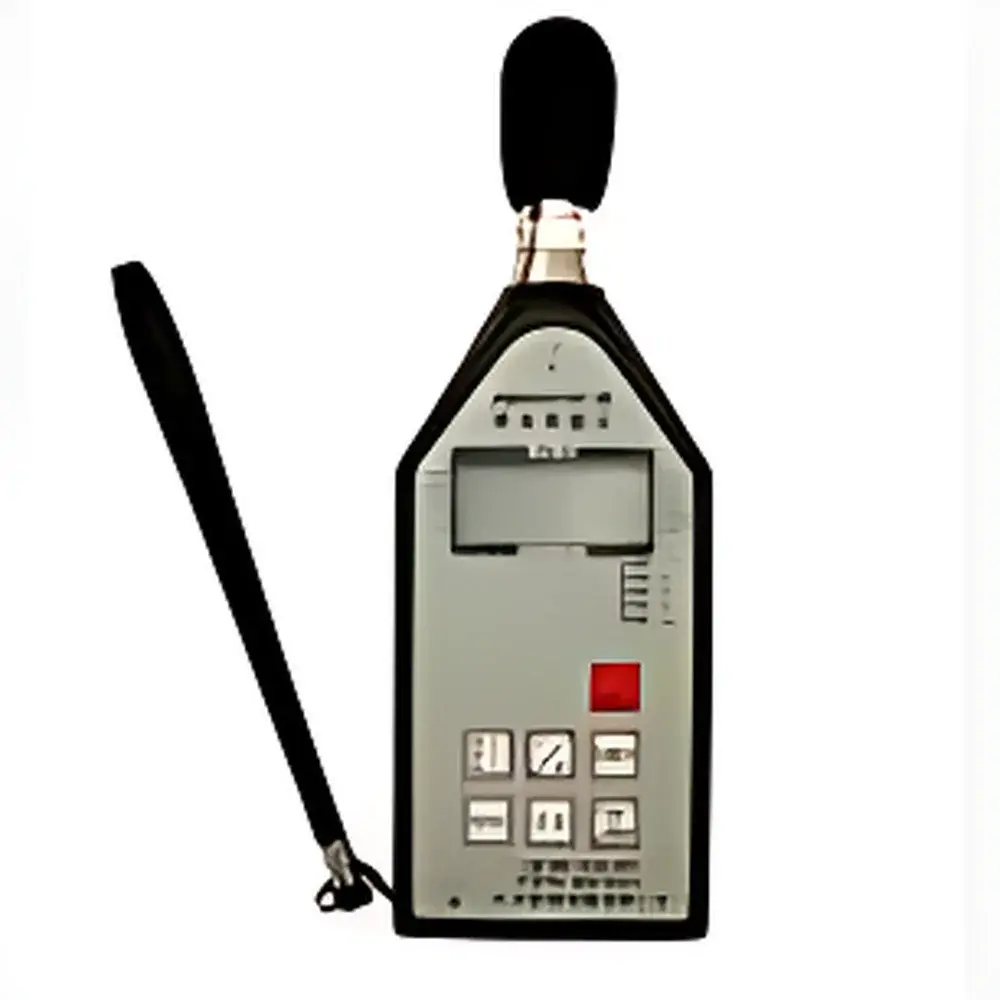
AWA5633(D) Digital Sound Level Meter
| Origin | Zhejiang, China |
|---|---|
| Manufacturer Type | Authorized Distributor |
| Origin Category | Domestic (China) |
| Model | AWA5633(D) |
| Price | Available Upon Request |
| Noise Floor | <30 dB(A) |
| Maximum Measurable Level | 130 dB |
| Microphone | 12.7 mm (½-inch) Pre-polarized Condenser Microphone |
| Frequency Range | 31.5 Hz – 8 kHz |
| Frequency Weighting | A-weighting only |
| Detection | Digital RMS detection with >90 dB dynamic range |
| Time Weightings | Fast (F), Slow (S) |
| Range Control | Automatic |
| Display | 4-digit LCD, update rate: 1 reading/sec |
| Output | AC output (rms, unweighted) |
| Calibration | Compatible with AWA6221B Acoustic Calibrator (94 dB/114 dB @ 1 kHz) |
| Power Supply | 4×AA (R6) alkaline batteries, ~20 h continuous operation |
| Operating Environment | 0–40 °C, <90% RH (non-condensing) |
| Dimensions (L×W×H) | 210 × 75 × 32 mm |
| Weight | 0.3 kg (including batteries) |
Overview
The AWA5633(D) Digital Sound Level Meter is a compact, handheld instrument engineered for reliable and compliant field measurements of airborne sound pressure levels in occupational, environmental, and industrial settings. Based on digital signal processing (DSP) architecture and conforming to IEC 61672-1:2002 Class 2 and GB/T 3785–2010 Type 2 specifications, it delivers traceable acoustic performance suitable for routine noise surveys where regulatory documentation or preliminary assessment is required. Its measurement principle relies on precision electret condenser microphone transduction—coupled with real-time digital RMS detection—to convert sound pressure fluctuations into calibrated decibel values referenced to 20 µPa. The device operates exclusively with A-frequency weighting, which approximates the human ear’s sensitivity at moderate sound pressure levels (40–70 phon), making it appropriate for general-purpose environmental noise monitoring—including traffic, construction sites, factory floors, and building acoustics—without requiring complex spectral analysis.
Key Features
- Compact ergonomic design (210 × 75 × 32 mm; 0.3 kg with batteries) optimized for one-handed operation and extended field use.
- Digital RMS detector with >90 dB dynamic range ensures high linearity across low-level ambient noise (<30 dB(A) self-noise) and high-intensity sources up to 130 dB.
- Automatic range switching eliminates manual gain selection and reduces operator error during rapidly varying acoustic conditions.
- Real-time 4-digit LCD display updated once per second, showing instantaneous A-weighted sound pressure level (LA) with Fast (F) or Slow (S) time weighting.
- Integrated AC output enables connection to data loggers, oscilloscopes, or external recording systems for waveform capture or long-term trend analysis.
- Pre-polarized ½-inch (12.7 mm) condenser microphone provides stable sensitivity without external polarization voltage, reducing dependency on specialized cabling or power supplies.
- Compliant battery operation using four standard AA cells supports approximately 20 hours of continuous measurement under typical load—ideal for multi-site audits or mobile survey teams.
Sample Compatibility & Compliance
The AWA5633(D) is designed for free-field or diffuse-field sound pressure measurements in air, with no intrinsic capability for octave-band or 1/3-octave analysis, impulse noise evaluation, or LAeq integration. It meets the metrological requirements of IEC 61672-1:2002 Class 2 for sound level meters used in non-critical compliance assessments, including preliminary workplace noise screening per ISO 9612:2009 and basic environmental noise mapping aligned with EU Directive 2002/49/EC Annex II. While not certified for legal metrology (e.g., court-admissible evidence or statutory emission reporting), its calibration traceability—via AWA6221B acoustic calibrator (94 dB / 114 dB @ 1 kHz, ±0.3 dB)—supports GLP-aligned field verification prior to and after measurement campaigns. Device operation remains valid within 0–40 °C ambient temperature and relative humidity below 90% non-condensing.
Software & Data Management
The AWA5633(D) operates as a standalone instrument without embedded memory or USB connectivity. All measurements are displayed in real time but not stored internally. For data logging, users must interface the AC output with an external analog-to-digital converter or portable recorder. No proprietary software is bundled; however, third-party acquisition platforms compatible with 0–1 V rms analog inputs (e.g., MATLAB Data Acquisition Toolbox, LabVIEW DAQmx, or Audacity with appropriate audio interface) may be employed for post-processing. Calibration events should be manually documented per ISO/IEC 17025:2017 Clause 6.4.10 to maintain audit trails. While the unit does not support FDA 21 CFR Part 11 or electronic signature functionality, its simplicity ensures minimal validation burden in GxP-adjacent applications such as facility qualification noise baselines.
Applications
- Preliminary occupational noise assessments in manufacturing, warehousing, and maintenance environments.
- Community noise monitoring near roadways, railways, airports, and construction zones.
- Building acoustics verification—e.g., façade transmission loss screening or HVAC system noise checks.
- Educational laboratory demonstrations of sound intensity, distance attenuation, and frequency weighting effects.
- Field validation of noise control interventions (e.g., barrier efficacy, muffler performance, or equipment isolation).
- Baseline surveys supporting ISO 14001 environmental management system implementation.
FAQ
Does the AWA5633(D) support C-weighting or Z-weighting?
No. This model implements A-frequency weighting only, as specified by IEC 61672-1 Class 2 requirements for general-purpose sound level meters.
Can it measure equivalent continuous sound level (LAeq)?
No. The device lacks integrated time-averaging or statistical analysis functions; it displays only instantaneous LAF or LAS.
Is the microphone included or optional?
The 12.7 mm pre-polarized condenser microphone is permanently integrated into the main housing and not user-replaceable.
What is the recommended calibration interval?
Annual calibration against an accredited acoustic calibrator (e.g., AWA6221B) is advised per ISO 9001 and ISO/IEC 17025 guidelines for measurement assurance.
Can it operate in outdoor rain or high humidity?
It is rated for ≤90% RH non-condensing environments only; prolonged exposure to precipitation or condensation may compromise microphone diaphragm integrity and electronics reliability.







