
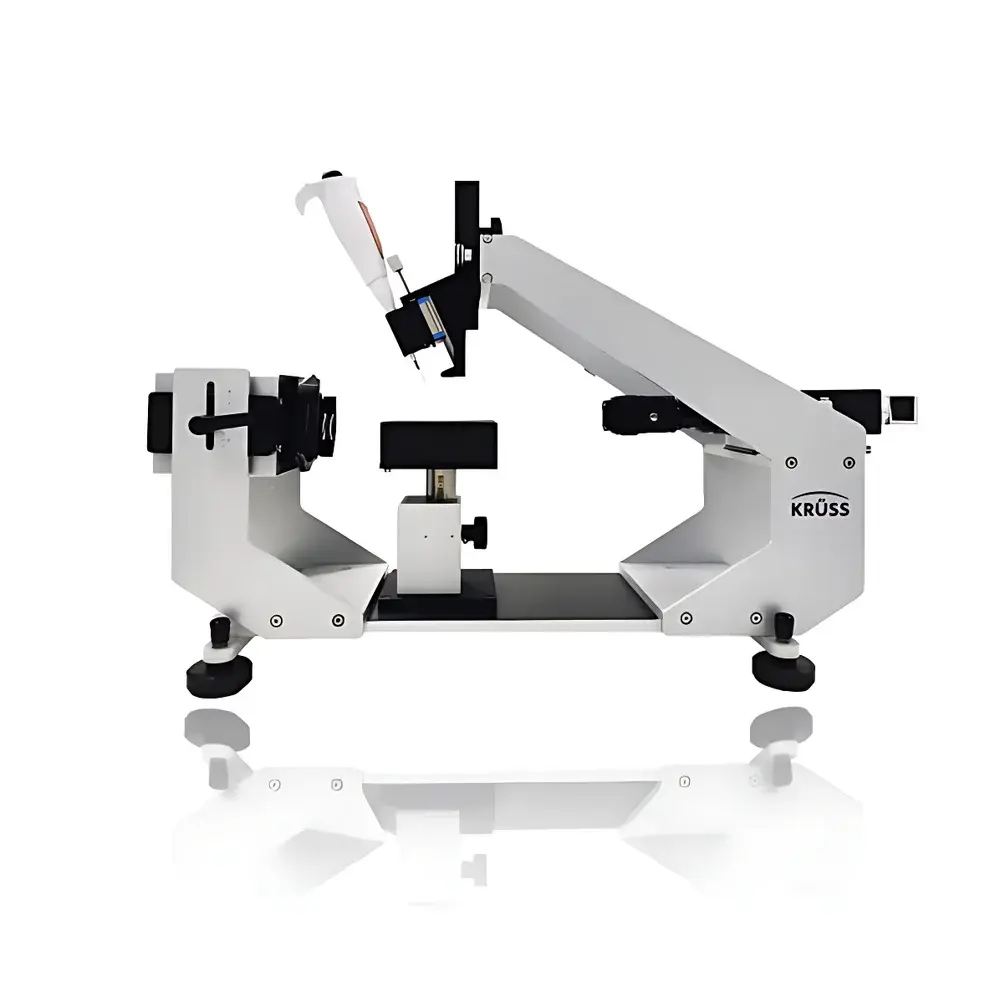
Krüss DSAeco Plus Contact Angle Analyzer
| Brand | Krüss |
|---|---|
| Origin | Germany |
| Model | DSAeco Plus |
| Contact Angle Range | 0–180° |
| Accuracy | ±0.3° |
| Maximum Sample Dimensions | 320 × ∞ × 165 mm (W × D × H) |
| Stage Dimensions | 105 × 105 mm (W × D) |
| Dispensing Precision | 0.1 µL |
| High-Speed Imaging | up to 2000 fps |
| Camera Resolution | 1900 × 1200 pixels |
| Measurement Methods | Six built-in contact angle calculation algorithms (e.g., sessile drop, tilting plate, captive bubble, dynamic advancing/receding, θ–A analysis) |
Overview
The Krüss DSAeco Plus Contact Angle Analyzer is an entry-level, high-value instrument engineered for quantitative surface wettability characterization in academic laboratories, quality control environments, and R&D facilities where rigorous yet cost-conscious surface analysis is required. It operates on the optical sessile drop principle—capturing high-resolution side-view images of liquid droplets deposited on solid substrates—and computes contact angles using pixel-based edge detection and curvature fitting algorithms. Designed for reproducible interfacial thermodynamic assessment, the DSAeco Plus supports static, dynamic (advancing/receding), and time-resolved contact angle measurements, enabling evaluation of surface heterogeneity, cleanliness, coating uniformity, and post-treatment efficacy. Its modular architecture integrates a precision motorized dispensing system, a high-sensitivity CMOS camera with adjustable frame rates, and a vibration-damped optical stage—ensuring stable imaging even under non-ideal lab conditions.
Key Features
- Optical measurement platform with 1900 × 1200 pixel resolution and real-time image acquisition at speeds up to 2000 fps—enabling robust dynamic contact angle tracking during rapid wetting or dewetting events.
- Six validated contact angle calculation methods embedded in Krüss ADVANCE software: tangent, circle, ellipse, Young–Laplace fitting, axisymmetric drop shape analysis (ADSA), and automated baseline correction—supporting ISO 19403-2 and ASTM D7334 compliance workflows.
- Precision microdispensing unit with 0.1 µL resolution and programmable volume, speed, and delay parameters—minimizing operator-induced variability and ensuring repeatable droplet formation across multiple samples.
- Large-format sample stage (105 × 105 mm) accommodates oversized or irregularly shaped specimens; extended depth capability (unlimited in D-direction) allows integration with external fixtures such as environmental chambers or tensile stages.
- Modular lighting system with adjustable LED intensity and coaxial illumination geometry—reducing glare artifacts and enhancing droplet contour contrast on reflective or textured surfaces.
- Compact, benchtop footprint (320 × ∞ × 165 mm W × D × H) optimized for space-constrained labs without compromising mechanical stability or optical path integrity.
Sample Compatibility & Compliance
The DSAeco Plus accepts rigid and flexible substrates—including metals, polymers, ceramics, textiles, and thin films—with no requirement for conductive or transparent properties. Its open-stage design permits direct mounting of industrial parts (e.g., machined components, printed circuit boards, or coated glass panels) without size-related truncation. The system complies with fundamental metrological requirements outlined in ISO/IEC 17025 for calibration traceability and supports GLP documentation protocols through timestamped image archiving and user-accessible audit logs. While not certified for FDA 21 CFR Part 11 out-of-the-box, ADVANCE software provides configurable electronic signature fields, data integrity controls, and exportable CSV/PDF reports suitable for internal QA/QC validation and regulatory submission preparation.
Software & Data Management
Krüss ADVANCE software serves as the unified interface for instrument control, image processing, and statistical reporting. It features batch processing for multi-sample campaigns, automatic contact angle trend plotting over time, and customizable report templates aligned with internal SOPs. All raw images, metadata (including timestamp, operator ID, environmental conditions), and processed results are stored in a structured SQLite database with optional network backup. Export options include TIFF (lossless), PNG, and annotated PDFs—compatible with LIMS integration via standard file I/O protocols. Software updates are delivered through Krüss’ secure customer portal and include firmware patches, algorithm refinements, and expanded material library entries.
Applications
- Surface cleanliness verification prior to bonding, painting, or plasma treatment—detecting hydrophobic contaminants via contact angle hysteresis shifts.
- Quantitative evaluation of plasma, corona, flame, or chemical etching treatments—correlating contact angle reduction with surface energy increase (via Owens–Wendt method).
- Quality assurance of hydrophilic/hydrophobic coatings on medical devices, filtration membranes, or packaging films.
- Research into surfactant adsorption kinetics, evaporation-driven contact line pinning, and coffee-ring effect mitigation strategies.
- Educational use in materials science and colloid chemistry curricula—demonstrating Young’s equation, Wenzel/Cassie–Baxter transitions, and surface free energy component modeling.
FAQ
What types of liquids can be used with the DSAeco Plus?
Deionized water, glycerol, diiodomethane, ethylene glycol, and common organic solvents (e.g., ethanol, acetone) are routinely employed. Viscosity and volatility must be considered when selecting frame rate and dispensing parameters.
Is environmental control (temperature/humidity) supported?
Yes—the open-stage design allows integration with third-party environmental chambers or humidity generators; temperature-stable operation is maintained from 15–35°C ambient.
Can the system measure surface free energy?
Yes—ADVANCE software includes the Owens–Wendt, Wu, and van Oss–Chaudhury–Good models for calculating dispersive and polar surface energy components using contact angle data from at least two probe liquids.
Does the DSAeco Plus support automated measurement sequences?
Yes—user-defined macros enable unattended multi-position, multi-liquid, or time-lapse experiments with full metadata logging and error recovery.
What calibration procedures are recommended?
Krüss recommends daily verification using a certified reference slide (e.g., Krüss CR-10) and annual factory recalibration for traceable accuracy. Camera lens focus and dispensing tip alignment checks should be performed before each measurement session.



