
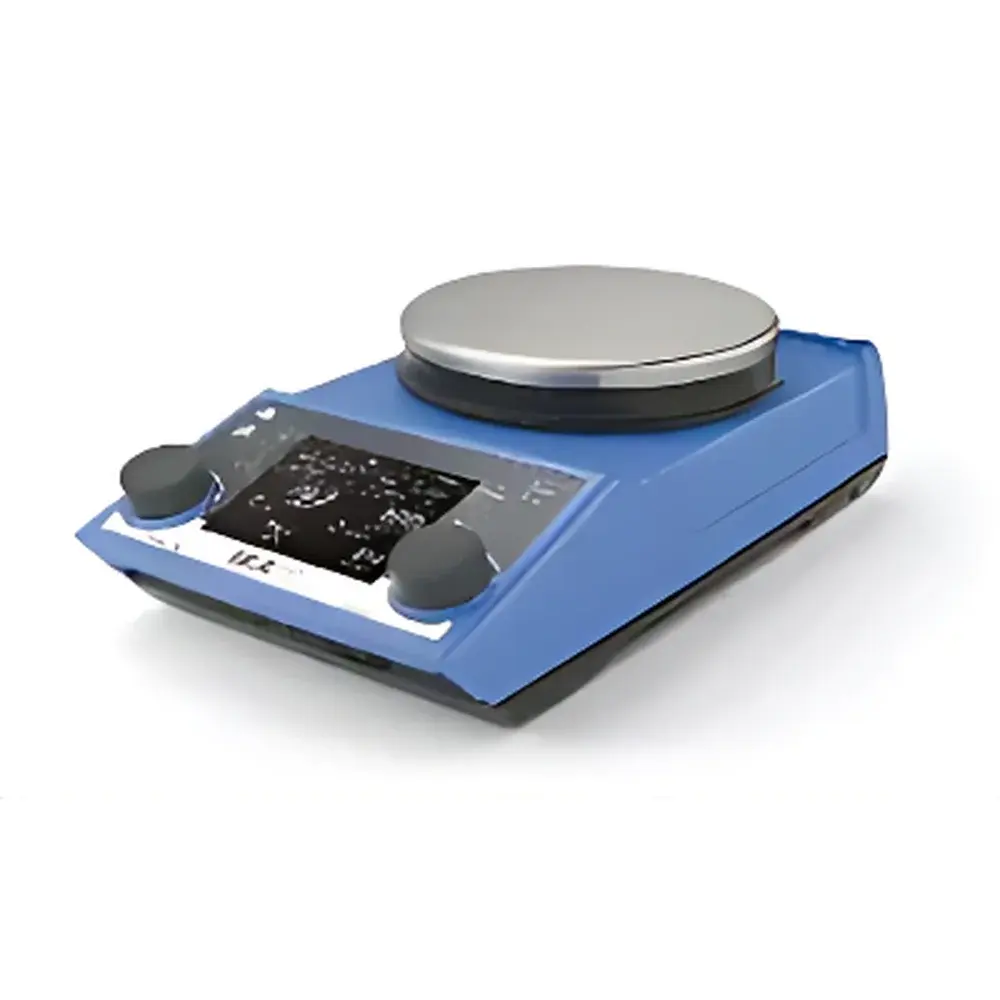
IKA RET control-visc Advanced Heating Magnetic Stirrer with Integrated Precision Balance and Dual-Temperature Control
| Brand | IKA |
|---|---|
| Origin | Germany |
| Model | RET control-visc |
| Motor Output Power | 9 W |
| Max. Stirring Volume (H₂O) | 20 L |
| Speed Range | 50–1700 rpm |
| Speed Setting Accuracy | ±10 rpm |
| Stirrer Bar Length Compatibility | 20–80 mm |
| Heating Plate Material | Stainless Steel 1.4301 (DIN) |
| Heating Plate Diameter | Ø135 mm |
| Heating Power | 600 W |
| Max. Plate Surface Temperature | 340 °C |
| Temperature Setting Range (Plate) | 0–340 °C |
| Temperature Setting Resolution | 0.1 K |
| Ambient Temperature Range | 5–40 °C |
| Relative Humidity Limit | ≤80 % RH |
| Ingress Protection | IP42 (DIN EN 60529) |
| External Temperature Sensor Interface | PT100 / PT1000 (dual-channel) |
| Media Temp. Control Capability | Yes (e.g., 1 L M50 silicone oil in H1500 bath |
| Safety Overtemperature Cut-off Range | 50–380 °C |
| Integrated Precision Balance | Capacity 10–5000 g |
| Weighing Accuracy | ±(0.3% + 2) g |
| Max. Load | 5 kg |
| pH Measurement Support | Yes (BNC female socket) |
| Display | Full-color TFT screen with multilingual UI |
| Communication Interfaces | RS232, USB (for remote control, data export, firmware update) |
| Special Functions | Intermittent Mode, Torque Trend Monitoring, Stirrer Bar Detection (“Jump Detection”), Timer/Countdown, Graphical Real-time Plotting, Programmable Protocols, Error Code Diagnostics (e.g., Error 5 = Media Detection Fault), Lock Key Function, Post-Shutdown Plate Temp. Hold Display (until <50 °C), Dual-Mode Temperature Control (Rapid Ramp vs. High-Stability Regulation) |
Overview
The IKA RET control-visc is an advanced, all-in-one heating magnetic stirrer engineered for precision laboratory workflows requiring simultaneous temperature control, real-time viscosity trend monitoring, gravimetric measurement, and pH integration. Unlike conventional stirrers, it implements a dual-sensor thermal architecture—supporting independent regulation of both heating plate surface temperature and actual sample or bath medium temperature via optional PT100/PT1000 probes—enabling compliance with thermally sensitive protocols in pharmaceutical development, polymer synthesis, and QC testing. Its core stirring mechanism employs a high-efficiency brushless DC motor delivering consistent torque across the full speed range (50–1700 rpm), while integrated Hall-effect sensing enables reliable detection of stirrer bar displacement (“jump detection”) to prevent uncontrolled mixing or vortex collapse. The unit complies with DIN EN 60529 (IP42) for dust and splash resistance, and its stainless steel 1.4301 heating plate ensures chemical inertness and long-term thermal stability up to 340 °C.
Key Features
- Integrated high-precision balance (10–5000 g range, ±(0.3% + 2) g accuracy) eliminates need for external weighing stations during reagent addition or titration workflows.
- Dual-channel temperature control architecture supports concurrent monitoring and regulation of both heating plate and medium/sample temperature—critical for ASTM D2196 or ISO 2555-compliant rheological preconditioning.
- Full-color TFT display with multilingual interface (English, German, French, Spanish, Chinese) provides intuitive navigation, graphical real-time plotting of torque trends, and context-sensitive error diagnostics (e.g., Error 5 indicates media detection fault).
- Programmable intermittent mode, timer/countdown functions, and customizable ramp-hold profiles support GLP-aligned SOP execution without manual intervention.
- BNC female socket enables direct connection of standard pH electrodes—facilitating in-situ acid-base titrations or buffer calibration under controlled thermal and agitation conditions.
- RS232 and USB interfaces allow bidirectional communication with LIMS or ELN systems; USB port supports firmware updates and secure data export compliant with FDA 21 CFR Part 11 audit trail requirements.
- “Lock Key” function prevents accidental parameter modification during unattended operation—a necessity for overnight polymerization or dissolution testing.
Sample Compatibility & Compliance
The RET control-visc accommodates stirring vessels from 10 mL vials to 20 L reactors using standard PTFE- or glass-coated stir bars (20–80 mm length). Its stainless steel 1.4301 heating plate resists corrosion from organic solvents, acids, and bases—validated per DIN 58944 for lab equipment durability. When paired with certified PT100 sensors and calibrated weight standards, the system meets traceability requirements under ISO/IEC 17025 for accredited testing laboratories. The dual-temperature control loop satisfies USP environmental monitoring prerequisites for aseptic compounding workflows where media temperature deviation must remain within ±0.5 K. IP42 ingress protection ensures operational reliability in shared lab environments subject to incidental splashes or particulate exposure.
Software & Data Management
No proprietary software installation is required: native ASCII-based command protocols over RS232 enable seamless integration into existing LabVIEW, Python, or MATLAB automation frameworks. USB mass storage mode permits direct export of timestamped torque, temperature, weight, and pH logs as CSV files—with column headers aligned to MIQE and FAIR data principles. All parameter changes—including safety limit adjustments—are logged with user ID (if network-authenticated), timestamp, and pre/post values, fulfilling ALCOA+ data integrity criteria. Firmware updates retain user-defined protocols and calibration offsets, ensuring continuity across maintenance cycles.
Applications
- Pharmaceutical: Dissolution testing per USP , viscosity profiling of hydrogels during thermal gelation, and pH-controlled crystallization studies.
- Materials Science: Sol-gel synthesis under inert atmosphere (with optional hood integration), nanoparticle dispersion stability assessment, and curing kinetics of epoxy resins.
- Quality Control: Batch-to-batch consistency verification of emulsions, suspensions, and colloidal systems via torque trend analysis.
- Academic Research: Teaching labs benefit from graphical torque visualization for fluid dynamics demonstrations; research labs leverage programmable sequences for reproducible multi-step reaction protocols.
- Chemistry: Controlled addition of reagents with simultaneous gravimetric feedback and exotherm management via dynamic temperature setpoint adjustment.
FAQ
Does the RET control-visc support external temperature feedback for closed-loop control?
Yes—it accepts dual PT100 or PT1000 inputs, enabling independent PID regulation of both heating plate and sample/bath temperature.
Can torque trend data be exported in real time during operation?
Yes—via RS232 or USB, with configurable sampling intervals (100 ms to 10 s) and CSV-formatted output including absolute torque, rotational speed, and temperature timestamps.
Is the integrated balance compliant with ISO 9001 calibration requirements?
The balance module supports external calibration using Class M2 weights; calibration records and uncertainty budgets are exportable for internal audit documentation.
What safety certifications does the device hold?
It conforms to IEC 61010-1 (Safety Requirements for Electrical Equipment for Measurement, Control, and Laboratory Use) and carries CE, UKCA, and EAC markings.
How is data integrity ensured during power interruption?
Non-volatile memory retains active protocols, safety limits, and last-used parameters; no configuration loss occurs during brief outages (<500 ms).



