
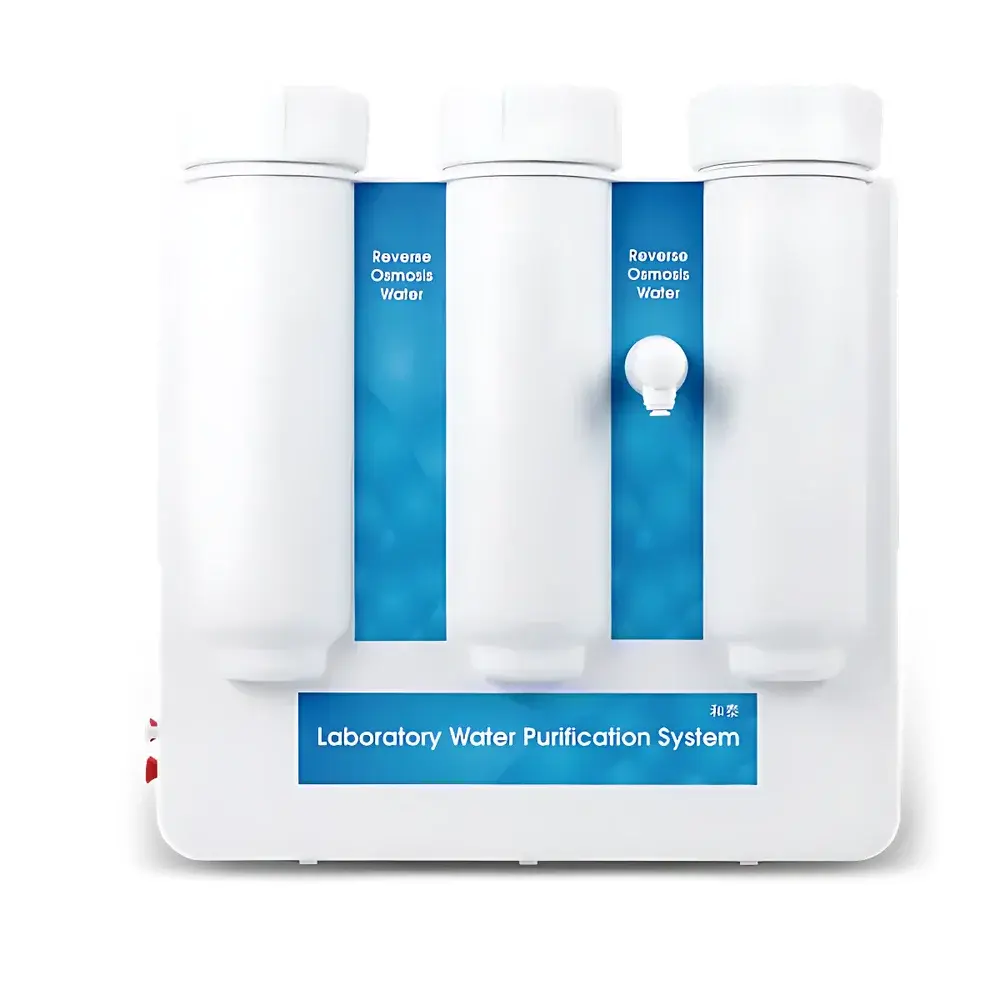
HHitech Smart-RO Reverse Osmosis Pure Water System
| Brand | HHitech |
|---|---|
| Origin | Shanghai, China |
| Model | Smart-RO |
| Pure Water Output | 15 L/h (Smart-RO15) / 30 L/h (Smart-RO30) |
| Instant Flow Rate | Up to 2.0 L/min (with pressurized storage tank) |
| RO Rejection | >97–99% for ions (new membrane), >99% for organics (MW > 200 Da), >99% for particles & bacteria |
| Bacterial Count | <0.01 CFU/mL (with optional (0.45 + 0.1) µm PES terminal filter) |
| Particles (>0.2 µm) | <1/mL (with optional (0.45 + 0.1) µm PES terminal filter) |
| Feed Water | Municipal tap water, 5–45 °C, pressure 1.0–4.0 kgf/cm² |
| Dimensions (L×W×H) | 41 × 22 × 42 cm |
| Weight | ~20 kg |
| Electrical | 100–240 V, 50/60 Hz |
| Power Consumption | 48 W (Smart-RO15) / 72 W (Smart-RO30) |
| Certifications | NSF-certified tubing & fittings, DOW RO membrane, imported UV lamp (185 nm & 254 nm), MWCO 5000 Da UF module, PES terminal filter |
Overview
The HHitech Smart-RO Reverse Osmosis Pure Water System is an engineered laboratory-grade water purification platform designed to deliver consistent, high-purity reverse osmosis (RO) water for analytical instrumentation feed, buffer preparation, glassware rinsing, and as a pre-treatment stage for downstream ultra-pure water systems. Operating on the principle of cross-flow membrane filtration under hydraulic pressure, the Smart-RO system utilizes semi-permeable polyamide thin-film composite (TFC) membranes—sourced from Dow Chemical—to selectively reject dissolved ions, colloids, organic molecules (MW > 200 Da), microorganisms, and particulates. Its dual-stage rejection architecture—comprising integrated pretreatment, high-efficiency RO membrane module, and optional post-RO polishing components—ensures stable performance across variable municipal feed water conditions while maintaining compliance with ISO 3696 Grade 3 and ASTM D1193 Type IV specifications for purified water.
Key Features
- Modular, space-efficient design with one-piece injection-molded sanitary polypropylene (PP) chassis—resistant to chemical leaching and compliant with GLP ergonomic maintenance protocols.
- Integrated quick-release prefilter housing: Top-mounted rotary lid enables tool-free replacement of sediment and activated carbon cartridges without cabinet disassembly.
- Intelligent microprocessor control with backlit LCD interface: Real-time display of operational status (flushing, full tank, producing, low feed), water temperature, and system alerts—including SERVICE mode activation upon leak detection (optional).
- Automated RO membrane flush cycle: Programmable periodic low-pressure flushing mitigates scaling and biofilm accumulation, extending membrane service life beyond 24 months under typical lab usage.
- NSF-certified fluid path: All tubing, quick-connect fittings, and valve manifolds meet NSF/ANSI Standard 58 and 61 requirements, minimizing total organic carbon (TOC) contribution (<5 ppb baseline).
- Dual-wavelength UV oxidation: Imported 185 nm / 254 nm germicidal lamp reduces microbial load and photo-oxidizes trace organics, lowering TOC to <10 ppb in post-UV RO water.
- Optional high-retention polishing: Integrated 5000 Da molecular weight cutoff (MWCO) ultrafiltration (UF) module removes endotoxins (<0.001 EU/mL); paired with (0.45 + 0.1) µm PES terminal filtration for sterile-grade output (<0.01 CFU/mL).
Sample Compatibility & Compliance
The Smart-RO system is validated for continuous operation with potable municipal feed water meeting WHO Guidelines for Drinking-water Quality and local regulatory limits for turbidity (<1 NTU), chlorine (<3 mg/L), and hardness (<200 ppm CaCO₃ equivalent). It conforms to key international standards governing laboratory water quality and equipment safety: ISO 3696:1987 (Grade 3 purified water), ASTM D1193-20 (Type IV reagent water), and CLSI EP22-A2 for water system validation. All wetted materials—including Dow RO membrane elements, GE Healthcare–grade PES filters, and UV quartz sleeves—are documented for extractables and leachables per USP . The system supports audit-ready GLP/GMP workflows via timestamped event logging (when integrated with optional data export module) and meets mechanical safety requirements per IEC 61010-1.
Software & Data Management
While the base Smart-RO operates via embedded firmware without external software dependency, its LCD interface logs critical operational events—including membrane flush cycles, tank fill/drain sequences, and fault triggers—with time/date stamps. For laboratories requiring electronic records, the system supports optional RS232 or USB data export to third-party LIMS or ELN platforms. When deployed in regulated environments (e.g., pharmaceutical QC labs), the unit can be qualified per IQ/OQ protocols; its alarm states (e.g., “SERVICE” for leak detection) are mapped to discrete dry-contact outputs for integration into building management systems. All firmware updates are delivered via secure offline USB flash drive to maintain air-gapped integrity—fully compatible with FDA 21 CFR Part 11 requirements when paired with appropriate electronic signature controls.
Applications
- Feed water supply for HPLC, LC-MS, IC, and AAS instrumentation requiring low-conductivity, low-TOC input.
- Preparation of buffers, diluents, and reagents for molecular biology (PCR, electrophoresis) and cell culture media formulation.
- Routine cleaning and final rinsing of volumetric glassware, pipettes, and stainless-steel surfaces in analytical and clinical labs.
- Primary purification stage for multi-tiered ultra-pure water systems—feeding subsequent EDI, mixed-bed DI, or UV/UF polishing modules.
- Supporting ISO/IEC 17025-accredited testing laboratories where documented water quality consistency and traceable maintenance history are mandatory.
FAQ
What feed water quality is required for optimal Smart-RO performance?
Municipal tap water with temperature between 5–45 °C, pressure 1.0–4.0 kgf/cm², turbidity <1 NTU, free chlorine <3 mg/L, and total hardness <200 ppm CaCO₃ equivalent.
Can the Smart-RO be connected directly to point-of-use applications without a storage tank?
No—the rated instantaneous flow rate of 2.0 L/min is achievable only when paired with a pressurized storage tank; direct draw applications require supplemental booster pumping.
Is the system compliant with FDA 21 CFR Part 11 for electronic records?
Yes—when configured with optional data export and integrated into a validated electronic signature workflow, all logged events meet ALCOA+ principles for attributable, legible, contemporaneous, original, and accurate records.
How often must the RO membrane be replaced?
Under typical lab conditions (feed TDS <300 ppm, proper pretreatment), membrane replacement is recommended every 24–36 months; real-time performance monitoring via TDS meter and pressure differentials supports predictive maintenance scheduling.
Does the Smart-RO support remote monitoring or IoT integration?
Not natively—but analog voltage outputs (0–5 V) for tank level and digital relay signals for alarm states enable integration with industrial SCADA or custom LabView-based dashboards.



