
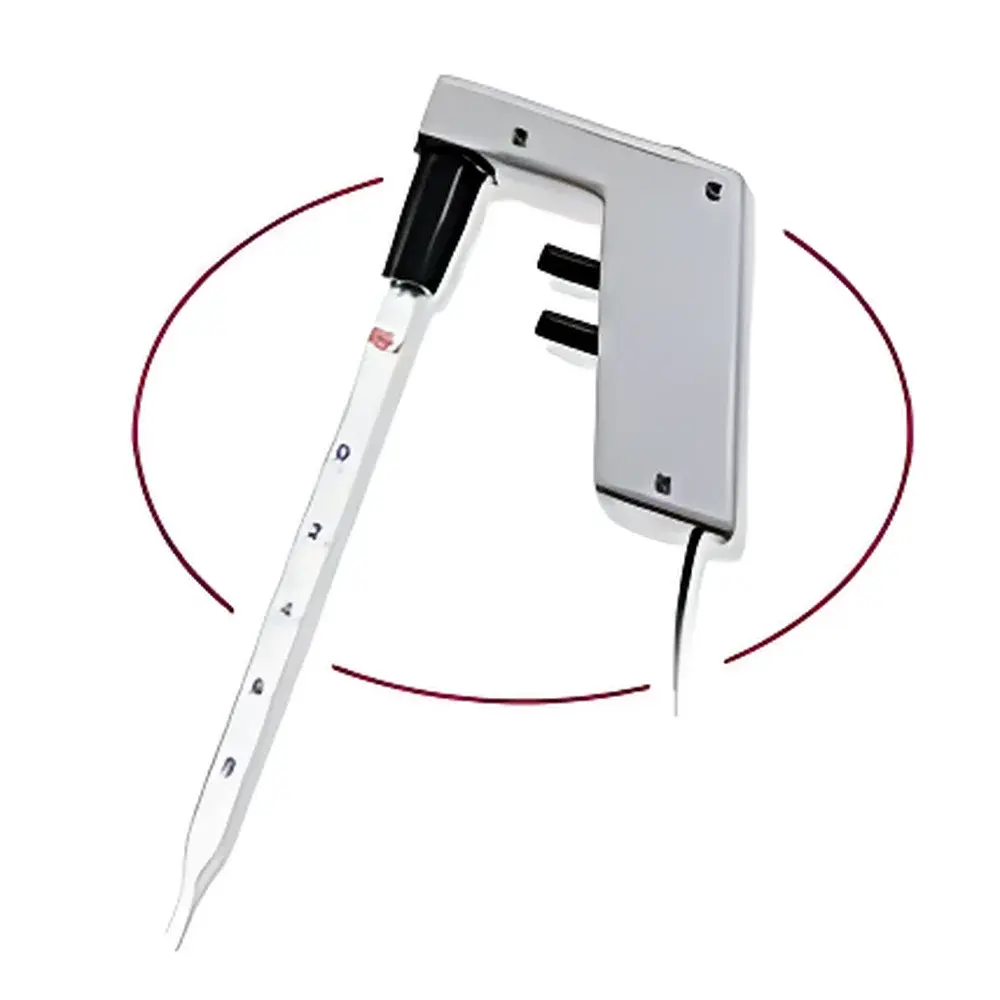
DRUMMOND Original Pipet-Aid® Basic Electronic Pipette
| Brand | DRUMMOND |
|---|---|
| Origin | USA |
| Model | Original Pipet-Aid® |
| Voltage | 220 V AC, CE-marked |
| Filtration Options | Standard (non-filter), TC Nosepiece (0.8 µm hydrophilic + 0.8 µm hydrophobic dual-layer), Dual-Pump Air Filtration Unit |
| Sterilization Compatibility | Autoclavable components (nosepiece, filters, tubing) |
| Compliance | CE, IEC 61000-4 EMC, IEC 60950-1 Safety |
Overview
The DRUMMOND Original Pipet-Aid® Basic Electronic Pipette is a precision-engineered, foot-controlled aspiration and dispensing system designed for consistent, ergonomic, and contamination-controlled liquid handling in molecular biology, cell culture, clinical diagnostics, and pharmaceutical QC laboratories. Unlike manual pipetting or basic electronic aids, the Pipet-Aid® operates on a positive-displacement vacuum principle—using a regulated DC motor-driven diaphragm pump to generate controlled negative pressure through a calibrated air path. This architecture eliminates reliance on user-dependent thumb force, thereby reducing operator fatigue and inter-user variability. Its core function is to aspirate and dispense liquids from glass or plastic serological pipettes (1–100 mL) with reproducible volume control via analog thumbwheel adjustment and tactile feedback. The system is not a volumetric pipette itself but a universal controller compatible with industry-standard reusable and disposable pipettes—making it a long-term capital investment rather than a consumable-dependent tool.
Key Features
- Ergonomic foot-switch operation enables hands-free control, preserving sterility during aseptic workflows and minimizing repetitive strain injuries (RSI) associated with thumb-actuated devices.
- Modular nosepiece design supports interchangeability between standard non-filter, TC (Tissue Culture) nosepieces, and optional dual-pump filtration units—each engineered to meet distinct biosafety requirements.
- The TC nosepiece integrates a certified dual-layer membrane filter: a 0.8 µm hydrophilic pre-filter followed by a 0.8 µm hydrophobic barrier; validated to retain particles ≥0.1 µm—including bacteria, mycoplasma, and aerosolized nucleic acids—ensuring protection against cross-contamination in sensitive applications such as stem cell culture or PCR setup.
- All critical wetted components—including nosepiece, silicone tubing, and filter housings—are autoclavable at 121°C for 20 minutes (up to 50 cycles), supporting GLP/GMP-compliant reusability without performance degradation.
- CE-marked per IEC 61000-4 (EMC immunity) and IEC 60950-1 (electrical safety), with stable operation across laboratory-grade 220 V AC power environments.
- No internal battery or charging circuitry—eliminates drift due to voltage fluctuation and extends service life beyond typical rechargeable alternatives.
Sample Compatibility & Compliance
The Pipet-Aid® accommodates all standard conical-tip serological pipettes (1, 2, 5, 10, 25, 50, and 100 mL), whether borosilicate glass or medical-grade polystyrene. It is routinely deployed in ISO 13485-certified device manufacturing labs, CLIA-waived clinical settings, and academic core facilities performing USP sterility testing. When equipped with the TC nosepiece and dual-layer filter, the system meets ASTM E2994-15 criteria for aerosol containment in tissue culture workstations. Filter integrity is verified per ISO 16889:2017 particle retention testing methodology. Device documentation includes traceable CE Declaration of Conformity and RoHS compliance statements—fully auditable for FDA 21 CFR Part 11–aligned quality systems requiring equipment qualification records.
Software & Data Management
As a hardware-only analog control system, the Original Pipet-Aid® does not incorporate embedded firmware, digital displays, or data logging capabilities. This design choice prioritizes operational reliability, electromagnetic noise immunity, and long-term calibration stability—critical attributes in regulated environments where software validation burdens outweigh functional benefits. All mechanical adjustments (e.g., flow rate, aspiration speed) are performed manually via calibrated thumbwheel and verified using gravimetric ISO 8655-3 test protocols. Maintenance logs, filter replacement dates, and autoclave cycle tracking are maintained externally per laboratory SOPs—aligning with ALCOA+ principles for paper-based or LIMS-integrated recordkeeping.
Applications
- Aseptic transfer of mammalian cell suspensions, primary isolates, and organoid cultures without compromising viability or introducing adventitious agents.
- High-volume media preparation and buffer aliquoting in bioprocessing support labs—where throughput and repeatability supersede single-step accuracy.
- Pre-analytical sample handling in clinical microbiology, including inoculation of blood culture bottles and dilution series for antimicrobial susceptibility testing (AST).
- Reagent dispensing in ELISA, Western blotting, and immunohistochemistry workflows where tip-to-tip consistency reduces assay CVs.
- Teaching laboratories requiring robust, repairable instrumentation that demonstrates fundamental fluid dynamics principles without abstraction layers.
FAQ
Is the Pipet-Aid® compatible with positive-displacement pipettes or only air-cushion types?
It is exclusively designed for use with standard air-cushion serological pipettes—not positive-displacement or electronic single-channel pipettes.
Can the TC nosepiece filters be sterilized using ethylene oxide (EtO) or hydrogen peroxide plasma?
No—only steam autoclaving (121°C, 15–20 psi, 20 min) is validated. EtO and plasma methods compromise membrane hydrophobicity and pore integrity.
What is the expected service life of the diaphragm pump under continuous daily use?
Rated for >10,000 hours of operation; field data from academic core facilities show median uptime exceeding 7 years with biannual maintenance.
Does DRUMMOND provide IQ/OQ documentation packages for GMP installations?
Yes—customizable qualification templates (including test protocols, acceptance criteria, and sign-off sheets) are available upon request for FDA/EMA-regulated users.
How frequently must the dual-layer filter be replaced during routine cell culture work?
Typically every 2–4 weeks depending on usage intensity; visual inspection for discoloration or airflow resistance increase is recommended prior to each autoclave cycle.



